Bora Initiation Ceremony Origin Myth Meaning & Symbolism
An ancestral being carves sacred law into the land, creating the first Bora ground to initiate boys into men, binding them to Country and Dreaming.
The Tale of Bora Initiation Ceremony Origin
Listen. In the time before time, when the world was soft and the Dreaming ancestors walked the earth, there was a great trouble. The people were scattered, their hearts restless. The boys grew tall and strong in body, but their spirits remained unanchored, like smoke on the wind. They knew the skills of the hunt, the names of the plants, but they did not know the Law. They did not know the deep, singing threads that connected them to the land, to the ancestors, to each other. A hollow place grew in the tribe, a silence where sacred knowledge should have hummed.
From this silence, a great Ancestral Being arose. He was known by many names, but his purpose was one: to carve order from the chaos of becoming. He journeyed across the length and breadth of the land, his feet reading the songlines in the earth. He carried with him not a spear, but a profound sorrow for the uninitiated, and a resolve as hard as the quartzite ridges. He sought a place of power, where the sky pressed close to the earth and the veil between worlds was thin.
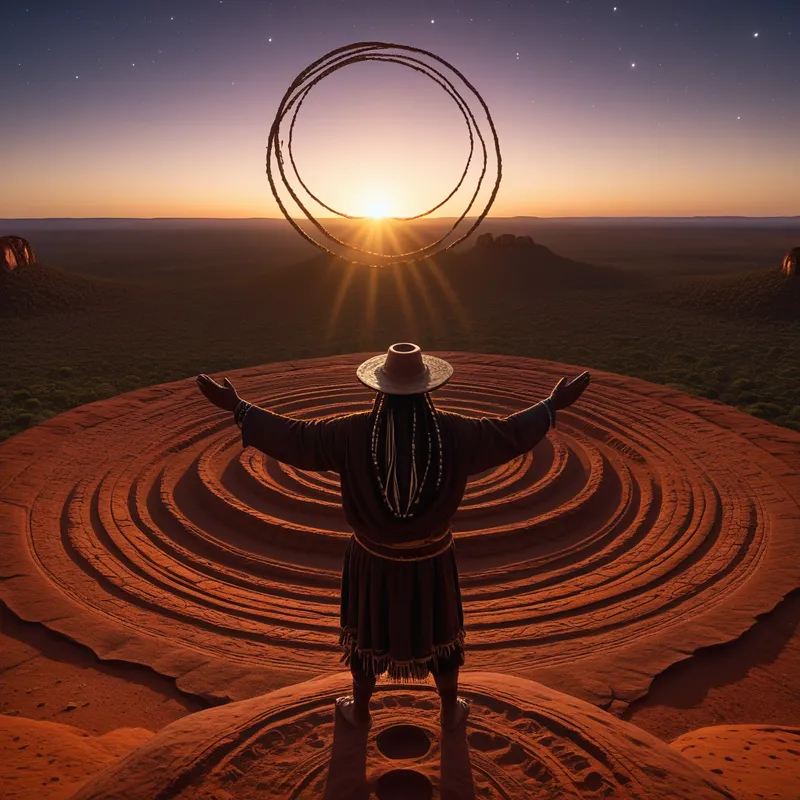
He found it in a broad clearing, guarded by ancient, wise trees. The air there thrummed with potential. With a mighty cry that was part thunder, part human lament, he began his work. He did not build with stone or wood, but with story and spirit. He stamped his foot, and the earth groaned, rising in a perfect, circular ring. He walked a wider circle, and another ring emerged from the soil, concentric to the first. This was the Bora ground—an outer ring for the unproven, an inner ring for the transformed, connected by a sacred, hidden path.
Then, he began to sing. His song was the Law itself. It was the history of the stars, the morality of the kangaroo, the secret language of the honey ant. As he sang, he danced, and his dance-steps carved symbols into the hard ground: circles for campsites, lines for journeys, arcs for ancestors. He took red ochre, the blood of the earth, and yellow clay, the fat of the sun, and painted these stories onto the bodies of the waiting elders. He gave them the dances of manhood, the chants of responsibility, the sacred objects that were not toys but tokens of cosmic truth.
Finally, he called the first boys. They were brought from the women’s camp, their childhoods symbolically left behind. They were smeared with ash, made humble. With awe and terror in their hearts, they were led down the hidden path, across the threshold of the first ring, and into the sacred space between. There, in the firelight, shadowed by the dancing elders who now embodied the Ancestral Being himself, they heard the Law sung into their very bones. They were tested. They learned secrets that tied their breath to the wind, their pulse to the river’s flow. When they emerged from the inner ring, they did not walk out as boys. They were men, born anew into the Law, their hollow places filled with the living map of Country and Dreaming. The Ancestral Being looked upon them, his work complete, and faded back into the land, leaving the rings as his eternal promise and instruction.
Cultural Origins & Context
This origin story belongs to many Aboriginal language groups across eastern Australia, particularly among the peoples of New South Wales and Queensland. The Bora ceremony was the central, most sacred rite of passage for boys entering manhood. The myth of its creation was not a tale told to children, but a profound truth enacted and revealed during the initiation itself. It was transmitted by senior law-men, the custodians of the ceremony, through ritual performance, song, and the very landscape of the Bora ground, which was a permanent fixture in the territory.
Its societal function was foundational. It was the mechanism for the intergenerational transmission of The Law—encompassing ethics, ecology, kinship, and spirituality. The myth authenticated the ceremony, rooting it not in human invention, but in the actions of the Dreaming ancestors. It transformed a physical space into a metaphysical one, a classroom of the soul. The story served as both template and justification: this is how it was done at the beginning of time, and so it must be done now to maintain the balance of the world.
Symbolic Architecture
The myth’s architecture is a profound blueprint for psychological and social order. The Ancestral Being represents the archetypal principle of wise ordering—the impulse of consciousness to structure the raw potential of youth into a responsible, culturally integrated form. He is the personified Dreaming itself, intervening to correct a spiritual deficit.
The two rings are the core symbol. The outer ring represents the known world, the profane, the identity of childhood. The inner ring is the realm of the sacred, the secret, the integrated adult self. The hidden path between them is the liminal, transformative ordeal itself—a space of death and rebirth.
Initiation is not an addition of knowledge, but a subtraction of an old self, creating a vessel that can only be filled by the sacred.
The ash, ochre, and rituals are alchemical agents. Ash signifies the reduction of the ego to its bare essence. Ochre, the "blood of the earth," reconnects the initiate to the animate, living land. The secret knowledge given is not merely informational; it is relational, weaving the individual’s psyche into the larger psychic tapestry of clan and Country.
The Dreamer's Resonance
When this mythic pattern stirs in the modern dreamer, it signals a profound summons from the psyche’s own council of elders. To dream of being led to a strange, circular clearing, of encountering imposing, painted figures, or of crossing a threshold into a ringed space, is to dream of initiation.
The somatic process is often one of acute anxiety mixed with awe—a feeling of being unprepared, exposed, yet drawn toward something monumental. Psychologically, this represents the ego’s confrontation with the Self (Jung’s term for the total, regulating center of the psyche). The old adaptive personality—the "boy" or "girl" suited to a previous life stage—is being called to account. The dream may highlight feelings of being an impostor, of lacking true depth or connection, mirroring the "hollow place" in the myth. The dream figures, whether frightening or solemn, represent aspects of one’s own inner authority and wisdom, often repressed or unrecognized, now demanding a rite of passage that the contemporary world has failed to provide.
Alchemical Translation
For the modern individual, the Bora origin myth models the arduous, self-directed process of individuation. Our culture lacks formal rites, so the psyche must create its own.
The first alchemical stage (nigredo) is the recognition of the "hollow place"—the feeling of spiritual or existential aimlessness, the unanchored smoke. This is the necessary decay of outworn attitudes. The Ancestral Being within us is the emerging voice of the Self, which begins to carve out sacred space. This translates to setting deliberate, often difficult boundaries: creating time for reflection, engaging in therapy, or pursuing a discipline that feels "sacred" in its demand for integrity.
The two rings become the structure of our transformation. The "outer ring" work is the public facing effort: changing careers, ending unhealthy relationships, adopting new habits. The "inner ring" work is the private, sacred ordeal: facing shadow material, grieving old wounds, and receiving the "secret knowledge" of one’s own unique essence and values. The hidden path is the liminal period of transition—the messy, disorienting, in-between state where the old is gone but the new is not yet solid.
The transmutation is complete not when we gain a new title, but when our personal law becomes congruent with the deepest law of our own nature, and we feel irrevocably bound to the "country" of our authentic soul.
Emerging as an "initiate" means one’s actions are no longer governed solely by parental introjects or societal expectations, but by an internalized, living Law—a personal ethic that connects one’s small life to a greater, meaningful order.
Associated Symbols
Explore related symbols from the CaleaDream lexicon:
- Circle — The primary symbol of the Bora ground itself, representing totality, the cycle of life and death, and the sacred boundary that separates the profane from the holy.
- Initiation — The core action of the myth, representing the irreversible transition from one state of being to another, guided by sacred law and ancestral wisdom.
- Ritual — The structured, symbolic actions performed by the Ancestral Being and the elders, which transform a physical process into a metaphysical event, embedding law into the body and soul.
- Earth — The very substance from which the rings are raised, symbolizing the grounded, tangible nature of the sacred and the fact that true wisdom is rooted in connection to land and reality.
- Mask — Represented by the painted designs and embodied performance of the elders, symbolizing the assumption of an ancestral identity and the revelation of hidden, archetypal truths.
- Threshold — The moment of crossing from the outer to the inner ring, the critical point of no return in the transformative ordeal, where the old self is left behind.
- Spirit — The invisible but palpable force of the Dreaming that animates the ceremony, the knowledge passed down, and the transformed state of the initiate.
- Journey — The path the Ancestral Being walks to find the sacred site, and the symbolic journey the boy takes from childhood to adulthood, which is both a physical movement and an interior pilgrimage.
- Sacrifice — The willing surrender of childhood innocence, autonomy, and old identities required to enter the sacred space and receive the burdens and gifts of the Law.
- Order — The ultimate gift of the Ancestral Being, imposing a cosmic and social structure onto potential chaos, providing a map for living in right relationship with all things.
- Dream — The timeless, foundational dimension of the Dreaming from which the ceremony originates, representing the psychic and mythic blueprint for reality.
- Root — The deep, ancestral connection to land and tradition that the initiation establishes, tethering the newly formed man to the source of his identity and responsibility.