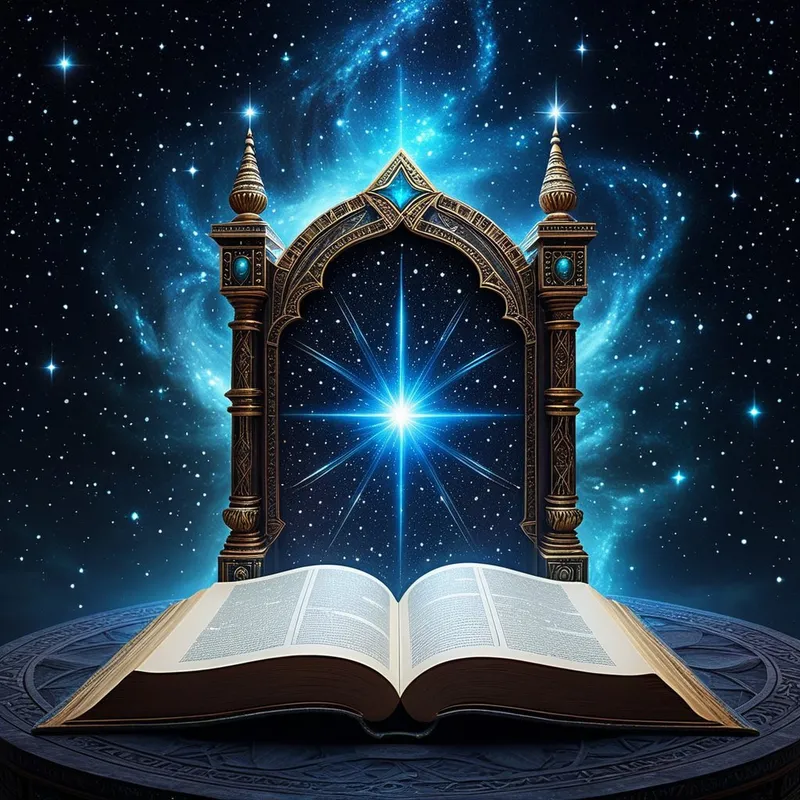
Book of Life Myth Meaning & Symbolism
A celestial ledger recording the names of the righteous, opened at the final judgment to determine eternal destiny.
The Tale of the Book of Life
Hear now of the ledger that was before time, written in the breath of the Ancient of Days. It rests not on any shelf of stone or wood, but upon the foundation of the world itself. Its covers are the dawn and the dusk; its pages, the parchment of eternity.
In the courts of heaven, where silence is a song and light has weight, this tome holds its vigil. It is not a book of stories, but of names. Each name is not merely ink, but a soul’s echo, a life distilled to its essential signature. The scribe is no mere angel with a quill, but the very gaze of the Divine, which sees the end from the beginning.
The drama unfolds not in the busyness of earth, but at the still point of all ages. A trumpet sounds, a sound that unravels mountains and calls the sea to give up its dead. The thrones are set. Before the assembled host of heaven and the generations of humanity, the Book is brought forth. Its opening is not a rustle of paper, but the cracking open of reality, a sound like the birth and death of stars.
One by one, they come—the great and the small, the remembered and the forgotten. Their entire earthly journey, every secret thought and public deed, hangs in the balance of a single question: Is my name written there? The angel turns the pages, which flow like a river of liquid gold. To find one’s name is to feel a cord of light snap into place, connecting the heart to a source of unending love. To search and find only absence is to experience a dissolution more profound than death—a final, terrible silence where the soul itself seems to unwrite its own being.
This is the final reckoning. The Book does not judge; it reveals. It is the mirror held up to the essence of a life, and what stares back determines the journey into the everlasting day or the outer darkness.
Cultural Origins & Context
The image of the Book of Life is woven deeply into the tapestry of Jewish and early Christian apocalyptic thought. Its roots stretch back to the Hebrew Bible, where it appears as a record of the living community (Torah) and of those destined for protection. This concept was dramatically expanded in the tumultuous centuries before and after the birth of Christ, a period rife with persecution and cosmic speculation.
The myth found its most potent expression in the apocalyptic literature of the era, most famously in the Book of Revelation. Here, it served a crucial sociological and psychological function for marginalized communities. For believers facing Roman oppression, the promise that their fidelity was recorded in heaven’s own ledger was a profound source of hope and identity. It transformed earthly suffering into a cosmic drama where their names were eternally significant. The myth was passed down through sermons, art, and liturgy, a stark reminder that human authority was temporary, but divine recognition was eternal.
Symbolic Architecture
The Book of Life is not merely a list; it is a profound symbol of ultimate meaning and personal authenticity.
The Book is the Self, and the name written within is the true signature of the soul, earned not given, realized not assigned.
The Book itself symbolizes the objective totality of existence—the unalterable record of what is. It represents the Self, the complete and eternal pattern of an individual, known fully only to the divine. The Name is the essence of individual identity, but not the ego’s name. It is the true name, the core of being that aligns with cosmic truth (righteousness). The Writing signifies the act of living authentically. It implies that our choices, our loves, and our sacrifices are the pen with which we inscribe ourselves onto the fabric of reality. The Judgment scene is the psyche’s confrontation with its own totality, a moment of ruthless introspection where excuses fall away and only essence remains.
The Dreamer's Resonance
When this myth stirs in the modern unconscious, it often surfaces in dreams of searching, testing, or final evaluation. You may dream of:
- Frantically looking for your name on a list, diploma, or door.
- Being handed a book about your own life that you are terrified to open.
- Standing before a stern but luminous authority figure who is reviewing your actions.
These are not prophecies of doom, but somatic signals of a profound psychological process: the ego’s confrontation with the shadow and the demands of the Self. The anxiety is the felt sense of being seen—truly and completely—by your own deepest conscience. The dream is initiating a process of self-auditing, where you are compelled to ask: What have I truly built with my life? Is my external persona in alignment with my inner truth? The terror of the "name not found" reflects the dread of existential insignificance, of having lived a life that does not reflect one’s potential.

Alchemical Translation
The alchemical journey mirrored in this myth is the transformation of leaden, scattered existence into golden, coherent essence—the process of individuation.
The initial state is the unexamined life, where actions and identity are separate. The opening of the Book represents the crucial, often painful, stage of illumination or nigredo (the blackening), where we consent to see ourselves wholly—our failures, our cruelties, our unlived potential. This is the divine judgment internalized: the ego stands trial before the Self.
The fire of judgment is not for destruction, but for refinement. It burns away the dross of the false self so the golden name of the true self may be revealed.
The act of writing the name is the long work of integration. Each conscious choice, each act of integrity, each acceptance of responsibility is a stroke of the pen. We are not passively inscribed; we are active scribes of our own souls, collaborating with the transcendent (the Divine Scribe) to define who we are. The final revelation—the name found—symbolizes the achievement of psychic wholeness. It is the moment when the persona, the shadow, the anima/animus, and all other complexes are reconciled under the authority of the Self. You become, as the alchemists sought, a lapis philosophorum—a living stone, a complete and enduring essence. Your life is no longer a series of accidents, but a legible, coherent text in the great library of being.
Associated Symbols
Explore related symbols from the CaleaDream lexicon: