Bone Whistle of the Shaman Myth Meaning & Symbolism
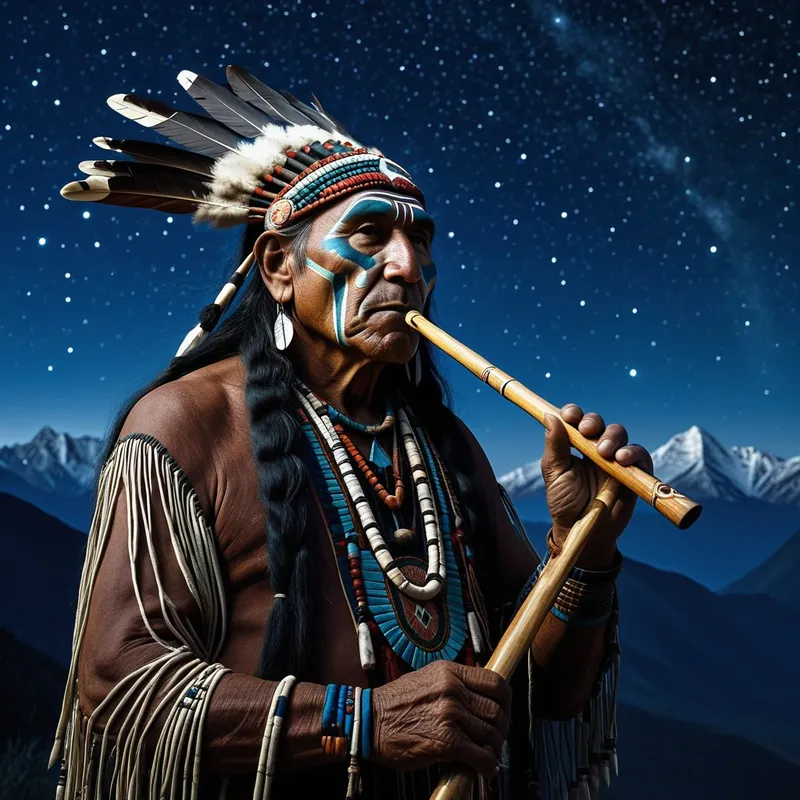
A shaman, shattered by loss, fashions a flute from his own bone to call back the spirit of his beloved from the land of the dead.
The Tale of Bone Whistle of the Shaman
Listen. The wind does not just blow through the canyon. It remembers. It carries a song older than the stones, a melody born not of reed or wood, but of sacrifice. This is the story of how song was married to sorrow, and how a man walked the razor’s edge between the worlds.
There was a man, a shaman, whose heart was a vast and knowing country. He knew the language of the wolf and the path of the eagle. But his true country, the warm hearth of his world, was his wife. Her laughter was the spring that watered his soul. Then, the great silence fell. A sickness, swift and cold as a winter river, took her. It carried her spirit away to the Land of Shadows, a place where the living may not follow.
The shaman’s world shattered. The songs of the forest became noise. The medicine in his pouch was dust. He sat by the cold fire, and his grief was not a tear, but a continent. He felt the cord that had tied her spirit to the earth, now severed, frayed, and drifting into the west. A terrible stillness filled him, a hollow where his heart had been. In that hollow, a thought began to echo, faint but relentless as a drumbeat: What remains when all is lost? What is the one thing the spirits cannot take?
He walked away from the village, into the high, lonely places where the earth meets the sky. For days and nights, he fasted, he prayed, he cried out to the manitous. He received only the echo of his own emptiness. Finally, under a moon thin as a claw, the answer came. It was not a voice, but a knowing that settled in his bones. The connection was gone, but the bridge must be built from the substance of the builder. From what he was, truly and irrevocably.
With a flint knife cleansed in sage smoke, and a heart calm as deep water, he performed the unthinkable. He cut into his own flesh, at his side. There was no cry, only a focused breath. From his living body, he removed a single rib. The pain was a white fire, but it was a clean pain, a truth pain. He held the bone, still warm with the memory of his life, of the breath that had once expanded his chest beside her.
By a stream singing over stones, he worked. He hollowed the bone with patient care. He drilled the finger holes, not by measure, but by the memory of the gaps between her laughter. He fashioned a mouthpiece. He did not carve decorations of power; the bone itself was the ultimate sigil. As the sun bled into the horizon, he lifted the flute to his lips. His first breath into it was not a breath of air, but the breath of his sacrifice, his longing, his very essence.
He did not play a tune known to men. He played the sound of the space she left behind. He played the shape of her absence. The note that rose was piercing, clear, and infinitely sad. It did not travel through the air; it traveled beneath it, vibrating along the hidden threads that connect all things. It crossed the river, the plain, and the dark mountains. It reached the misty shores of the Land of Shadows.
And there, a spirit stirring in the grey stillness, heard it. It was not a sound, but a pull, a recognition more profound than name or memory. It was the call of its own other half, sung from the substance of love itself. Slowly, drawn by a cord of sacred sound, the spirit began the long journey back. The shaman played until his breath grew thin and the stars wheeled overhead. He played until, in the pre-dawn glow, a faint, familiar warmth touched the edge of his perception. He had not brought back the dead. But he had called home a presence. He had rebuilt the bridge, not to the land of the living as it was, but to a new country where love and loss could speak to one another, forever.
Cultural Origins & Context
This myth, in its many variations, is found among several Native American nations, particularly across the Plains and some Southwestern cultures. It is not a single, fixed story but a powerful narrative pattern passed down through oral tradition, often by medicine people and storytellers during long winter nights or important ceremonies. Its primary function was not mere entertainment, but profound instruction.
The story served as a sacred map for understanding the deepest crises of the human soul. It validated the reality of paralyzing grief while providing a mythical template for navigating it. It taught that the most potent medicine often comes from the wound itself, and that true power—medicine power—is not about dominance over spirits, but about forging a relationship through ultimate vulnerability and authenticity. The shaman’s act was the ultimate expression of this principle: using the very material of his own suffering and physical being as the instrument of communion.
Symbolic Architecture
The myth’s power lies in its stark, alchemical symbolism. Each element is a profound psychological truth.
The Bone is the ultimate symbol of what endures. Flesh decays, emotion fluctuates, but bone is the lasting structure, the core identity. By sacrificing a rib—the bone that protects the heart—the shaman offers the very architecture of his protection and selfhood. He makes his core vulnerability his strength.
The instrument of salvation is always fashioned from the wreckage of the ship.
The Whistle/Flute represents channeled breath, spirit (Taku Skanskan), and intentional communication. It transforms the raw, inarticulate cry of grief into a focused, directed call. It is the technology of the soul, turning passive suffering into active invocation.
The Land of Shadows is not merely an afterlife, but the psychological shadow realm, the place where we relegate all we have lost, our unresolved pain, and our disowned parts. The beloved’s spirit there represents a vital aspect of the shaman’s own psyche that has become dissociated through trauma.
The Journey Back signifies the process of re-integration. The spirit does not return to old life, but to a new, conscious relationship. This mirrors the psychological truth that we cannot undo loss, but we can reclaim the energy and love bound within it, transforming our relationship to the past.

The Dreamer's Resonance
When this myth stirs in the modern dreamer, it signals a profound psychic initiation centered on irreducible loss. To dream of carving an instrument from your own bone suggests you are in a process where conventional solutions and external comforts have failed. You are being compelled to find the answer within the wound itself.
Somatically, this may manifest as a focus around the rib cage, the heart, or the breath—a tightness, a sense of hollow emptiness, or conversely, a strange, focused energy in that center. Psychologically, you are at the stage between the "great silence" and the act of creation. The dream is the call to begin that alchemy: to identify what core, enduring part of yourself (your "bone") must be consciously offered up to transform your grief, addiction, or depression from a state of being into a tool for calling back your own lost vitality, your own dissociated spirit.
Alchemical Translation
The myth of the Bone Whistle is a perfect model for the individuation process, specifically the stage of nigredo, the black despair, and its transmutation into the albedo, the clear, illuminating spirit.
First, the conscious ego (the shaman) is utterly dissolved by the encounter with the unconscious (the death of the beloved). All former identities and powers are rendered null. This is the necessary, brutal stage of dissolution. The triumph of the myth is that it does not bypass this despair, but requires it as the raw material.
The act of self-surgery is the conscious ego’s decision to engage in a sacred, painful introspection—to remove a foundational structure of the personality (a defense mechanism, a cherished self-image, an old identity) that, while part of the self, is now seen as material for a higher function. This is active sacrifice, not passive suffering.
Fashioning the whistle is the work of therapy, art, journaling, or ritual: giving form to the formless pain. Playing it is the act of expressing that refined truth to the world and, crucially, into the depths of one’s own psyche. The call is for the anima or lost vitality, the feeling-function that has retreated into the unconscious Land of Shadows.
The spirit that answers the call is never the one that was lost; it is the one that has been transformed by the calling.
The final reunion is not a regression, but the establishment of a new, conscious dialogue between the ego and the once-lost parts of the soul. The shaman becomes whole not by getting his old life back, but by becoming the living bridge between the world of form and the world of spirit, between his conscious suffering and his unconscious healing. His medicine is now unassailable, for it is made of himself. He has performed the ultimate alchemy: turning the lead of unbearable grief into the gold of sacred, enduring connection.
Associated Symbols
Explore related symbols from the CaleaDream lexicon: