Bon Creation Myth Myth Meaning & Symbolism
From the luminous void, a creator deity emerges, whose compassionate gaze births the world of form, suffering, and the path to liberation.
The Tale of the Bon Creation Myth
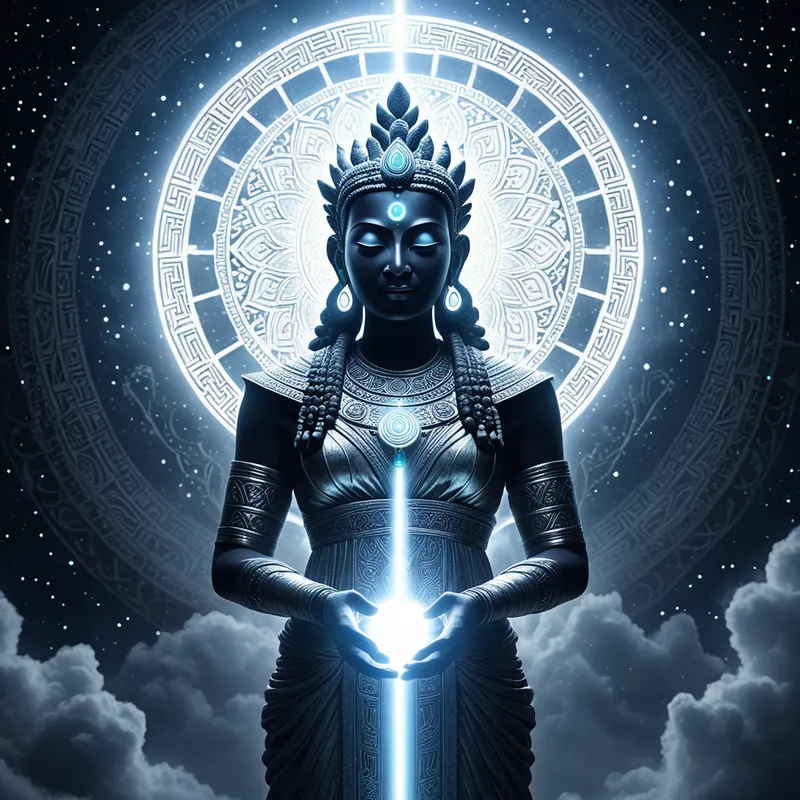
In the beginning, there was not darkness, nor was there light. There was only the Künzhi, the All-Base, an infinite, luminous emptiness. It was a vast, pregnant silence, a potentiality humming with the music of what could be. From this ground of pure being, not by will but by natural emanation, arose a presence of unimaginable clarity: Shenlha Okar, the God of White Light. His body was the essence of compassion, his mind the essence of space itself.
Shenlha Okar gazed from the heart of the void. And in his gaze—a gaze of boundless, non-discriminating love—something stirred. From the luminous emptiness, a subtle vibration emerged. It was the first sound, the hum of manifestation. From this sound, two principles crystallized like frost on the mirror of the void: the White Light of existence and the Black Light of non-existence. They swirled, not yet in conflict, but in a dynamic, cosmic dance.
Then, from the union of Shenlha Okar’s compassionate essence and these nascent lights, the world-egg formed. It was not an egg of matter, but an egg of potential, floating in the Chuchag, the primeval waters of chaos that now churned beneath the void. Within this egg, the elements slept—earth, water, fire, air, and space—tangled in a slumber of pure possibility.
The egg knew a pressure, a yearning to be. And it cracked. Not with a violent rupture, but with a sigh that became the wind. From the upper shell rose the pure, radiant realm of the gods, the Lha. It was a land of luminous mountains and crystal skies, born from the White Light. From the lower shell fell the denser particles, coalescing into the dark, tumultuous realm of the demons, the Düd, born from the Black Light. And between them, from the very substance of the egg’s middle, the human realm, Mi, was woven—a tapestry of solid earth, flowing rivers, and the first, fragile breath of life.
But the realms were unstable. The demonic forces of the Düd, chaotic and powerful, surged upward, threatening to engulf the nascent order of the Lha and the Mi. The world trembled on the brink of dissolution back into the primeval waters. It was then that the great Shenrab Miwo, the teacher of the Bon, is said to have manifested. With wisdom, not with force, he performed the great act of ordering. He did not destroy the demons, but subdued them, turning their chaotic power into the foundational pillars of the world. He pinned the earth with sacred mountains, channeled the waters into rivers, and established the rhythms of day and night, life and death. The universe breathed its first steady breath, a cosmos born from luminous emptiness, structured by compassionate wisdom, and forever holding the tension between its radiant and its shadowed halves.

Cultural Origins & Context
This mythos is the foundational narrative of Bon, the ancient, animistic, and shamanic substrate of Tibetan culture. It was not a single, canonical text but a living oral tradition, recited and performed by priests known as Shen or Bonpo during rituals for healing, divination, and the maintenance of cosmic and social order. Its function was profoundly practical: to explain the origin of the world's duality—light and dark, order and chaos, gods and demons—and to provide a sacred map for navigating it. By recounting the emergence from Künzhi and the ordering acts of Shenrab Miwo, the myth established a template for ritual. Every ceremony became a symbolic re-enactment of this primordial ordering, a way to harmonize the human realm (Mi) with the divine (Lha) and pacify the chaotic (Düd) forces that cause illness and misfortune. It is a cosmology deeply rooted in the Tibetan landscape itself, where mountains are seen as the literal pins of existence and lakes as remnants of the primeval waters.
Symbolic Architecture
The myth is not a literal history but a profound map of the psyche's own origins. The Künzhi represents the undifferentiated ground of consciousness, the Self before the birth of the ego. Shenlha Okar is the archetype of pure awareness, the first flicker of conscious light within the void of the unconscious.
Creation begins not with a command, but with a gaze. The world is born from compassionate attention.
The separation into White and Black Light symbolizes the fundamental psychic split that creates experience: subject and object, self and other, conscious and unconscious. The world-egg is the nascent psyche, containing all potential. Its cracking is the trauma—and the necessity—of individuation. The three realms are internal states: the Lha is our aspiration, our spiritual heights and ideals; the Düd is our repressed shadow, our chaotic instincts and unresolved trauma; the Mi is our conscious ego, forever caught between these two powerful inner forces. The demonic uprising is the inevitable eruption of the shadow when it is ignored or denied. Shenrab Miwo’s pacification represents the ego's difficult, sacred task: not to annihilate the shadow, but to engage with it, transform its raw energy, and integrate it into a stable, whole personality. The ordered world that results is the achieved state of psychological integration.
The Dreamer's Resonance
When this mythic pattern stirs in the modern dreamer, it often signals a profound process of psychic (re)creation or disintegration. Dreams of featureless, luminous voids or infinite, silent spaces may touch the Künzhi—a feeling of returning to source before a new life phase. Dreams of eggs, especially cracking or hatching eggs, speak directly to the world-egg, indicating a nascent self-structure about to emerge.
More turbulent are dreams reflecting the realm of the Düd: chaotic floods, dark, pursuing figures, or landscapes that dissolve into formlessness. These are not mere nightmares but somatic communications of the "demonic" uprising—the psyche's chaotic, unintegrated contents breaking into consciousness. Conversely, dreams of radiant, orderly temples or luminous beings connect to the Lha realm, reflecting spiritual yearning or idealized self-images. The dreamer experiencing this full mythic arc is undergoing a death and rebirth of the ego-structure, where old certainties (the previous world-order) are dissolving back into the primeval waters, awaiting the inner Shenrab Miwo—the organizing principle of the Self—to establish a new, more authentic order.
Alchemical Translation
The alchemical journey modeled here is the transmutation of primal, unconscious potential (Künzhi) into a conscious, individuated life of meaning. The prima materia is the undifferentiated self. The first operation is the emanatio: the spontaneous arising of awareness (Shenlha Okar’s gaze). This is meditation, the act of turning compassionate attention inward.
The chaos of the Düd is not the enemy of the process; it is the essential, volatile ingredient without which no stable gold can be made.
The separation into light and dark (separatio) is the painful but crucial stage of making the unconscious conscious—acknowledging our duality. The "cracking of the egg" is the mortificatio, the death of naive wholeness, necessary for growth. The subsequent battle and ordering is the core of the work: coniunctio oppositorum, the conjunction of opposites. The modern individual must perform Shenrab Miwo’s task internally. One must face the inner "demons" of rage, shame, grief, and fear (the Düd), not to destroy them, but to hear their message, honor their energy, and redirect that power. Simultaneously, one must temper spiritual ideals (Lha) with grounded reality. The final, ordered cosmos is the lapis philosophorum, the Philosopher's Stone: not a perfect, static state, but a dynamic, resilient psyche capable of holding the tension of opposites, rooted in the luminous emptiness from which it came. It is the achievement of an authentic self, created from the raw materials of one's own existence.
Associated Symbols
Explore related symbols from the CaleaDream lexicon:
- Mythical Landscapes — The three realms (Lha, Mi, Düd) represent the archetypal inner landscapes of the psyche: the celestial, the earthly, and the chthonic.
- Light — The White Light of Shenlha Okar symbolizes primordial consciousness, pure awareness, and the illuminating power of compassion that initiates creation.
- Shadow — The Black Light and the realm of the Düd embody the unconscious shadow, the necessary chaotic and instinctual force that must be integrated, not vanquished.
- Water — The Chuchag, the primeval waters, represent the formless, potential-filled unconscious from which all differentiated forms emerge and into which they may dissolve.
- Mountain — The sacred mountains pinned by Shenrab Miwo symbolize the achieved stability of the integrated Self, a firm structure arising from chaotic foundations.
- Egg — The world-egg is the symbol of wholeness-in-potential, the contained psyche holding all elements of being before the necessary fracture of individuation.
- Order — The final act of the myth establishes cosmic order, mirroring the psychological process of creating a coherent, functional ego-structure from inner chaos.
- Chaos — The demonic uprising represents the creative-destructive force of chaos, essential for breaking rigid structures and allowing for new growth and reorganization.
- God — Shenlha Okar represents the archetypal Creator not as a external being, but as the immanent principle of conscious, compassionate awareness within the ground of being.
- Mirror — The luminous void of Künzhi acts as a perfect mirror, reflecting nothing until the gaze of awareness arises, creating the first duality of seer and seen.
- Dragon — In the context of the Düd, the dragon symbolizes the raw, untamed, and powerful psychic energy of the unconscious that must be encountered and transformed.
- Rebirth — The entire myth is a cycle of emanation, dissolution, and re-ordering, modeling the perpetual psychic process of death and rebirth required for individuation.