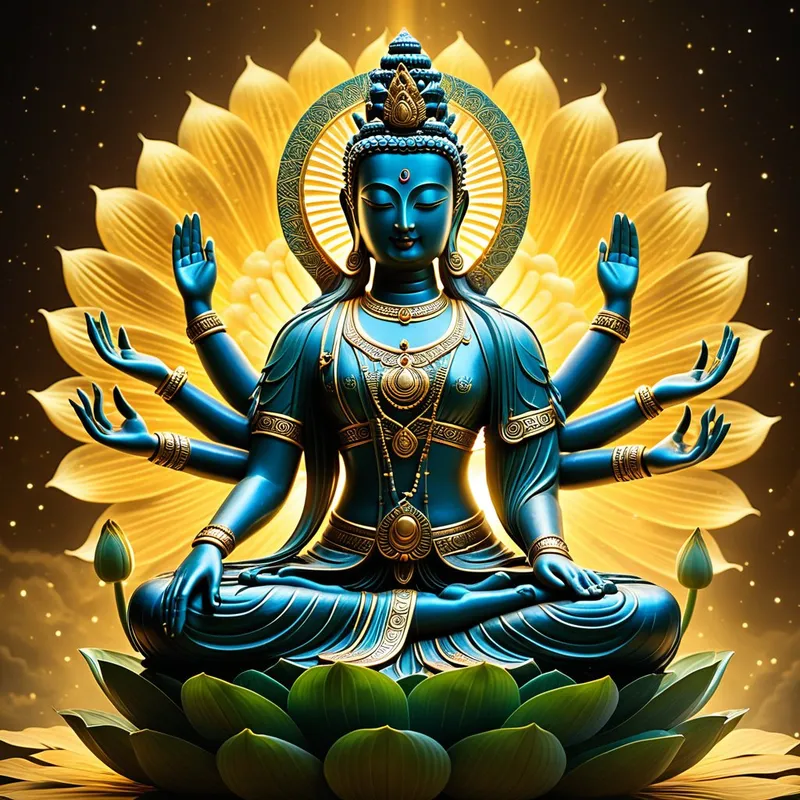
Bodhisattva Myth Meaning & Symbolism
A being who renounces final liberation, vowing to remain in the cycle of existence until every last sentient being is awakened.
The Tale of Bodhisattva
Listen. In the deep, turning wheel of worlds, where suffering is the common tongue and ignorance the oldest shadow, a moment of impossible choice was made. It did not happen in a flash of lightning or the roar of a dragon, but in a silence so vast it swallowed sound.
Picture a being who has walked the path to its very end. Through countless lifetimes, they have polished the mind like a mirror, worn away every clinging desire, every shred of illusion. They stand now at the shore of the great ocean, Nirvana. Its peace is absolute, a cool, silent dissolution of the self into boundless freedom. The waves of birth, aging, sickness, and death lap no more at their feet. The door is open. All they must do is step through, and the long travail of existence will be over.
But as they raise their foot to cross that final threshold, they hear it. A sound woven from a billion threads: the muffled cry of a child in the dark, the confused murmur of the hungry ghost, the roar of the beast in its cage of instinct, the silent despair of the god clinging to fading pleasure. It is the cacophony of Samsara, the wheel of becoming. They look back.
And in that looking back, the heart breaks open not with sorrow, but with a vow that shakes the foundations of reality. The foot lowers. They turn away from the open door. "Until the grass itself is enlightened," they whisper, a promise not to the sky, but to the mud. "I will not enter final peace. I will return, again and again, in whatever form is needed, until not a single being is left behind in this night."
This is the birth of the Bodhisattva. Not a god to be worshipped from afar, but a revolutionary of the spirit. They take the map to freedom and scatter its pieces as seeds in the darkest soil. They become the doctor who enters the plague-ridden city, the guide who walks back into the labyrinth to lead others out, the parent who stays up all night, singing to soothe a universe of frightened children. Their journey is no longer toward an exit, but a deeper, endless descent into the heart of the world's cry, armed with nothing but limitless compassion and the fierce, patient wisdom of one who could leave but chooses to stay.

Cultural Origins & Context
The Bodhisattva ideal is the majestic flowering of the Mahayana Buddhist tradition, which emerged around the 1st century BCE to 1st century CE in India. It represented a democratization and expansion of the spiritual path. While early Buddhist teachings focused on the arduous personal journey of the Arhat toward individual liberation, Mahayana scriptures, or Sutras, proclaimed a path for the many.
This myth was not passed down as a single story of one hero, but as an archetypal template embodied by countless figures, such as Avalokiteshvara, Manjushri, and Vajrapani. It was lived out in the aspirational vows of monks, nuns, and lay practitioners. The societal function was profound: it transformed the spiritual quest from a private, world-denying asceticism into a cosmic, world-embracing ethic of service. It created a cultural hero who modeled the ultimate integration of wisdom (seeing the emptiness of self) with compassion (acting for the benefit of all).
Symbolic Architecture
The Bodhisattva is the ultimate symbol of the integrated psyche, where the drive for self-perfection meets and is utterly transformed by the impulse of radical empathy. Psychologically, they represent the ego that has glimpsed its own dissolution—the peace of being nothing—and yet chooses to reassemble itself, not out of attachment, but as a vehicle of grace.
The greatest rebellion is not against a god or a king, but against the very logic of the universe that permits isolated salvation.
The Bodhicitta, the "awakening mind," is the central symbol. It is not mere sentimentality, but a volcanic eruption of will and love that reorients the entire psychic structure. The "postponement" of Nirvana is the myth's brilliant paradox: by renouncing the endpoint, the Bodhisattva gains the whole path. Their "goal" becomes the journey itself, which is now infinite in its scope and intimacy.
The Bodhisattva's tools—Paramitas—are a blueprint for psychological maturation. Each perfection is a muscle to be strengthened not for personal gain, but to increase one's capacity to bear the world's suffering and transform it.

The Dreamer's Resonance
When this myth stirs in the modern dreamer, it often manifests not as a glorious figure, but as a profound and troubling dilemma. You may dream of being at the airport, ticket in hand for a flight to paradise, but you cannot board because you've forgotten someone—a face you can't quite see, a voice calling from the terminal. You dream of finally achieving the promotion, the acclaim, the peace you sought, only to find it tastes like ash because your loved ones are struggling. You dream of building a beautiful, walled garden, then hearing cries from outside the walls, and feeling compelled to tear the walls down, letting the chaos in.
These dreams signal a critical juncture in individuation: the confrontation between the ego's project of self-improvement and the soul's call to communion. The somatic feeling is often a wrenching in the chest—a heart-chakra activation. It is the psyche's intuition that wholeness cannot be found in separation, that our liberation is bound up with the liberation of others. The dreamer is being asked to move from a psychology of "achievement" to a psychology of "vow."

Alchemical Translation
The alchemical work modeled by the Bodhisattva myth is the transmutation of the leaden, self-concerned ego into the gold of a conscious, chosen identity as a nexus of healing. It is the most demanding of operations: to hold the tension of the opposites between absolute freedom and absolute responsibility.
The individuated Self is not a perfected island, but a clearing-house for grace.
First, one must "reach the shore"—do the necessary inner work, face one's shadows, achieve a degree of self-mastery and insight. This is the nigredo and albedo. But the myth insists this is only half the work. The rubedo, the reddening, is the return. It is taking that hard-won gold of consciousness and dissolving it back into the community, the relationship, the political fray, the environmental crisis—not as a savior, but as a committed participant.
For the modern individual, this translates to a life lived with "Bodhisattva intent." It means pursuing your therapy, your art, your career, your meditation not merely to "fix yourself" or "find happiness," but to become a more effective agent of healing in your sphere of influence. Your vocation becomes a vehicle for your vow. Your wounds, understood and integrated, become sources of empathy rather than isolation. You stop seeking an exit from life's messiness and instead commit to dignifying it, piece by piece, from within. You choose the wheel, not to be crushed by it, but to turn it, ever so slightly, toward the light.
Associated Symbols
Explore related symbols from the CaleaDream lexicon: