Blood Brotherhood Myth Meaning & Symbolism
A sacred oath of loyalty is forged in blood, binding two warriors as kin, testing the ultimate price of brotherhood against fate's cruel design.
The Tale of Blood Brotherhood
Let the fire burn low. Listen, and hear the whisper in the smoke of a bond that was stronger than steel, and a doom that was sharper than any blade.
In the days when the Æsir still walked closely with men, there lived a warrior of renown. His name was Helgi, and his arm was strong, his heart was bold, and his hair was like spun gold in the sun. He traveled the whale-roads, and in his wanderings he came upon another lord, Sinfjötli. Where Helgi was light, Sinfjötli was shadow—dark of hair and eye, his laughter sharp, his prowess in battle a thing of terrible beauty. They fought side-by-side against a common foe, and in the red mist of the shield-wall, they saw in each other a reflection of their own unmatched spirit. A kinship was born, not of womb, but of will.
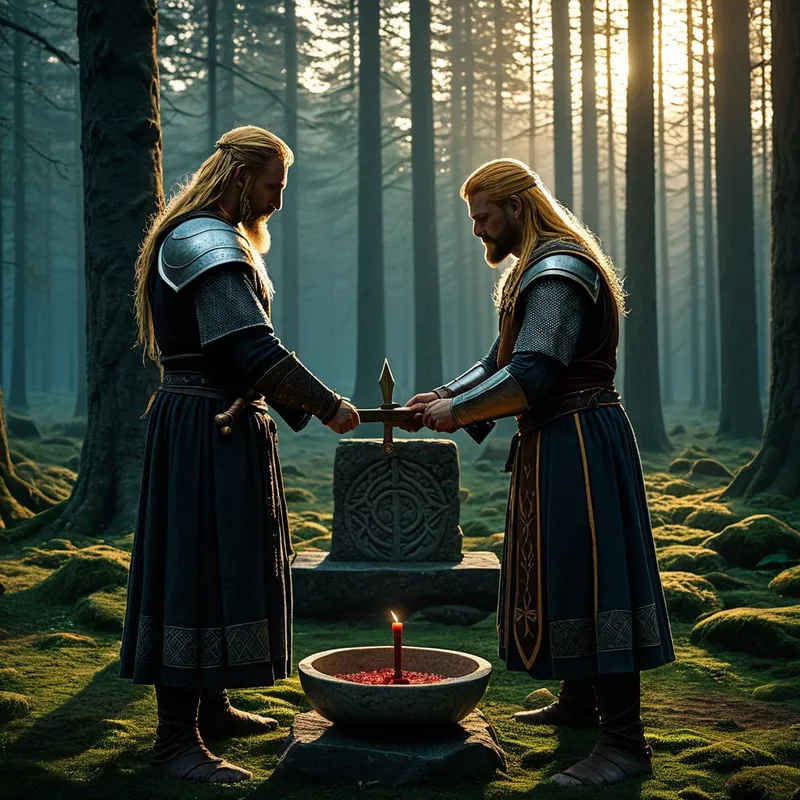
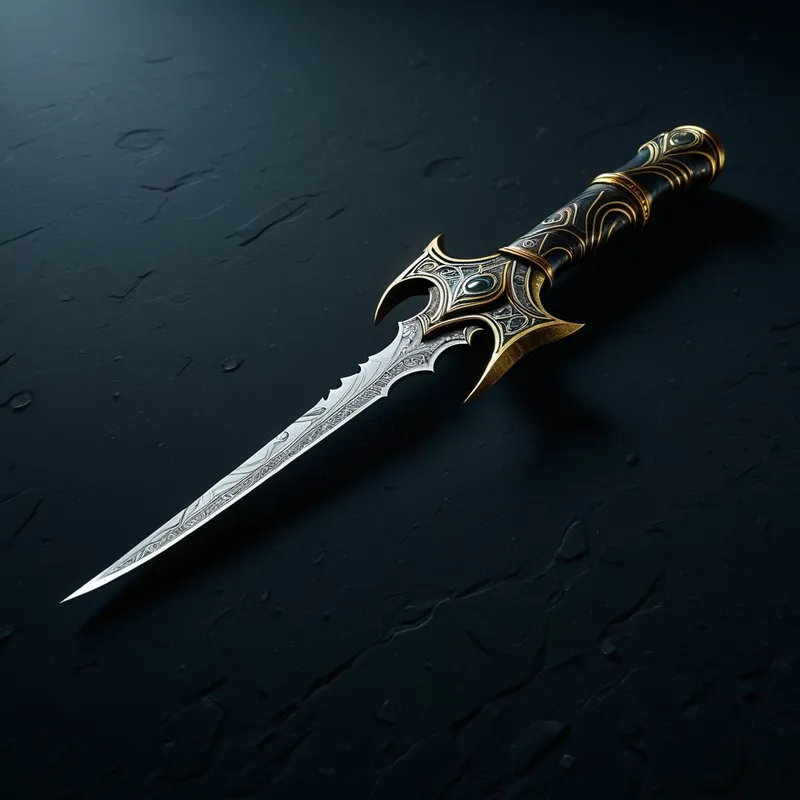
After the battle, on a patch of earth still damp with blood, they made a vow. "No hall shall be closed to us, no treasure denied," Helgi declared. "Our fates shall be as one." Sinfjötli, his gaze unflinching, agreed. They sought a sacred grove, a place where the roots of the Yggdrasil were said to touch the world of men. There, they cut a long strip of turf, raising the sod at both ends so it formed an arch of living earth. They took a spear, its point honed to a cruel sharpness, and passed beneath that arch of soil and grass—a symbolic womb of the earth itself.
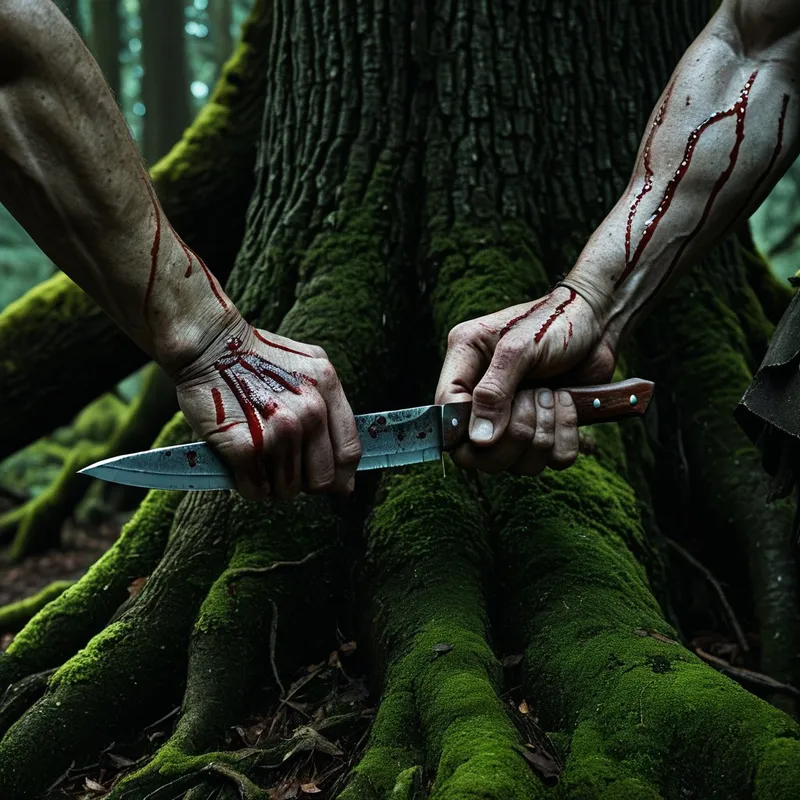
Then came the oath. With a ritual knife, they drew blood from the hollow of their own arms. Letting the dark red life fall into a bronze bowl, they mingled it together—gold and shadow becoming one. They dipped their hands into the sacred mixture, clasping palm to bloody palm. The words they spoke are lost to time, but their meaning echoed in the silent grove: Where your blood flows, so shall mine. Your enemy is my enemy. Your honor is my honor. Your doom… is my doom.
For a time, the bond held true. They were invincible. Kings fell before them, treasures were won, and songs were sung of the blood-brothers. But fate, the ørlög woven by the Nornir, is a tapestry with bitter threads. A dispute arose over a crown, a woman, a slight—the sagas disagree on the spark, but not on the fire. Old loyalties to kin and kingdom strained against the new loyalty of the oath. The bond, forged to make them invulnerable, became a cage. To honor one vow was to break another. The mingled blood in their veins now felt like a poison.
The end did not come in a glorious last stand. It came in a grim, quiet realization. The oath they had made beneath the arch of earth was eternal, binding them beyond life. To be free, the bond itself had to die, and the only thing that could kill such a bond was the one who made it. The story holds its breath here, in the moment before the breaking. Did one raise a blade against the other? Or did they, in a final, tragic act of twisted loyalty, turn their matched weapons upon a common enemy, walking knowingly into a trap of their own making, so that neither would have to live with the betrayal? The skalds sing that they fell together, on the same field, their blood soaking back into the earth from which their brotherhood had sprung. The arch of turf collapsed, and the grove was silent once more.
Cultural Origins & Context
The ritual of blood brotherhood, or fóstbræðralag, was a profound social and legal institution in the Norse world, far more binding than a simple friendship. It is detailed in sagas like Völsunga saga and Gísla saga, serving as a critical plot device that explores the tension between chosen loyalty and inherited duty.
This was not a casual practice but a solemn ceremony, often witnessed and involving specific ritual actions: passing under a strip of raised turf, mingling blood, and swearing oaths. By mixing their blood, the participants were literally creating a new kinship—they became one blood. In a society where bloodlines dictated inheritance, vengeance, and social standing, this was a revolutionary act. It created an artificial but legally recognized family tie, obligating the brothers to support each other in feud and law, to inherit from one another, and to seek vengeance for each other's death.
The mythic tales of blood brotherhood, therefore, were not mere entertainment. They were ethical parables told in mead-halls, exploring the outermost limits of human commitment. They asked the listening warrior: What happens when the oath you swear to your blood-brother conflicts with your duty to your birth brother, your king, or your own survival? The stories provided a narrative framework for understanding the immense power and potential tragedy of such a bond, teaching that some ties, once forged, cannot be undone without paying a price in blood or honor.
Symbolic Architecture
At its heart, the myth of blood brotherhood is a profound exploration of the Shadow and the Double. The two warriors—often one light, one dark—represent complementary aspects of a single psyche. Helgi is the conscious ego: noble, solar, aspiring to order and glory. Sinfjötli is the unconscious Shadow: instinctual, lunar, possessing raw power and cunning amoral strength.
The ritual of blood-mixing is the ultimate act of psychic integration. It is the ego's brave, desperate attempt to make a pact with its own hidden depths, to harness that power for its conscious goals.
The raised turf, an arch of living earth, symbolizes the threshold of this integration—a rebirth into a new, more complete self. The mingled blood represents the irreversible blending of conscious and unconscious contents. For a time, this creates the "hero," an individual of phenomenal capability who seems to transcend ordinary human limits.
But the myth warns us. Integration is not assimilation. The Shadow retains its own nature. The conflict that arises is the inevitable tension between the ego's chosen path and the autonomous, often disruptive, will of the unconscious. The oath becomes a trap because it presupposes a perfect unity that is impossible to maintain. The psyche is a parliament, not a dictatorship. The tragic end symbolizes the catastrophic psychic collapse that occurs when one part seeks to utterly dominate or sever itself from the other. The bond must be honored, even in its breaking, leading to a form of psychic death—the end of an old, unsustainable mode of being.
The Dreamer's Resonance
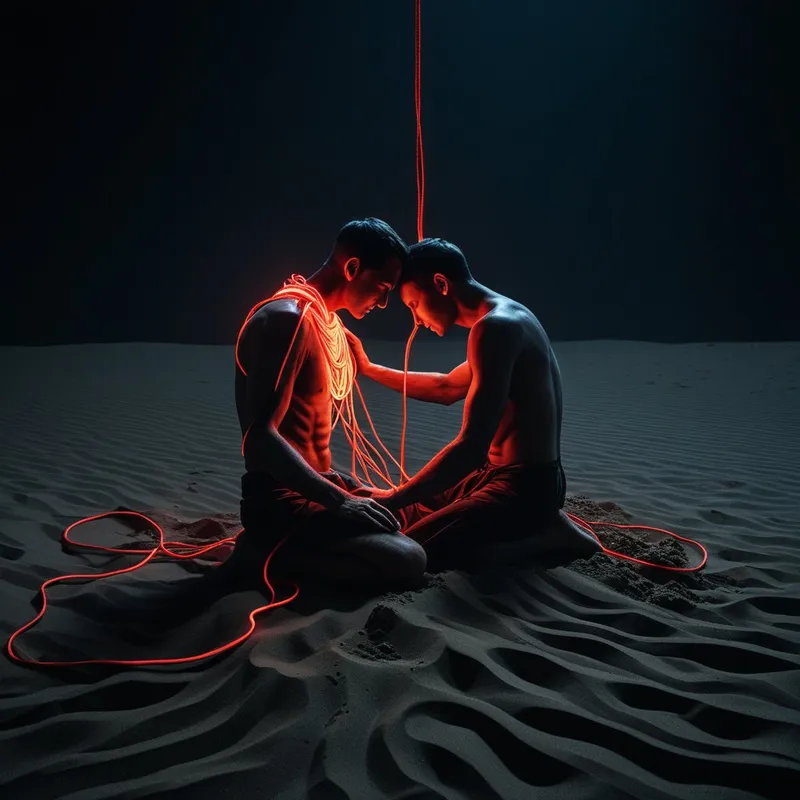
When this myth stirs in the modern dreamer, it rarely appears as Vikings and turf arches. Instead, it manifests as potent, visceral imagery of binding and merging. You may dream of being surgically attached to another person, of sharing a vital organ, or of a contract signed in a substance that feels like liquid life. The somatic sensation is often one of constriction—a tight band around the chest, or the feeling of another's heartbeat echoing in your own veins.
Psychologically, this dream pattern surfaces when you are in a relationship or commitment of overwhelming intensity. This could be a romantic partnership, a business alliance, a creative collaboration, or even an obsessive identification with a cause or group. The dream signals that a bond formed in a spirit of empowerment ("together we are stronger") has become enmeshed and limiting. You have, perhaps unknowingly, "mingled your blood"—surrendering too much of your individual autonomy, blurring your boundaries to the point where your friend's success feels like your failure, or their problem becomes your existential crisis.
The dream is the psyche's attempt to bring this unconscious enmeshment into view. It asks: What oath have you sworn that is now costing you your self? Where have you promised loyalty to something that is in conflict with your own deepest fate? The discomfort is a call to re-negotiate the terms of the bond, to differentiate, before the tension leads to an explosive or tragic rupture in waking life.
Alchemical Translation
The alchemical journey mirrored in this myth is the Coniunctio—the sacred marriage or union of opposites. However, it is the Coniunctio in its most perilous and final stage. The initial mixing of substances (the blood) is the Solutio, a dissolution of separate identities. This creates a potent, unified prima materia, the empowered hero.
The subsequent conflict and tragic end represent the necessary Separatio and Mortificatio. The alchemical process cannot stop at union; the fused material must be putrefied, slain, and separated again at a higher level.
The myth teaches that true individuation is not about becoming a perfectly unified, conflict-free being. It is about learning to hold the tension of opposites within oneself without being torn apart, and to honor the relationship between different parts of the self even when they are in opposition.
For the modern individual, the "alchemical translation" of this myth is the move from enmeshment to conscious relationship. First, one must identify where they have made an unconscious "blood oath"—perhaps with their inner critic (merging with self-judgment), their persona (merging with a social role), or a projected ideal (merging with another person). The heroic phase of empowered action inevitably falters when this merged state clashes with other aspects of life.
The triumph is not in maintaining the fusion, but in undergoing the Mortificatio: the courageous, often painful, act of differentiating. This means setting boundaries, acknowledging conflicting loyalties within oneself, and accepting that some bonds, to remain life-giving, must change form. The "death" of the blood-brotherhood is not a failure, but the Nigredo—the dark night of the soul that precedes renewal. From the ashes of that collapsed union, a new consciousness can arise: one that relates to its own inner "other" not as a sworn, identical brother, but as a respected, distinct, and eternally connected counterpart. The oath is not broken; it is transcended. The blood is not cleansed; it is remembered, now as the source of wisdom, not of bondage.
Associated Symbols
Explore related symbols from the CaleaDream lexicon: