Blarney Stone Myth Meaning & Symbolism
A myth of a king, a goddess, and a stone that grants the gift of persuasive speech, weaving together sovereignty, cunning, and the magic of language.
The Tale of the Blarney Stone
Hear now a tale not of brute strength, but of silver tongues and cunning words. It begins in a time when the green mists of Éire still clung to the old gods, and the walls of men’s castles were thin against the whispers of the Sídhe.
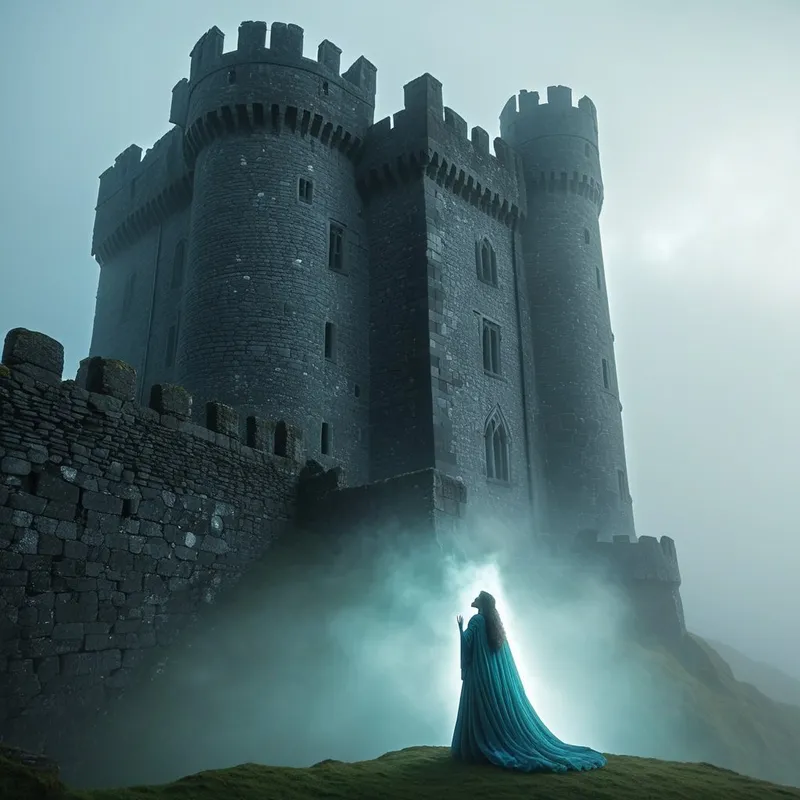
Dermot McCarthy, Lord of Blarney, found his world shrinking. His enemies circled like carrion birds, his legal pleas in the English courts turned to dust in his hands. The law was a trap of foreign words, and he was a man of action, his Gaelic heart choking on their dry, twisting sentences. In his darkest hour, as he walked the banks of a slow-moving stream, the water spoke. Not with a voice, but with a presence—a chill, beautiful, and ancient knowing that settled in the marrow of his bones. It was Clíodhna, a goddess of the Tuatha Dé Danann, who had not forgotten the old ways or the old blood.
She appeared as a shimmer in the willow shade, her voice the sound of water over deep stones. "You seek a weapon to defend your home, Mac Cárthaigh? You look to the sword, but the battle is fought with the tongue. The true sovereignty of a king lies not in the land he holds, but in the words that hold the land for him."
Dermot, desperate, asked for this power. Clíodhna’s smile was as sharp as a sickle moon. "Power is never given. It is earned through a meeting of worlds. In the morning light, you will find a stone. It is a piece of the true Lia Fáil, the stone that cries out beneath the rightful king. It fell from the heavens and now sleeps in the lake. Retrieve it. Set it high in your fortress. Then, you must perform the geis: you must invert yourself. At the stroke of noon, when the world is upright, you must turn yourself upside-down, suspend your mortal certainty, and press your lips to the stone. In that kiss of humility and peril, the gift will pass."
The next dawn, Dermot and his men found the stone—a block of limestone darker than the rest, humming with a silent vibration. With great ropes and sweat, they hauled it from the lake’s embrace and built it into the very battlements of Blarney Castle, a hundred feet above the hard earth.
The day came. Dermot was bound at the ankles and lowered head-first down the sheer wall, the world a dizzying inversion of sky-below and ground-above. The wind roared in his ears. His blood pounded in his temples. As the castle bell tolled noon, he stretched his neck, his life hanging by a rope and his courage, and pressed his lips to the cold, rough surface of the stone.
It was not a flash of light, but a flood of knowing. The chaos of his thoughts ordered itself into flowing streams. The right word for every occasion, the persuasive turn of phrase, the charming deflection—all settled on his tongue like honey. He was hauled back, righted, and when he spoke his thanks to his men, his voice held a new music. He went to the English courts and spoke with such beguiling eloquence, such charming promises and intricate explanations, that he endlessly delayed and confused his adversaries. His "Blarney" became legendary—a speech so sweetly reasonable it disarmed all opposition. His land and sovereignty were preserved not by the sword, but by the sublime and cunning power of the gifted word.

Cultural Origins & Context
The myth of the Blarney Stone is a fascinating late-medieval folktale, a graft of ancient Celtic symbolic roots onto the historical trunk of the McCarthy clan of Munster in the 15th and 16th centuries. While the stone itself is a genuine limestone block in the battlements of Blarney Castle near Cork, its legendary power is a classic example of pseudepigraphy—the attribution of a deeper, older significance to a physical object to explain its perceived potency.
The story draws from deep wells of Celtic tradition. The central motif—a stone conferring a kingly or divine gift—directly echoes the Lia Fáil at Tara, the stone said to roar when the true High King of Ireland stood upon it. Here, the gift is not legitimacy through birthright, but the essential skill to maintain that legitimacy: eloquent persuasion. The involvement of Clíodhna, a goddess of the Sídhe associated with the region, ties the tale to the pre-Christian belief that sovereignty and the right to rule were bestowed by the land itself, often personified as a goddess. This myth served a clear societal function for the McCarthys: it legitimized their political cunning and diplomatic success as a divine endowment, a "soft power" mythologized into magical power. It was a story told not just in castles, but in taverns and hearths, transforming a local landmark into a national symbol of Irish wit, resilience, and the subversive power of language under pressure.
Symbolic Architecture
At its core, the Blarney Stone myth is about the alchemy of language and the inverted path to personal sovereignty. The stone is more than a rock; it is a talisman of communicative power.
The stone represents the hardened, ancient wisdom of the earth itself—the latent potential for order and persuasion that exists before language forms.
The ritual kiss is the key symbol. To gain the gift, the hero must perform a radical, vulnerable inversion. He turns his world upside down, literally risking his life. This symbolizes the death of the old, straightforward, and perhaps brute-force mindset. The ego is displaced; a new perspective is forced upon him. The kiss itself is an act of intimate contact with this ancient wisdom—a communion. It is not taken, but received through an act of surrender and connection.
Clíodhna represents the anima mundi, the soul of the world, or the deep, intuitive unconscious. She provides the solution not from the realm of conscious strategy, but from the mythic, symbolic realm. The gift she guides Dermot to is "cunning speech"—the ability to navigate complex, oppressive systems (the English law) using charm, nuance, and psychological insight. This is the archetypal weapon of the underdog, the intellect, and the diplomat.
The Dreamer's Resonance
When this myth pattern stirs in the modern psyche, it often manifests in dreams of speaking or being unable to speak. One might dream of finding a strange, heavy stone they feel compelled to put in their mouth, or of their tongue turning to stone or, conversely, becoming impossibly fluid and silver. Dreams of being upside-down on a cliff edge, or of kissing a cold, ancient object, also resonate with this narrative.
Somatically, this can point to a process of integrating one's voice. The dreamer may be in a life situation where they feel politically, socially, or personally powerless—"losing their case" like Dermot. The psyche is signaling the need for a new kind of power: not confrontation, but persuasive articulation. The feeling of inversion reflects the disorientation required to shift from a mindset of action to one of communication, from force to influence. It is the psychological preparation to "kiss the stone"—to embrace a vulnerable, perhaps humbling, but deeply connective act that will unlock a latent skill. The anxiety in the dream is the ego's fear of this necessary surrender and reorientation.
Alchemical Translation
The journey of Dermot McCarthy is a precise map for the modern individuation process, specifically the alchemical stage of solutio (dissolution) and coagulatio (coagulation). The initial state is one of confrontation with an oppressive, rigid external structure (the court, the law, the enemy). The conscious attitude is failing.
The alchemical work begins when the ego, in its desperation, turns to the unconscious (the goddess in the water). The solution offered is always symbolic, never literal.
The retrieval and elevation of the stone is the elevation of the symbolic function. The dreamer must identify the core, ancient "truth" or value within themselves (their inner Lia Fáil) and install it at the highest point of their psychic structure—make it a central, guiding principle.
The ritual inversion and kiss are the crux of the transmutation. This is the solutio—the dissolving of the old, rigid ego-position. By voluntarily turning oneself upside down, one dissolves certainty and allows the contents of the unconscious to flow into consciousness. The kiss is the coniunctio, the sacred marriage of conscious intent and unconscious wisdom. From this union, a new faculty is born: the lapis philosophorum (philosopher's stone) in this context is the "gifted tongue."
For the modern individual, this translates to any process where we must develop persuasive personal authority. It might be finding one's authentic voice in a career, learning the "language" to navigate a difficult relationship, or articulating a creative vision. The myth teaches that this power is not manufactured by the ego alone. It is received through a humble, risky, and intimate engagement with the deeper, non-rational wisdom of the Self—by being willing to see the world from an entirely new angle, and by having the courage to connect with something ancient and powerful within. The result is not mere trickery, but true eloquence: the ability to speak from a place of integrated wisdom, where word and essence are finally aligned.
Associated Symbols
Explore related symbols from the CaleaDream lexicon: