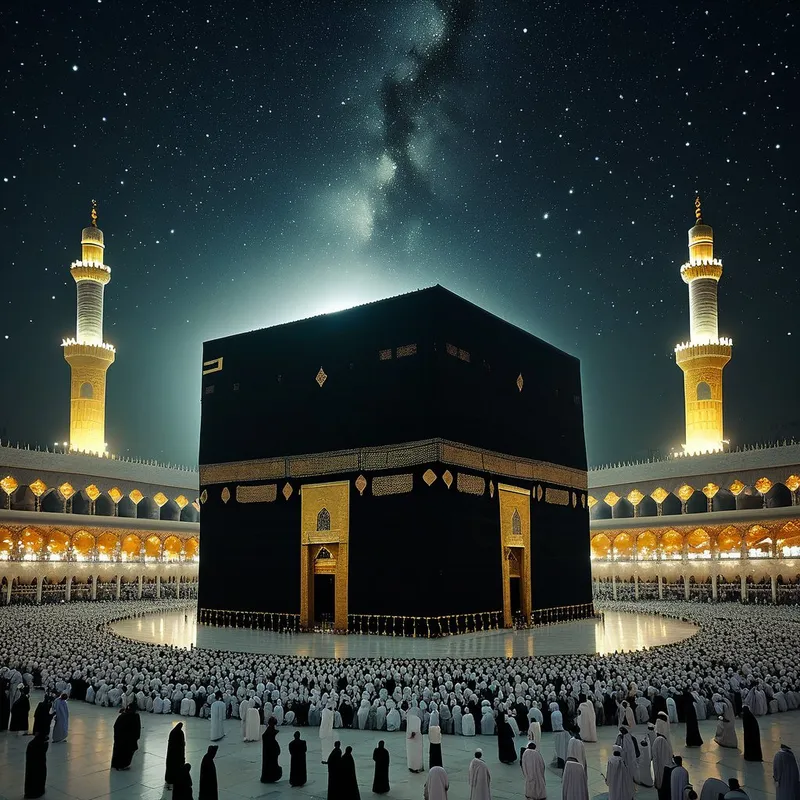
Black Stone of Mecca Myth Meaning & Symbolism
A celestial stone, fallen from heaven, becomes the sacred axis of devotion, embodying divine covenant, human fallibility, and the promise of ultimate purification.
The Tale of Black Stone of Mecca
Listen, and let the veils of time grow thin. In the age before ages, when the world was a whisper still forming on the lips of the Divine, the heavens wept a single, perfect tear. It was not of water, but of condensed light and primordial covenant, a fragment of the right hand of the Allah. This tear fell through the vault of stars, cooling as it descended, its brilliance dimming to a profound, absorbing black—the color of the void that holds all potential. It struck the barren valley of Mecca, not with a crash, but with a resonant thrum that silenced the winds.
The stone waited, an anchor. Eons passed. Then came Ibrahim, the Friend of God, driven by a command to build a house for the One. With his son Isma'il, they raised the foundations of the Kaaba. But a house for the Infinite cannot be sealed by mortal hands alone. An angel, Jibril, brought the Black Stone to Ibrahim, its surface still humming with the memory of paradise. With reverence, they set it into the eastern corner, the cornerstone of the earthly axis touching the divine.
But the world is a place of forgetting. The stone, touched by countless hands seeking and straying, absorbed the grime of human transgression. It darkened further, a testament not to its own nature, but to the nature of those who came to it—a mirror of the soul's journey from purity, through the dust of existence, toward a hoped-for return. It witnessed idolatry, was kissed and revered, was stolen and shattered, its pieces bound together in a band of silver—a scar of fracture and repair held in a loving embrace.
And it is said, in a whisper that runs deeper than history, that on the Last Day, when the scales are set and the scrolls unrolled, the Stone will speak. It will bear witness with eyes of stone, testifying for every soul that ever approached it in sincerity. Then, it will be returned, its blackness burned away in the furnace of ultimate truth, and it will shine again with the blinding, white radiance of its first dawn.
Cultural Origins & Context
The narrative of the Hajar al-Aswad is woven from threads of pre-Islamic Arabian tradition, Hadith literature, and Islamic eschatology. It exists not as a single, codified "myth" from one source, but as a living constellation of stories, theological commentaries, and pilgrim lore that has evolved over millennia.
In the pre-Islamic Jahiliyyah, the stone was likely a revered betyl, a focal point of tribal veneration. With the advent of Islam, its story was recalibrated within a monotheistic framework, linking it directly to the prophets Ibrahim and Muhammad. The latter, in a pivotal moment, is said to have used the Stone to peacefully resolve a dispute among Meccan clans about who should have the honor of placing it, demonstrating wisdom over force.
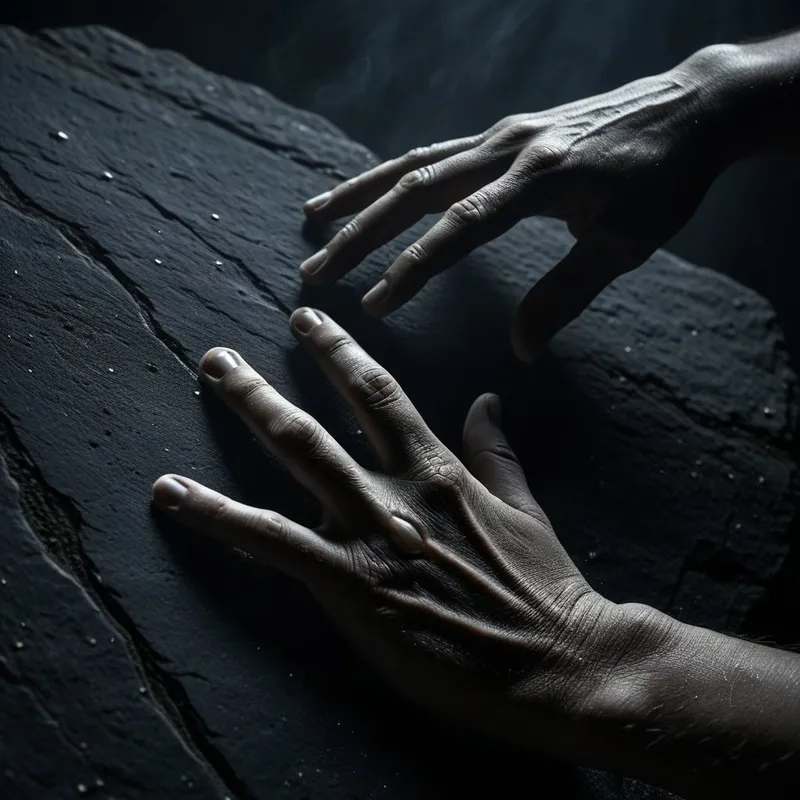
Its societal function is multifaceted. For the individual pilgrim, touching or kissing the Stone during the Hajj or Umrah is a profound physical connection to a sacred lineage. Culturally, it serves as the literal and symbolic starting point for the Tawaf, the act of orbiting the divine center. It is a tactile anchor in a spiritual practice, a point of contact between the human and the transcendent, passed down through generations not just in story, but in embodied ritual.
Symbolic Architecture
The Black Stone is a master symbol of paradoxical unity. It is a axis mundi, the still point around which the cosmos of devotion turns. Its blackness is not an absence, but a profound absorption—it receives all light, all intention, all sin, and reflects nothing back but the seeker's own state.
It is the divine fingerprint on the clay of the world, the enduring mark of a covenant that precedes human failure.
Psychologically, it represents the Self in the Jungian sense—the central, archetypal core of the personality that is often obscure, mysterious, and "black" to the conscious ego. It is whole yet visibly fractured, held together by a "band" of consciousness (the silver casing). We circle it (individuation) but can never fully possess or comprehend it. It is both perfect (of celestial origin) and imperfect (stained, broken), mirroring the human condition: a divine spark encased in the earthly, fractured yet striving for wholeness.
The Dreamer's Resonance
When the Black Stone appears in a modern dream, detached from its religious context, it signals a profound encounter with the dreamer's inner Self. The somatic experience is often one of magnetic pull—a deep, gravitational longing to touch or connect with something foundational.
To dream of searching for the Stone indicates a quest for meaning, for an authentic center in a life that feels fragmented. To dream of touching it may coincide with a moment of deep self-acceptance or a spiritual awakening. Conversely, to dream of it being dirty, unreachable, or crumbling may reflect feelings of spiritual alienation, guilt, or the fear that one's core has been irreparably stained by life's experiences. The silver band binding it is crucial; it speaks to the dreamer's capacity for self-compassion and the conscious effort required to hold one's fractured psyche together. This dream symbol asks: What is the unshakeable, ancient center around which your life orbits? What stains do you fear are upon it, and what love (the silver) holds you intact?

Alchemical Translation
The myth of the Black Stone is a perfect map for the alchemical process of psychic transmutation. The journey begins with the Nigredo—the blackening. This is not the stone's original state, but the state it acquires through contact with the world. Psychologically, this is the necessary descent into the shadow, the acknowledgment of one's flaws, traumas, and "sins." We must recognize the stain upon our own inner stone.
The Albedo, the whitening, is foreshadowed in the eschatological promise of the Stone's return to radiant purity. This is the cleansing that follows honest confrontation. But the critical, ongoing stage is the Contunctio—the sacred marriage symbolized by the stone itself. It is the union of opposites: heaven and earth (celestial origin/earthly location), black and white (stained/pure), fracture and unity (broken pieces/silver band).
The work is not to become the unblemished white stone, but to become the whole black stone—to integrate the stain into the sacred narrative of the self.
For the modern individual, the "Tawaf" is the daily practice of circling this inner center—through meditation, reflection, creative work, or relationship—without expecting to possess it. The silver band is the loving awareness we must consciously apply to our broken parts. The triumph is not a final, static purity, but the enduring capacity to be a vessel—black, absorbing, fractured yet held—for a meaning that transcends the self. We are called to build our Kaaba around this mysterious core, and in orbiting it sincerely, we are, piece by fractured piece, made whole.
Associated Symbols
Explore related symbols from the CaleaDream lexicon: