
Bishops' Rings Myth Meaning & Symbolism
A myth of a bishop whose sacred rings, forged from divine light, are stolen, plunging the world into spiritual silence until a perilous journey restores them.
The Tale of Bishops' Rings
Listen, and hear the tale whispered in the vaults of forgotten cathedrals, a story not of parchment, but of light and silence.
In the First Age, when the world was young and the voice of the divine was a clear song in the wind, the first Bishop was given a sacred charge. Not of land or law, but of resonance. From the heart of the celestial forge, where God’s will becomes substance, seven rings were drawn. They were not of metal, but of solidified light, each a perfect, humming circle of a different hue—the colors of dawn, of deep wine, of forest moss, of clear sky, of ripe wheat, of twilight, and of the pure, unseen light behind the stars. These were the Bishops' Rings.
To the Bishop, they were bestowed upon his hands. His task was not to wear them as adornment, but to hold them in perpetual, prayerful orbit. As he chanted the hours, the rings would turn slowly above his palms, and their resonant frequencies wove the invisible Order of the world. They tuned the Circle of the seasons, harmonized the growth of the Tree, calmed the fury of the Ocean, and made the Moon’s pull a gentle tide in the human soul. The world thrived in this sacred symphony. Prayers were felt as warmth, virtue had a scent like rain-washed earth, and despair could be lifted like a minor chord resolved.
But a Shadow grew in the symmetry. It was not a demon of fire, but a spirit of perfect, deafening silence—a being born from the first moment a human heart praised itself instead of the source. This entity, The Stillness, coveted the rings. Not for power, but for cessation. It longed to swallow the fundamental song.
One long night, during the Ritual of the deepest watch, The Stillness flowed into the sanctuary not as a form, but as an absence of sound. The Bishop, weary from centuries of vigil, faltered. His prayer hitched for a single breath. In that instant of human frailty, the rings flickered. The Stillness struck, not with force, but with a vacuum of intent. It did not steal the light; it inverted it. The rings were pulled from their sacred orbit and swallowed into a silence so profound it was a Cave in the world’s soul.
The consequence was not an explosion, but a great forgetting. The seasons stuttered. The connection between Father sky and Earth grew thin. Prayers fell like stones. The human spirit felt a cold, hollow ache where resonance once lived—a spiritual Wound. The Bishop stood in the suddenly dark sanctuary, his hands empty, bearing the weight of the world’s silence.
His Journey to restore them was the path of a ghost walking through a muted world. He followed the fading echo of his own last prayer into the wilderness, into the hearts of mountains where echoes go to die, and across seas that had forgotten how to sing. He confronted The Stillness not with a sword, but with a vulnerability so complete it became a weapon. He offered not a demand, but his own lifelong silence—the sacrifice of his voice, the very instrument of his office—to fill the vacuum. In that exchange of one silence for another, the inverted light could not be held. The rings, tarnished and dim, were expelled.
But they were broken, their song scattered. The Bishop, now voiceless, collected the fragments. He did not return to his cathedral. Instead, he went to the crossroads of the world, to the humblest Temple—a simple hearth. And there, with hands that had held cosmic light, he performed the simplest act: he tended the Fire. He baked bread. He bound the Seed. In these acts of grounded Caregiver, the fragments of the rings absorbed the raw, unspoken love of service. Slowly, over a lifetime of mundane Sacrifice, they regrew their light. Not upon his hands, but within the world itself. The song returned, not as a cathedral’s roar, but as the hearth’s crackle, the River’s flow, the honest word between friends. The rings were restored, but their locus had shifted from one man’s hands to the heart of all compassionate action.
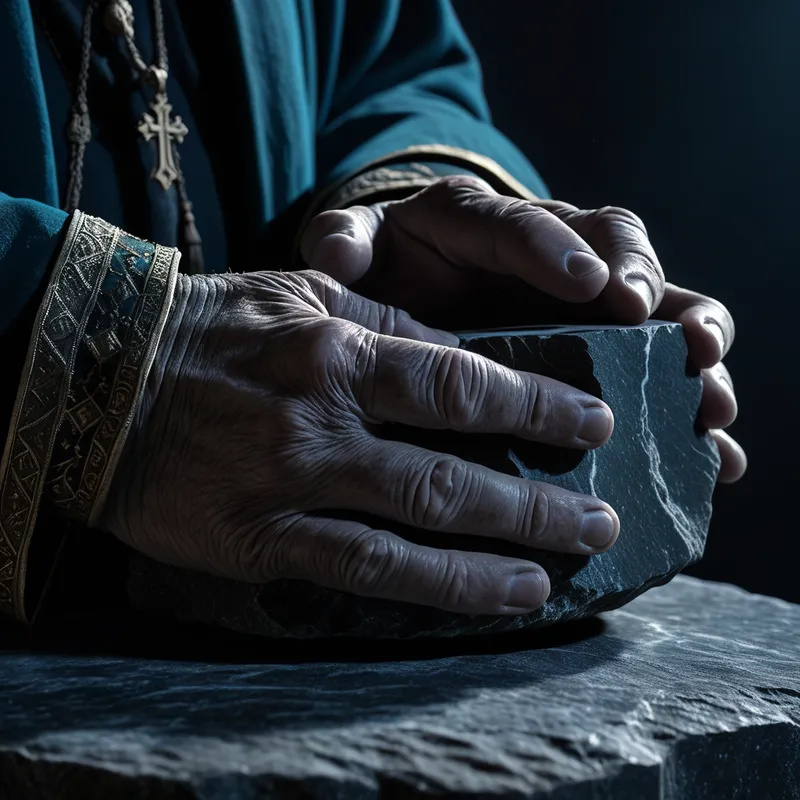
Cultural Origins & Context
The myth of the Bishops' Rings finds its roots not in official dogma, but in the folk imagination of late medieval and early modern Christian communities, particularly in regions where the institutional Church's authority was both revered and felt as a distant, cosmic mechanism. It was a story told by monks in scriptoriums during the long nights, by traveling friars at crossroads, and by grandmothers spinning tales by the fire. Its function was dual.
Firstly, it served as an etiological myth for spiritual dryness—those periods of profound doubt or emotional numbness known as "acedia" or the "dark night of the soul." When prayers felt empty and God seemed silent, the tale provided a narrative: the Rings were dimmed, the Song was faint, but not gone. It framed spiritual despair not as a personal failure, but as a cosmic event requiring patient, faithful action.
Secondly, it subtly critiqued and humanized ecclesiastical power. The Bishop, though a figure of immense spiritual authority, is brought low by a moment of very human weariness. His redemption comes not through reclaiming his lofty throne, but through embracing humble, earthly service. This reflected a deep popular theology that located the divine presence not solely in sacraments administered by princes of the church, but in the daily acts of charity and integrity—the true "keeping of the rings."
Symbolic Architecture
The myth’s power lies in its rich tapestry of symbols. The Bishops' Rings themselves represent the animating principle, the logos or divine harmony that structures reality and connects the human psyche to the transpersonal. They are the psychic energy that makes meaning possible.
The rings are not jewels of authority, but living organs of connection; their theft is not the loss of power, but the amputation of soul.
The Bishop embodies the Caregiver archetype in its most profound sense: the steward of the world-soul. His initial vigil represents the ego’s role in maintaining conscious order. His failure is the inevitable exhaustion of the conscious mind trying to sustain a connection to the Self through effort alone. The Stillness is the Shadow aspect of the divine—not evil, but the terrifying potential for meaninglessness, the vacuum that exists when relationship ceases.
The restoration Journey maps the path of individuation. He must descend into the world (the unconscious) and reclaim the lost fragments (complexes, lost potential) not by force, but by offering up his primary identity—his voice, his official power. This is the sacrifice of the inflated ego. The final restoration through humble service signifies that the Self, the central ordering principle, is ultimately integrated not through grandiosity, but through relatedness to the simple, concrete reality of life.

The Dreamer's Resonance
When this myth stirs in the modern Dream, it often manifests as dreams of losing something vital and intangible: the ability to speak, the fading of colors from the world, or the malfunction of a crucial, beautiful machine that once kept everything in harmony. The dreamer may find themselves in a position of responsibility where their inner "tools" feel inert.
Somatically, this can correlate with feelings of burnout, depression, or creative block—a sense that one’s inner compass is spinning. Psychologically, the dream signals that the connection between the conscious personality and the nourishing depths of the unconscious (the divine song) has been compromised. The dream-ego, like the Bishop, is being called to acknowledge its weariness and its shadow. The theft of the rings in the dream is not an external catastrophe, but an internal revelation: the psyche has allowed its vital connection to be "swallowed by stillness," often through over-identification with a role, neglect of the inner life, or unprocessed grief.

Alchemical Translation
The alchemical process mirrored here is the opus contra naturam—the work against one’s current nature. The initial state is the unio mentalis, a spiritualized consciousness (the Bishop in his vigil) disconnected from the body of the world. The "theft" is the necessary nigredo, the blackening, the descent into chaos and despair where all previous light fails.
The silence that swallows the light is the prima materia, the dark, fertile ground from which the true, more resilient gold must be grown.
The Bishop’s journey is the separatio and mortificatio—separating from his old identity (his voice) and allowing it to die. His humble service is the solutio—dissolution into the waters of common life. Baking bread and tending fire are the slow, patient processes of coagulatio—giving new, solid form to the spirit. The final, decentralized restoration of the rings represents the achievement of the lapis philosophorum, the philosopher's stone. Here, the stone is not an object, but a condition: a psyche where the divine order (the rings) is no longer projected onto an external authority figure or a perfect ritual, but is discovered as the innate, resonant structure of a life lived with integrity and compassionate action in the world. The Self is realized as immanent within the fabric of daily existence.
Associated Symbols
Explore related symbols from the CaleaDream lexicon:
- Ring — The central symbol of wholeness, sacred covenant, and eternal return; its loss represents a rupture in the psyche's connection to the Self.
- Circle — The geometric essence of the rings, representing cosmic order, cyclical time, and the mandala of the psyche seeking equilibrium.
- Shadow — Embodied by The Stillness, it represents the repressed potential for meaninglessness that must be confronted to reclaim lost vitality.
- Sacrifice — The Bishop's offering of his voice, modeling the necessary surrender of the ego's prized identity to heal a greater rupture.
- Journey — The archetypal path of descent and return, mapping the process of confronting loss in the unconscious and integrating its lessons.
- Wound — The spiritual and psychic emptiness created by the rings' theft, the felt experience of disconnection that initiates the healing quest.
- Order — The divine harmony maintained by the rings' song, symbolizing the innate, often unseen structure that makes coherent experience possible.
- Healing — The slow, humble process of restoration through grounded action, representing the integration of spirit and matter, psyche and world.
- Temple — Transformed from a grand cathedral to a simple hearth, representing the shift of the sacred locus from external institution to the inner sanctum of heartfelt action.
- Caregiver — The archetype embodied by the Bishop, ultimately defined not by solemn duty but by nurturing service as the true medium for spiritual power.
- Light — The substance of the rings, representing consciousness, divine presence, and the illuminating energy of the Self that can be dimmed but not extinguished.
- Ritual — The initial, formalized prayer that fails, then transforms into the informal, lived ritual of daily service as the true sustaining practice.
- Amethyst Crystal