Bima's Journey to the Underworld Myth Meaning & Symbolism
The Pandawa warrior Bima descends into the underworld to find his divine father, facing cosmic guardians and his own nature to achieve ultimate truth.
The Tale of Bima's Journey to the Underworld
Listen, and let the shadow-play of the world unfold. In the time when gods walked with men and the great epic of the Mahabharata was etched upon the soul of Java, there lived Bima. He was the second of the Pandawa, a warrior of raw, earth-shaking power, son of the wind god Bayu. Yet, for all his strength, a hollow echo resided in his heart—a question of origin, a longing for the true face of the father he knew only as a divine whisper.
His spiritual guide, the mighty sage Drona, saw this yearning. He did not offer comfort, but a direction: "Go to the southern ocean. Seek the meeting of sea and shore at the hour when the world holds its breath. There, you will find the path to your answer." Bima, with the unwavering resolve of a force of nature, journeyed to the wild coast. As the sun drowned in the western waves, he saw it—a colossal, gnarled Beringin tree, its roots plunging into the black waters, its branches clawing at the twilight sky. At its base, a fissure in the world, a mouth exhaling a chill that had never known the sun. This was the gateway to Saptapratala.
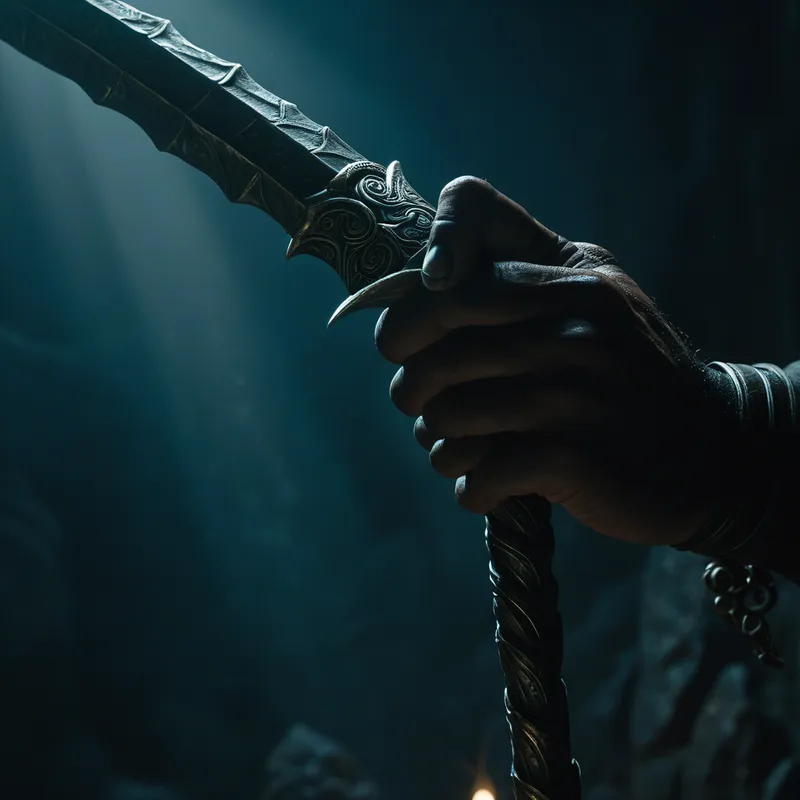
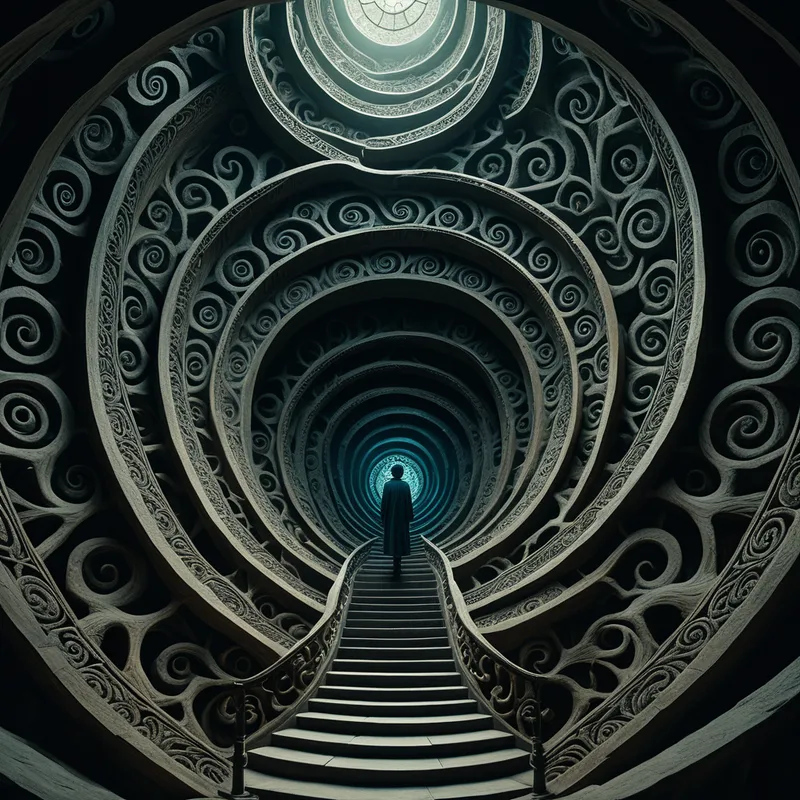
Without hesitation, Bima descended. The air grew thick and tasted of ancient stone and damp earth. He passed through seven realms, each a trial of essence. In the first, monstrous serpents coiled, hissing promises of a swift, poisoned death. Bima’s club, the Pancanaka, swung not in rage, but as a gardener clears obstructive weeds. Deeper he went, to where lakes of fire bubbled, their heat promising to melt bone and ambition alike. He waded through, his spirit cooling the flames around his steadfast form. He encountered illusions—palaces of gold, seductive apsaras, the mocking ghosts of past failures. He walked through them as a man walks through mist.
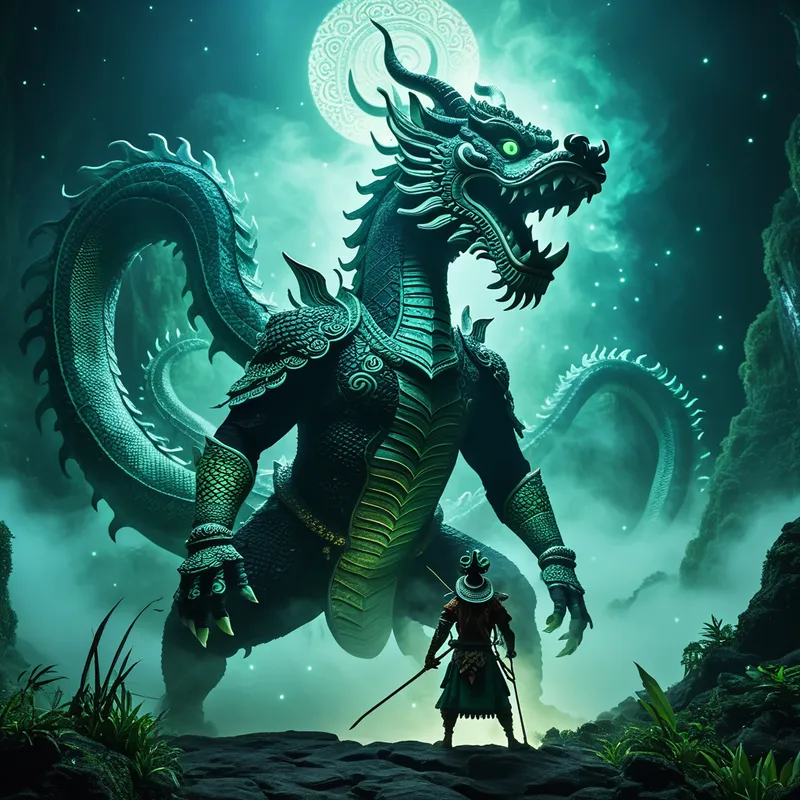
At the deepest nadir, in the seventh and final realm, the guardian awaited. Not a demon of mindless fury, but Nagabanda, a dragon of cosmic scale and ancient wisdom, its scales like polished obsidian, its eyes holding the cold light of dead stars. It did not attack, but posed a question that echoed in the marrow: "Why do you seek what you already are?" A battle ensued, but it was not of mere flesh and club. It was a battle of recognition. With a final, earth-cleaving blow, Bima struck not to kill, but to unveil. The form of Nagabanda shimmered, dissolved, and from its essence emerged the radiant, serene form of Sang Hyang Wenang.
The god spoke, his voice the sound of the wind in the high places. "You have journeyed not to a place, but through your own nature. You have faced the serpent of your primal power, the fire of your passion, the illusions of your desire. I am not separate from you, my son. I am the breath in your lungs, the resolve in your heart. You are Satria who has looked into the abyss and found it was his own reflection." In that moment of supreme realization, Bima was not given a weapon or a secret. He was given understanding. He ascended from the underworld not as a conqueror, but as a whole being, the journey inward complete.
Cultural Origins & Context
This myth is a distinctly Javanese elaboration, a deep cultural refraction of the broader Indian epic. It is rooted in the rich soil of Kejawen philosophy. The story was not merely read but performed, most famously in the sacred shadow theatre of wayang kulit. The dalang was not just an entertainer but a mystic, channeling this narrative over long nights, his voice and the flickering shadows against the cotton screen serving as a vehicle for communal instruction and spiritual contemplation.
The societal function was multifaceted. On one level, it reinforced the ideal of the ksatria—the warrior who pursues not just external victory but inner truth (sejati). On a deeper, esoteric level, it mapped the microcosm of the human being onto the macrocosm of the universe. The seven layers of Saptapratala correspond to the seven lower chakras or centers of energy within the body, with the final confrontation at the base, the seat of primal kundalini energy. The myth served as an allegorical guide for ascetics and seekers undertaking the rigorous path of tarekat, aiming to achieve unity with the divine (manunggaling kawula Gusti).
Symbolic Architecture
The journey is the ultimate map of the descent into the shadow. Bima represents the conscious ego, strong but incomplete, driven by a legitimate yearning for origin and meaning—the quest for the Father. The underworld is not a place of punishment, but the vast, uncharted territory of the personal and collective unconscious.
The hero does not go to slay a monster, but to meet the part of himself he has named 'monster,' and in that meeting, discover its divine provenance.
Each layer is a symbolic layer of the self: the serpents of base instinct and fear; the fires of uncontrolled passion and transformative potential; the illusions of the personal complex (gold, seduction, shame). Nagabanda, the dragon guardian, is the ultimate symbol of the coiled, latent power at the root of being—often feared, often projected as a monstrous "other." Its transformation into Sang Hyang Wenang reveals the alchemical secret: what we perceive as a terrifying obstacle to our growth is often the very shape of our untapped wholeness, guarding the treasure until we are ready to recognize it as our own.

The Dreamer's Resonance
When this myth stirs in the modern psyche, it manifests in dreams of profound descent. One may dream of finding a hidden basement in their childhood home that descends into impossible caverns, of being in an elevator that plummets through the floors of a familiar building into geological strata, or of navigating a dark, labyrinthine forest at night. The somatic experience is one of weight, pressure, and a chilling awe. There is often a guide—a voice, an animal, a deceased relative—or a palpable sense of being sent.
Psychologically, this signals a non-negotiable call from the Self. The conscious personality is being compelled to confront repressed material—old griefs, buried rages, primal fears, or a deep sense of spiritual alienation (the orphaned feeling Bima embodies). The dreamer is not being punished; they are being prepared. The terrifying figures encountered are the dream-ego's initial, symbolic perception of these unconscious contents. The process is one of initiation by ordeal, where the very fabric of one's identity is pressured to make room for what has been excluded.
Alchemical Translation
The myth models the Jungian process of individuation with stunning clarity. The first stage is the nigredo—the descent, the confrontation with the shadow in the blackness of Saptapratala. Bima's unwavering resolve is the crucial ego-strength needed to endure this dissolution without fragmenting. The battles are the separatio, consciously differentiating from and engaging with autonomous complexes (the serpents, the fires) rather than being unconsciously identified with or overwhelmed by them.
The climax with Nagabanda is the coniunctio, the sacred marriage of opposites. The conscious warrior (ego) faces the unconscious, instinctual power (shadow/dragon). The "defeat" of the dragon is not an act of violence, but an act of recognition and integration. This is the albedo, the whitening, where what was dark is revealed in its true, luminous nature.
The treasure hard to attain is not a jewel in a cave, but the realization that the cave, the dragon, and the seeker are all manifestations of the same singular, sacred reality.
Bima's return represents the rubedo, the reddening or embodiment of the achieved wholeness. He returns to the upper world bearing no physical trophy, but a transformed consciousness. He has internalized the Father principle, moving from a state of seeking authority externally to embodying authentic, self-realized power (wahyu). For the modern individual, this translates to the movement from living out of borrowed identities and unresolved parental complexes toward becoming the author of one's own meaning, grounded in the terrifying and glorious truth of one's complete self.
Associated Symbols
Explore related symbols from the CaleaDream lexicon:
- Underworld — The realm of Saptapratala represents the totality of the unconscious, the necessary descent into darkness where latent aspects of the self are guarded and await integration.
- Journey — Bima's vertical descent is the archetypal journey inward, a movement away from the known world of daylight consciousness into the mysterious depths of the psyche.
- Serpent — Appearing as both minor obstacles and the great dragon Nagabanda, the serpent symbolizes primal, coiled energy—kundalini, instinct, and the transformative power that is terrifying until consciously faced.
- Fire — The lakes of fire in the underworld represent the alchemical element of transformation, the painful but necessary process of burning away illusion and refining the base elements of the personality.
- Father — The divine father Bayu/Sang Hyang Wenang is the archetypal goal of the quest, symbolizing the seeker's origin, spiritual authority, and the logos principle that must be internalized.
- Cave — The entrance under the Beringin tree is the cave-mouth to the unconscious, a natural aperture leading from the surface world into the subterranean realms of mystery.
- Shadow — The entire underworld and its inhabitants collectively represent the psychological shadow, the repository of everything the conscious self has rejected, feared, or ignored.
- Hero — Bima embodies the hero archetype not in his external battles, but in his willingness to undertake the perilous inward journey for the sake of ultimate truth and wholeness.
- Dragon — Nagabanda is the dragon as guardian of treasure, symbolizing the immense, often frightening power of the deep unconscious that protects the core of the Self until the ego is ready.
- Rebirth — Bima's emergence from the underworld, having met his father, signifies a spiritual rebirth; the old, questing identity dies, and a new, realized being is born.
- Tree — The great Beringin at the ocean's edge is the world axis, connecting the heavens, earth, and underworld, and marking the sacred threshold between worlds of consciousness.