Billy Goats Gruff Myth Meaning & Symbolism
Three brothers must cross a troll-guarded bridge. The smallest goes first, promising a larger sibling, until the largest confronts and defeats the guardian, securing passage for all.
The Tale of Billy Goats Gruff
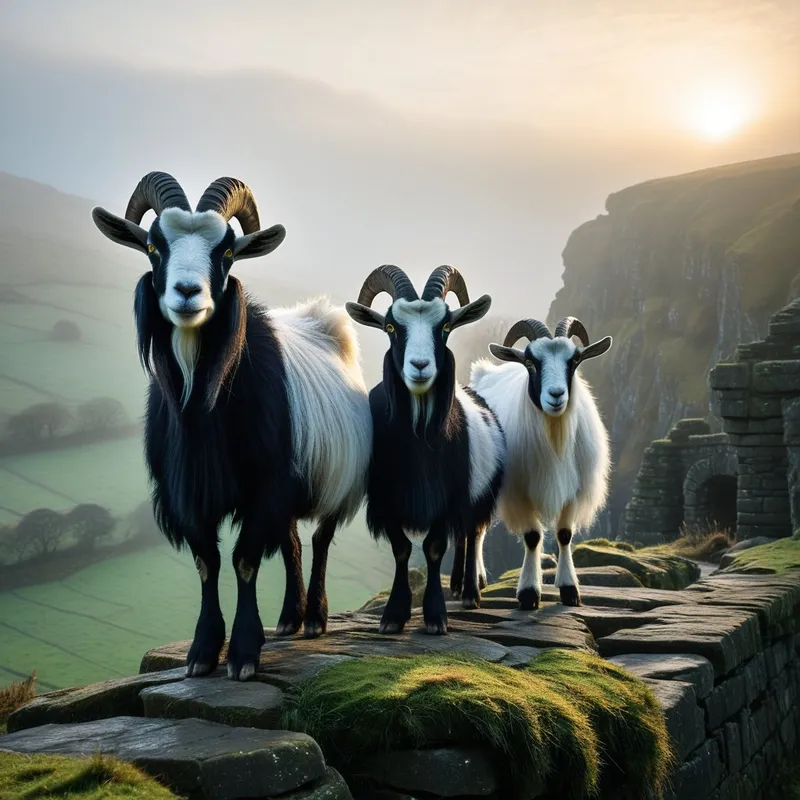
Listen, and hear a tale of hunger, wit, and the thing that dwells in the dark places. Once, on the high, wind-scoured moors where the grass grows sweet but scarce, there lived three brothers. They were billy goats, and they shared a single name: Gruff. There was the Little Billy Goat Gruff, who was all nimble bone and bright eye. There was the Middle Billy Goat Gruff, sturdy and strong. And there was the Great Big Billy Goat Gruff, a creature of thunderous step and horns like ancient, polished yew, a king in all but crown.
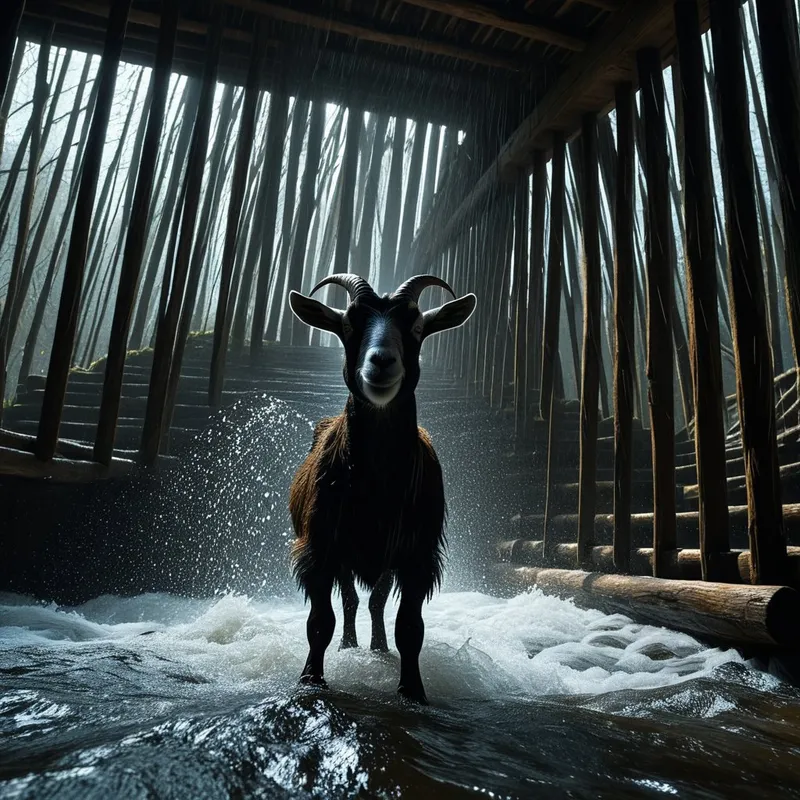
Their field was grazed to dust. Their bellies spoke with the voice of the hollow wind. But across a deep, cutting ravine, where a river sang a cold, swift song, they could see a hillside cloaked in emerald, a feast untouched. The only path was a bridge—an old, wooden bridge that creaked and groaned with the memory of countless crossings. But this bridge had a keeper, a toll-man of the most terrible kind. For in the damp and dripping shadows beneath its planks lived a troll, a creature of stone-grey flesh and eyes like burning coals, whose appetite was as vast as the ravine was deep. The law of the bridge was his law: "Who trips over my bridge?" he would roar. And the price of passage was a life.
The Little one, driven by hunger greater than fear, stepped onto the groaning wood. Trip, trap, trip, trap went his tiny hooves. At once, the world beneath the bridge erupted. "WHO'S THAT TRIPPING OVER MY BRIDGE?" bellowed a voice that seemed to rise from the riverbed itself.
The Little Billy Goat Gruff stopped, his heart a trapped bird. But a spark of cunning, older than fear, lit within him. "It is only I, the tiniest Billy Goat Gruff," he called, his voice thin but clear. "I'm going to the hillside to make myself fat."
"NO, I'M COMING TO GOBBLE YOU UP!" roared the troll.
"Oh, no! Do not eat me," pleaded the little one. "Wait for my brother, the Middle Billy Goat Gruff. He is much bigger than I!"
The troll grumbled, a sound like grinding stones. "Very well. Be off with you!" And the little goat, his trip-trapping now a frantic patter, scurried to the far side and the sweet, waiting grass.
Soon came the TRIP, TRAP, TRIP, TRAP of the Middle brother. Again, the shadow stirred. "WHO'S THAT TRIPPING OVER MY BRIDGE?"
"It is I, the Middle Billy Goat Gruff," he said, his voice firm. "I go to the hillside to make myself fat."
"NO, I'M COMING TO GOBBLE YOU UP!"
"Wait," said the Middle, his mind working swiftly. "Wait for my brother, the Great Big Billy Goat Gruff. He is far bigger still, a feast worthy of you!"
The troll, greedy and dull-witted, agreed. "Bah! Be off!" And the second goat crossed.
Then came a sound not of tripping or trapping, but of a deep, resonant THUD, THUMP, THUD, THUMP. The very bridge timbers bowed. It was the Great Big Billy Goat Gruff. He did not ask permission of the world; he announced his presence with his weight.
"WHO'S THAT TRAMPLING OVER MY BRIDGE?" The troll's roar was tinged with something new—not just anger, but a tremor of doubt.
The Great Big Billy Goat Gruff did not plead. He did not bargain. His voice rolled like summer thunder. "IT IS I! THE GREAT BIG BILLY GOAT GRUFF!"
"WELL, I'M COMING TO GOBBLE YOU UP!" screamed the troll, erupting from his gloom in a shower of rotten wood and river spray. He was huge, ugly, and terrible.
But the Great Big Goat lowered his head. Those horns, the colour of storm-aged wood, caught the pale moorland light. He did not run. He charged. With a force that shook the hills, he met the troll. He butted him, he battered him, he broke him upon his horns. With a final, shrieking wail, the troll was flung into the raging river below and swept away, forever.
And so, the bridge was clear. The Great Big Billy Goat Gruff joined his brothers on the lush, green hillside. There they grew so fat, so very fat, that they could hardly walk home. And if the bridge has not broken, they are there still, feasting in the sun, masters of their own crossing.
Cultural Origins & Context
This tale, so crisp and potent, is not native to England's soil in its deepest roots. It is a migrant, carried across the North Sea from the fjords and forests of Norse folklore. Collected by Peter Christen Asbjørnsen and Jørgen Moe in Norway, it was translated and adopted into the English-speaking canon, becoming a nursery staple. Its transmission is oral, folkloric—the stuff of hearthside telling, not temple inscription. It was told by parents and nannies, a story to thrill and slightly frighten children before bed. Its societal function was multifaceted: a simple lesson in bravery and cleverness, yes, but also a narrative inoculation. It taught that the world contains real, hungry dangers (the troll under the bridge), but that these dangers can be outwitted and, when one is strong enough, directly overcome. It models a progression of resourcefulness, preparing the young listener for the incremental challenges of growing up.
Symbolic Architecture
The myth’s power lies in its stark, almost algorithmic symbolism. It is a map of psychic confrontation and developmental stages.
The three goats are not three separate creatures, but one spirit in three stages of potency: the potential, the developing, and the actualized. They represent a single consciousness growing in capacity. The barren hillside is the exhausted current state of being; the lush pasture is the promise of psychological nourishment, the next stage of life, the Self awaiting realization.
The bridge is the threshold itself, the liminal space where one state of being is abandoned for another. All transformation requires crossing such a bridge.
But the threshold is never unguarded. The troll is the perfect embodiment of the Shadow that guards the treasure. He is the psychic toll-keeper, the embodiment of fear, inertia, regression, and the terror of the new. He dwells beneath the structure of consciousness (the bridge), in the chaotic, watery realm of the unconscious, demanding a sacrifice—a retreat back to a smaller, safer version of the self.
The strategy of the first two goats is not cowardice, but profound wisdom. They employ metis—cunning intelligence. They acknowledge the shadow's power ("you could eat me") but redirect its appetite toward a future, greater version of the self. This is the psychology of delay, of strategic retreat, of buying time for strength to gather. The final confrontation is inevitable. The Great Big Goat, the integrated ego fortified by the lessons of his brothers, does not negotiate. He embodies the full, assertive force of consciousness. His horns—symbols of penetrating insight, defense, and virile power—meet the shadow head-on and disperse it.
The Dreamer's Resonance
When this myth stirs in the modern dreamer, it signals a psyche at a threshold. To dream of a guarded bridge is to know, unconsciously, that a significant transition is at hand—a career change, the end of a relationship, a commitment that feels perilous.
Dreaming of being the small goat, facing a monstrous presence, captures the somatic reality of anxiety: the feeling of being insubstantial, of having only clever words as a defense. The troll’s roar is the gut-churn of dread. Dreaming as the middle goat reflects a growing inner resourcefulness, a testing of one's bargaining power with fate or fear.
To dream as the great goat, or to witness the final confrontation, often coincides with a moment of decisive action in waking life. The dream body feels powerful, grounded, immense. The act of butting or pushing the shadow-figure into water symbolizes the conscious integration and dissolution of a complex; the unconscious (water) reclaims the raw, unintegrated fear, allowing the ego passage.
Alchemical Translation
The process of the Three Billy Goats Gruff is a perfect allegory for psychic individuation. The alchemical work is one of sequential transmutation, moving from nigredo (the blackening, barren hillside) to albedo (the white, clarified victory).
First, the recognitio: the conscious mind (the goats) recognizes its state of lack and desires the prima materia (the green hill) of the unlived life. The bridge-crossing is the separatio—the decision to leave the known.
The troll represents the caput mortuum, the dead head or worthless residue that must be violently separated from the valuable substance during alchemical transformation.
The first two crossings are stages of solutio (dissolution in the waters of the unconscious, facing fear) and coagulatio (re-forming with a new strategy). The little goat’s cunning is the first flicker of the guiding lumen naturae, the light of nature. Each successful parley strengthens the psychic substance.
The final confrontation is the coniunctio, the sacred marriage of conscious will (the goat) and the transformed shadow energy (the defeated troll). It is not annihilation, but integration through overcoming. The troll’s energy, once a blocking guard, is transmuted. Its force is added to the goat’s, which is why the great goat becomes "so very fat"—he has incorporated the power that once opposed him.
The green hillside where they feast is the rubedo, the reddening, the achievement of the philosophical goal: a Self that is whole, nourished, and master of its own thresholds. The myth teaches that we do not cross our bridges alone. We are preceded by our smaller, cleverer selves, and we cross for the sake of the larger self we are destined to become.
Associated Symbols
Explore related symbols from the CaleaDream lexicon: