
Bento Myth Meaning & Symbolism
A myth of a humble farmer who, through devotion and sacrifice, transforms simple ingredients into a sacred offering, embodying the soul of Japanese culture.
The Tale of Bento
Listen, and hear the tale that is not written in scrolls, but tasted on the tongue and felt in the quiet space between heartbeats. In a time when the mountains were young gods and the rivers sang with the voices of kami, there lived a farmer named Takumi. His land was small, his back bent from dawn till dusk, and his harvests were just enough. Yet, in his chest beat a heart attuned to a deeper rhythm—the rhythm of engi, the sacred interdependence of all life.
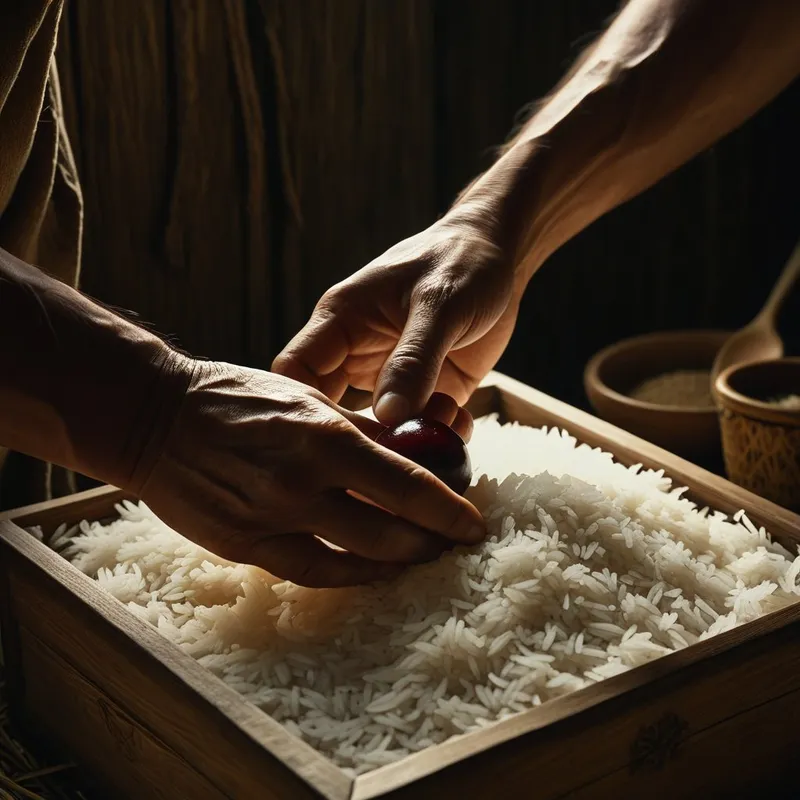
Each day, before the first light brushed the rice paddies, Takumi would perform a silent ritual. He would take a portion of his precious rice, the sweat of his brow made edible. He would add a few strands of wild greens foraged from the forest's edge, a gift from the mountain kami. A sliver of fish, caught from the stream with a prayer of thanks. A single, crimson pickled plum, like a captured sunset, to ward off spirits of decay. These were not mere scraps. In his hands, they became offerings.
He arranged them with a care that bordered on reverence in a simple, lacquered box. The white rice became a miniature mountain. The green vegetables, a forest. The fish, a river creature at rest. The plum, the heart of the world. He did not eat it himself. Instead, he would place this box at the small shrine for Inari, the kami of the harvest, and later, he began leaving them anonymously for his weary neighbors, for traveling monks, for anyone whose spirit seemed as parched as the summer soil.
The conflict was not a dragon to slay, but a creeping blight of the soul—a great forgetting. The village grew prosperous, but its people grew hurried, eating without seeing, consuming without gratitude. The connection to the land, to the labor, to the kami in all things, grew thin. Takumi watched this, and his heart ached. His daily offering became an act of quiet rebellion, a stubborn remembering.
One year, a terrible drought came. The rivers shrank. The rice stalks withered. Despair, cold and heavy, settled over the village. In their hunger, people hoarded what little they had, their eyes growing hard. On the day the last spring seemed to fail, Takumi went to his field. There was nothing. He returned to his hut, empty-handed. Yet, the ritual called to him. From the very bottom of his storage jar, he scraped the last few grains of rice. He found a single, wilted leaf. He had nothing else. With a profound sigh that was both surrender and prayer, he placed these meager remnants into his box—a mountain of dust, a forest of a single leaf.
He carried this, his most pitiful and most sincere offering, to the village shrine. As he opened the box under the withering sun, a miracle of subtlety occurred. The last grain of rice caught the light, gleaming like a pearl. The wilted leaf seemed to tremble with a remembered green. And in that moment of absolute humility and devotion, the kami Inari heard not the offering of food, but the offering of attention, of care, of sacrificial harmony. A gentle rain began to fall, not a storm, but a soft weeping of the heavens. And the people, drawn by the scent of rain and something else—the scent of a truth long forgotten—saw Takumi and his humble box. They saw not scarcity, but a universe in miniature. They remembered. From that day, the act of preparing a meal with such intentional care, of making the whole world fit in a box to nourish another, was called Bento. It became a sacrament of the everyday.
Cultural Origins & Context
The myth of Bento is a folkloric crystallization, not of a single story, but of a deep cultural practice that spans centuries. Its origins are woven into the practical and spiritual fabric of Japanese life. Historically, the packed meal dates back to the Kamakura period (1185–1333), where cooked and dried rice (hoshi-ii) was carried for sustenance. But the myth speaks to the ethos that transformed this practicality into an art form during the peaceful Edo period (1603–1868).
This was a time of urbanization, leisure, and the flourishing of a merchant class. People traveled to view cherry blossoms or attend theatre, and taking a meal along was necessary. The practice evolved from mere sustenance to an expression of mono no aware and social grace. The myth was passed down not by professional bards, but by mothers to daughters, by teachers to apprentices, in the kitchen and the workshop. Its societal function was multifaceted: it was a lesson in resourcefulness, a meditation on seasonal appreciation (shun), a manual of aesthetic balance, and a profound exercise in omoiyari (empathy). To prepare a bento for someone was to literally and figuratively care for their well-being, to offer a piece of ordered, beautiful world for their journey.
Symbolic Architecture
At its core, the myth of Bento is a symbolic map for the human psyche's relationship with the world. The box itself represents the container of the self—finite, bounded, yet capable of holding multitudes. The separate compartments speak to the necessary differentiation of psychic functions—thought, feeling, sensation, intuition—which must be acknowledged in their own space to prevent a chaotic muddling.
The act of arranging is the act of consciousness imposing a temporary, beautiful order on the chaos of raw experience.
The ingredients symbolize the raw, often disparate, elements of life: our labor (rice), our connection to nature (greens, fish), our joys and sorrows (the sweet and sour plum). In their unprocessed state, they are just parts. But through the ritual of selection, preparation, and arrangement—through the application of mindful attention—they are alchemized. The farmer Takumi is the archetype of the psychopomp or the caring ego, who performs this sacred work. His greatest offering in the drought is the ultimate psychological truth: when our inner resources seem depleted, the act of tending to the fragments with love and order is itself the prayer that invites renewal. The bento is thus a mandala of the microcosm, a complete world in harmony, reflecting the ideal state of the integrated psyche.

The Dreamer's Resonance
When this myth pattern surfaces in modern dreams, it seldom appears as a literal lunchbox. Instead, one may dream of meticulously organizing a toolbox, packing a suitcase with impossible precision, or trying to fit chaotic, emotional "objects" into the gridded drawers of an old apothecary cabinet. The somatic sensation is often one of focused anxiety or a deep, compulsive need for order amidst felt chaos.
Psychologically, this dream signals a process of psychic digestion and containment. The dreamer is likely grappling with an influx of experiences, responsibilities, or emotions that feel overwhelming and unintegrated. The compartments of the dream-bento represent an attempt by the unconscious to compartmentalize and process these elements. An empty compartment might signify a neglected aspect of the self or a hunger unfed. An overflowing one points to a burden or an emotion that demands more space and attention. The dream is an innate drive toward inner wa. It asks the dreamer: What raw ingredients of your life are you being asked to consciously "prepare"? What needs to be separated to be understood, and what needs to be brought together to create a nourishing whole?

Alchemical Translation
The myth of Bento provides a humble, daily model for the alchemical individuation process. Individuation is not a grand, single battle; it is the lifelong practice of gathering the scattered pieces of the self—the talents, the wounds, the ancestral patterns, the shadow aspects—and integrating them into a cohesive, functioning whole.
The first alchemical stage, nigredo (the blackening), is represented by the raw, separate, and sometimes "unappetizing" ingredients—our base moods, our unresolved conflicts, our mundane duties. The albedo (whitening) is the conscious, often laborious work of "washing," "cutting," and "preparing" these elements: examining them, understanding their nature, processing emotion. The rubedo (reddening), the final union, is the moment of arrangement within the box—the creation of a new, harmonious pattern from the once-chaotic parts.
The sacred is not found by escaping the mundane, but by performing the mundane with sacred attention.
For the modern individual, the alchemical translation is this: Your life, with all its compartmentalized roles (professional, parent, partner, friend) and chaotic demands, is your bento box. The act of living consciously is the act of being the farmer-artist of your own existence. It asks you to take the raw material of your day—the meetings, the chores, the moments of joy and frustration—and, through the ritual of reflective attention, arrange them into a narrative that has meaning, balance, and beauty. It is the practice of turning the burden of multiplicity into the gift of harmony, offering this integrated self back to the world, and in doing so, nourishing not just the body, but the soul of your own being. The final product is not perfection, but a testament to the care invested in the process—a small, perfect world held in your hands.
Associated Symbols
Explore related symbols from the CaleaDream lexicon: