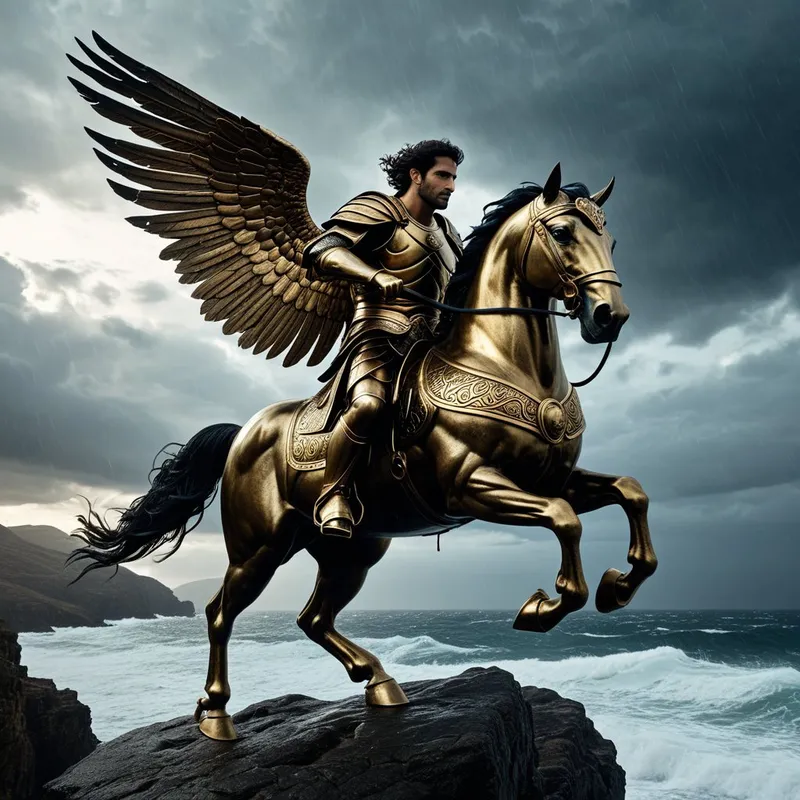
Bellerophon on Pegasus Myth Meaning & Symbolism
A hero tames the winged horse Pegasus to slay monsters, but his soaring ambition leads to a fatal fall from divine grace.
The Tale of Bellerophon on Pegasus
Hear now the story of a man who flew too close to the sun, not on waxen wings, but on the back of a creature born of gods and gorgon’s blood. In the city of Corinth, there lived a prince named Bellerophon, marked by a shadow. A terrible accident—a spear cast awry—had stained his hands with kin-blood, and he wandered, an exile haunted by the Erinyes. He sought purification in the court of King Proetus of Tiryns, but found only a new curse. The queen, Anteia, desired him, and when he refused her, her desire twisted into venomous accusation.
The king, bound by hospitality, would not kill Bellerophon in his own halls. Instead, he sent the youth on a journey east, to the kingdom of Lycia, bearing a sealed tablet of death. “Give this to my father-in-law, King Iobates,” Proetus said, his eyes cold. The message within was simple: Kill the bearer.
Iobates, too, was bound by the sacred laws of host and guest. He could not simply spill the stranger’s blood. So he devised a solution wrapped in the guise of a heroic quest: “Rid my land of the Chimera,” he commanded, a beast of nightmare that ravaged the countryside with flame and claw. It was a sentence of death.
Despairing, Bellerophon sought counsel from a seer. The prophecy was cryptic: to succeed, he must first tame the immortal, winged horse, Pegasus. The steed drank from the spring of Peirene, and there, under the watchful eye of the goddess Athena, Bellerophon waited. In a dream, Athena appeared and laid beside him a wondrous artifact: a golden bridle. At dawn, with the divine gift in hand, he approached the shimmering creature. Pegasus, sensing the god-touched tool, bowed his majestic head and accepted the bit.
Then came the ascent. Man and mount became a single entity, rising on thunderous wingbeats above the earth-bound world. From the dizzying heights, Bellerophon saw the Chimera as a speck of terror below. He dove, a mortal spear in his grip, guided by immortal grace. He drove his weapon into the monster’s fiery throat, and the beast fell, its chaos extinguished.
Triumphant, he returned to Iobates, who, thwarted, sent him on ever more impossible campaigns: against the warlike Amazons and a band of pirate raiders. Each time, borne aloft by Pegasus, Bellerophon prevailed. Iobates, finally seeing the hand of the gods upon the hero, relented, gave him his daughter in marriage, and shared his kingdom.
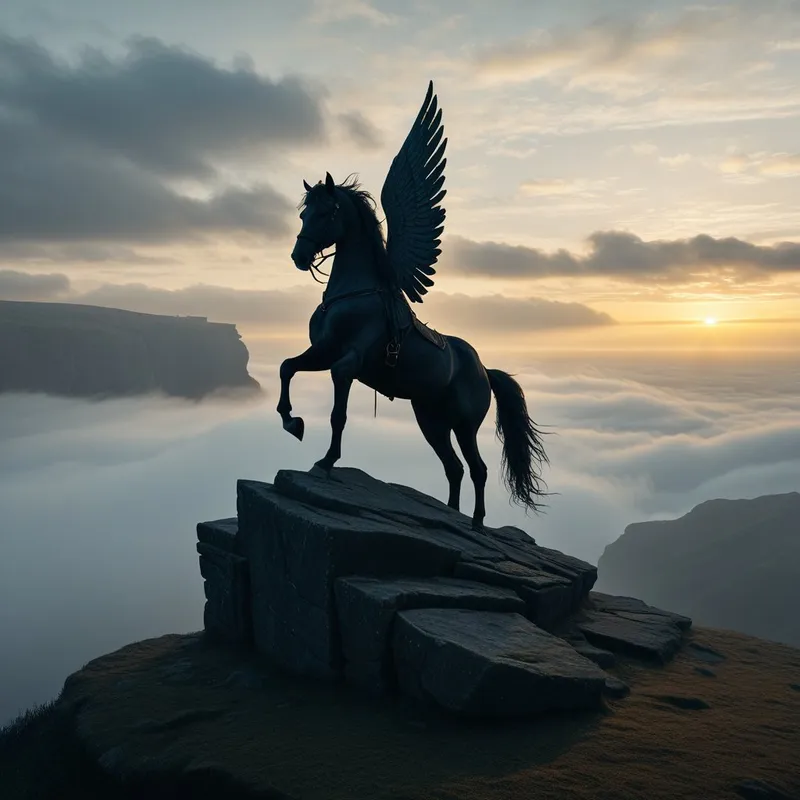
But the taste of the clouds is intoxicating. Bellerophon, the once-exiled murderer, now a king and a slayer of monsters, gazed upward. His ambition, no longer tethered to earthly tasks, turned toward the very home of the gods. Mount Olympus. He urged Pegasus upward, past the realm of eagles, into the thin, sacred air where mortals are not permitted. Zeus looked down, and his wrath was a simple, sentient insect. A gadfly stung Pegasus’s flank. The divine horse reared in shock, and Bellerophon, the rider who had conquered everything below, lost his grip. He fell, not as a hero, but as a man. He tumbled back to the common earth, crippled and broken, to wander the plains as a bitter, forgotten outcast, while Pegasus ascended alone to become the thunder-bearer of Zeus.
Cultural Origins & Context
This myth, most famously preserved in the poetry of Homer and later in the Bibliotheca of Pseudo-Apollodorus, is a foundational narrative of the Greek heroic age. It functioned as a powerful cultural parable. Told in symposia and recited by bards, it served multiple purposes: as an exciting adventure story, as an etiological myth explaining the origins of certain Lycian customs, and, most crucially, as a stern lesson on the immutable boundaries of the human condition.
The story encapsulates the Greek concept of hubris and its inevitable nemesis. Bellerophon’s initial trials—the false accusation, the deadly quests—represent the classic hero’s journey of overcoming external obstacles, often with divine aid (theoxenia). His success is a model of aristocratic aretē (excellence). However, the myth’s devastating second act underscores a societal warning: no amount of excellence permits a mortal to challenge the cosmic order. His fall is not a punishment for evil, but for the ultimate transgression of forgetting his place. The myth reinforced social and religious hierarchies, reminding even the most powerful kings and warriors of their mortal limits.
Symbolic Architecture
Psychologically, the myth maps the perilous journey of the ego in its relationship with the transcendent Self. Bellerophon represents the conscious personality—flawed, ambitious, and seeking redemption. Pegasus is the symbol of the soaring spirit, the divine inspiration (inspiration), and the unconscious psychic energy that can lift us beyond our mundane struggles.
The bridle is the critical symbol: consciousness must provide a form, a discipline, to harness the raw, wild power of the unconscious. Without it, Pegasus remains untouchable; with it, miraculous feats are possible.
The Chimera is the composite monster of our own repressed chaos—the fiery, animalistic complexes that terrorize the psyche. It can only be confronted and defeated from a higher perspective, from the vantage point granted by the integrated spirit (Pegasus). The successive battles represent the ongoing process of confronting different aspects of the shadow.
The fatal flight to Olympus is the ego’s inflation. It is the moment the individual, intoxicated by success, identifies with the transcendent power itself. “I am the one who flies,” confuses the rider with the winged force that carries him. This psychic inflation inevitably leads to a catastrophic fall, a humbling re-grounding in reality.

The Dreamer's Resonance
When this myth stirs in modern dreams, it signals a critical phase of psychic ascent and potential crisis. Dreaming of riding a winged horse speaks to a period where one feels empowered, creative, and lifted above life’s chronic problems. There is a sense of breakthrough, of harnessing a newfound talent or insight (the bridle) to achieve a goal.
Conversely, dreaming of falling from a great height, especially after a feeling of glorious flight, is the somatic signature of the Bellerophon complex in action. It often follows a real-world success that has threatened to define one’s entire identity. The body registers the impending crash of inflation before the mind admits it. The dream is a profound corrective from the Self, a warning that identification with an archetypal power (the Hero, the Genius, the Savior) is underway. The dreamer may be experiencing grandiosity, a loss of connection with ordinary human relationships, or an unsustainable pace. The fall in the dream, while terrifying, is ultimately an act of psychic preservation, forcing a necessary and painful return to the human realm.

Alchemical Translation
The alchemical process mirrored here is the sublimatio—the spiritualization or ascension of base matter—followed by a necessary coagulatio, the return to solid form. The initial stages are a textbook model of individuation: confronting the shadow (the accidental murder, the false accusation), receiving divine aid from the anima/animus figure (Athena’s gift), consciously integrating a powerful unconscious content (taming Pegasus), and using that union to defeat a monstrous, disorganized complex (the Chimera).
The ultimate goal of alchemy was not to escape matter, but to transmute it. Bellerophon’s error was to believe the goal was the flight itself, not what the flight enabled him to do on earth.
His tragedy is an incomplete opus. He mastered the sublimatio but refused the coagulatio. For the modern individual, the myth instructs that any spiritual awakening, any transcendent insight, any creative “flight,” must ultimately be brought back and applied to the healing and betterment of the earthly personality and its relationships. The bridle must remain in hand. To seek to live permanently in the rarefied air of the archetype is to invite a psychotic break or a crippling alienation. The true alchemical gold is not becoming a god, but becoming a fully realized, grounded human who has tasted the divine and used that knowledge to embody wisdom in the mortal world. Pegasus ascends to the gods; the healed human walks, humbled and whole, upon the earth.
Associated Symbols
Explore related symbols from the CaleaDream lexicon: