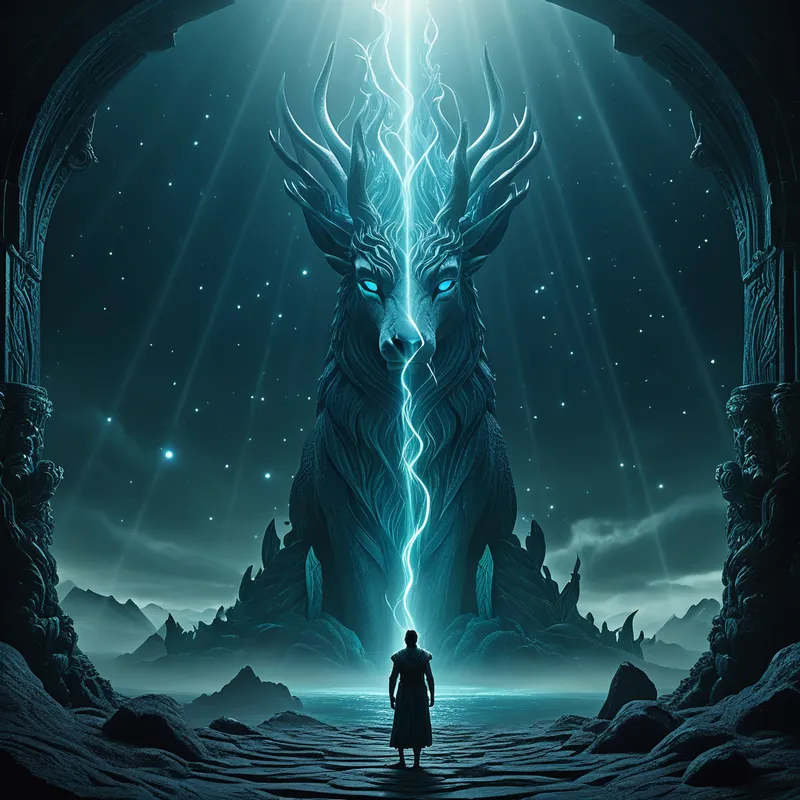
Batara Guru
The supreme creator deity in Indonesian mythology who shaped the cosmos and established divine order, yet whose authority is challenged by earthly forces.
The Tale of Batara Guru
In the beginning, before the separation of sky and sea, there was only the vast, silent unity of the cosmic ocean. From this primordial stillness, a thought took form, a vibration of intent that became the first being: Batara Guru, the Lord Teacher. He was not born but manifested, the first consciousness to emerge from the undifferentiated whole. With the weight of solitude upon him, he gazed upon the endless waters and felt the stirring of a profound creative urge.
To enact his will, he needed a foundation. He summoned a great turtle, a creature of immense patience and stability, from the depths. Upon its broad shell, he placed a massive serpent, a being of coiled potential and primal energy. Upon this living altar of turtle and serpent, Batara Guru stood. He began to dance. His dance was not mere movement; it was the first act of differentiation, a sacred geometry of intention. With each step, each gesture, substance separated from void, pattern emerged from chaos. The sky was lifted from the waters, the earth was drawn forth and made solid. Stars were scattered from his fingertips, and the sun and moon were placed in their celestial orbits.
Having shaped the cosmos, Batara Guru populated it. From the dust of the new earth and the light of his own essence, he fashioned the first humans. But his creation was not a gift of pure freedom. He established a strict and intricate divine order, a dharma for the world. He appointed his sons and daughters—the myriad dewata—as guardians of mountains, forests, winds, and rivers, creating a vast celestial bureaucracy to administer creation.
Yet, this perfect order was not destined to remain unchallenged. The story of Batara Guru is also one of profound tension. In one pivotal tale, humanity, led by a figure of immense earthly power and wisdom, grew restless under the god’s exacting decrees. They built a towering pillar, a ladder to the heavens, seeking to reach Batara Guru’s abode directly, to question his authority or claim their place beside him. Seeing this act of cosmic hubris, Batara Guru did not smite them with thunder. Instead, in a move of subtle, devastating power, he destroyed the foundation of their unity. He introduced difference—of language, of custom, of desire—where there had been harmony. The single human community shattered into countless scattered tribes, their common purpose lost in a babble of tongues. The challenge to his absolute authority was quelled not by annihilation, but by the fracturing of the challengers’ collective soul.
In other stories, his authority is tested from within his own family, through the rebellious or tragic actions of his divine children, whose dramas ripple through the mortal world as natural disasters and social upheavals. Batara Guru reigns, but his throne is one of magnificent, lonely sovereignty, perpetually aware of the simmering forces—both human and divine—that his own act of creation set into motion.
Cultural Origins & Context
Batara Guru’s roots sink deep into the spiritual soil of the Indonesian archipelago, a synthesis of indigenous Austronesian belief systems and the profound influences of Hinduism, which arrived via trade and cultural exchange over a millennium ago. He is a syncretic deity, a fusion of the Hindu god Shiva (particularly Shiva in his aspect as the supreme ascetic teacher and cosmic lord) with pre-existing indigenous conceptions of a supreme sky father or primordial ancestor.
This syncretism is key to understanding his dual nature. From Shiva, he inherits the attributes of the cosmic dancer, the destroyer of illusion, and the lord of meditation. From indigenous cosmology, he gains his role as the direct, personal shaper of the world and the progenitor of both gods and humans. He is not a distant, abstract principle but an active, willful personality engaged with his creation. This blend is most evident in the way his mythology was preserved and evolved, particularly in the lontar manuscripts of Java and Bali, and in the rich oral traditions of peoples like the Batak of Sumatra.
In these contexts, Batara Guru is not merely a figure of worship but a foundational character in a cosmic drama that explains the very structure of reality and the human condition. His establishment of order justifies social hierarchies and royal authority (kings often claiming descent from him), while the myths of rebellion against him provide a mythical explanation for the diversity of human cultures and the inherent human striving for autonomy, even against divine decree.
Symbolic Architecture
Batara Guru represents the archetypal moment when Consciousness awakens to Itself and, in doing so, creates the world of separation. He is the primal thought that divides the One into the Many. His dance is the archetype of all creative action—a purposeful movement that brings form from formlessness. Yet, his mythology reveals the inherent paradox of the Creator: in the act of granting existence, he also imposes limitation. The order he establishes is both a necessary container for life and a cage that inevitably provokes the desire for freedom.
He is the architect of reality, but his blueprint contains the cracks through which chaos and individuality will forever seep.
His response to humanity’s challenge is psychologically profound. He does not confront the rebellion with raw force, which would only affirm its power. Instead, he dissolves the unity that made the rebellion possible. This act symbolizes a deep psychological truth: the most potent form of control is often the fragmentation of consciousness, the sowing of inner division (doubt, conflicting desires, shame) that prevents a cohesive challenge to authority, whether that authority is an external god, a internalized superego, or a cultural dogma.
Batara Guru’s loneliness is not incidental; it is essential. The one who differentiates the world from himself necessarily becomes distinct from it. His sovereignty is thus tinged with the melancholy of separation, a price paid for the existence of a cosmos.

The Dreamer's Resonance
To encounter Batara Guru in the imaginal realm is to confront the foundational authority within one’s own psyche. He personifies the internal “creator”—that part of us that structures our reality, establishes our personal laws, values, and identity. He is the voice that says, “This is who you are, and this is how your world shall be.”
Dreaming of such a figure may signal a profound moment of self-creation or re-creation. It can appear during life transitions where one must consciously shape a new chapter, imposing order on inner chaos. Yet, the myth warns that this creative authority is not absolute. The dream may also bring the “towering pillar” of rebellion—an upwelling of repressed instincts, desires, or aspects of the self (the Shadow) that challenge the ego’s rigid control. The dreamer’s task is not necessarily to overthrow Batara Guru, but to engage with the tension, to recognize that the psyche’s wholeness requires both the ordering principle and the chaotic, creative force that tests its boundaries.
His presence asks the dreamer: What structures have I built my life upon? What unspoken laws do I obey? And what part of me is building a ladder to storm the heavens of my own self-conception?

Alchemical Translation
The alchemical process mirrored in Batara Guru’s myth begins with the Nigredo: the primal, undifferentiated waters, the unconscious unity. His emergence is the first stirring of the Albedo, the dawn of conscious awareness separating from the dark mass. His dance is the intricate work of Separatio and Coagulatio—distinguishing elements and fixing them into forms (earth, sky, stars).
The establishment of his celestial court represents the Citrinitas, the creation of a complex, ordered internal system—the psyche’s values, morals, and hierarchies. But the process does not end in this golden order. The rebellion of humanity and gods is the necessary Rubedo, the reddening, the fiery confrontation that tests and tempers the created structure. It is the crisis that prevents the psyche from becoming a sterile, rigid monument.
The ultimate goal is not the perfection of the initial creation, but the endurance of the creative tension itself. The true “philosopher’s stone” is the dynamic, living relationship between order and chaos, authority and rebellion, within the self.
Batara Guru’s enduring reign, despite the challenges, symbolizes the ego’s necessary, though never total, governance. The alchemical journey is about relating to this inner authority consciously, not being blindly ruled by it, allowing it to be informed and humbled by the very forces it seeks to order.
Associated Symbols
Explore related symbols from the CaleaDream lexicon:
- Ocean — The primordial, undifferentiated state of consciousness and potential from which all forms, including the creator himself, first emerge.
- Dance — The sacred, patterned movement that differentiates chaos into cosmos; the creative act as a dynamic, embodied ritual.
- Authority — The divine right to establish order and law, a power that is both foundational and inherently provocative to the spirit of freedom.
- Tower — The human aspiration to reach the divine realm directly, representing ambition, hubris, and the challenge to established hierarchy.
- Serpent — The primal, coiled energy of the unconscious that serves as the foundational support for conscious creation and spiritual authority.
- Order — The cosmic and social structure imposed by the creator, providing stability but also imposing limitation and provoking resistance.
- Chaos — The ever-present, formless potential that both precedes creation and continually seeps through the cracks of established order.
- Guru — The divine teacher whose first lesson is the act of creation itself, and whose authority is the curriculum for the soul’s development.
- Shadow — The fragmented, rebellious, and diverse aspects of creation (and the self) that challenge the unity and control of the central authority.
- Mountain — The abode of the gods and the symbol of the lofty, stable, yet isolated seat of supreme authority and cosmic perspective.