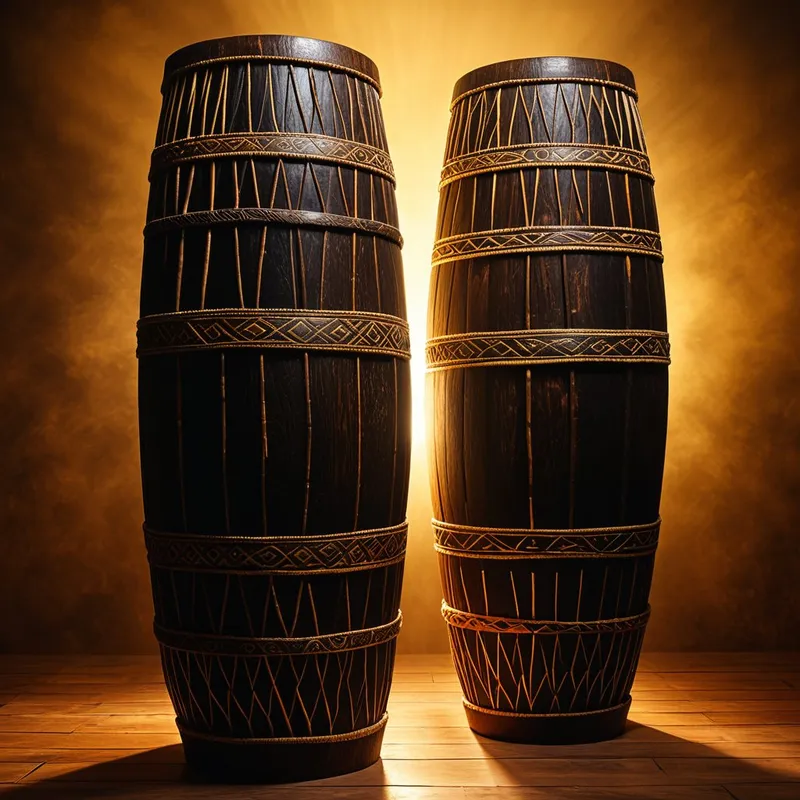
Batá Drums Myth Meaning & Symbolism
A sacred myth where the first Batá drums are forged from divine silence, becoming the living voice of the gods and the ancestors.
The Tale of Batá Drums
In the beginning, there was silence. Not an empty silence, but a deep, listening silence—the kind that exists before a word is spoken, when all potential hums in the womb of the world. The orishas moved through this silence, but their voices were like wind without trees, like rain without earth to receive it. They were known, but not heard. Their wisdom was a locked treasure, and humanity wandered in a world of surfaces, deaf to the depths.
Shango, king of fire and lightning, grew restless. His power was in the crack and the roar, but it faded into echo. Oshun, whose essence was the murmur of rivers and the honey of persuasion, found her currents had no song. Eshu, the trickster at the gate, could deliver no messages, for there was no language to carry them. The divine realm was a chorus of the mute, gazing upon a creation that could not perceive its creators.
The silence was a veil, and it pained Olodumare, the source of all. So, from the heart of this divine frustration, a command was woven into the fabric of being. It traveled not as sound, but as a compulsion in the blood, a knowing in the hands. It found a man, a hunter who listened to more than the rustle of game. He heard the speech of trees groaning in the wind, the conversation of stones worn by water. In a dream, the shapes came to him: an hourglass, a womb, a neck connecting two worlds.
Guided by this vision, he sought the sacred Iroko tree, its roots deep in the earth of the ancestors, its crown brushing the realm of the sky. With reverence, he took wood. From the antelope, a creature of grace and alertness, he took skin. He shaped, he carved, he stretched. He did not know what he made, only that his hands were not entirely his own.
When the form was complete, three drums of varying size, he sat before them in the clearing. His hands hovered. The great silence returned, now focused, pregnant. Then, he let them fall.
The sound was not a sound. It was a breaking. It was the first word after eternity. The deep, resonant boom of the Iya was the foundation of the world speaking itself. The middle response of the Itotele was the voice of community, of answer and balance. The sharp, chattering speech of the Okonkolo was the spark of individual consciousness, the question.
And the orishas sang.
Through the taut skin and hollowed wood, their essences found voice. Shango’s voice was rolling, explosive thunder. Oshun’s was a fluid, cascading melody. Yemoja’s was a profound, wave-like rhythm. Eshu’s was a complex, syncopated code. The drums became their tongues. The hunter was no longer just a man; he was the first Añá, the vessel for a sacred language. The silence was shattered, not by noise, but by conversation. The divine could now reach into the human heart, and the human, through the answering rhythm, could reach back. The Batá were born—not as instruments, but as living portals.
Cultural Origins & Context
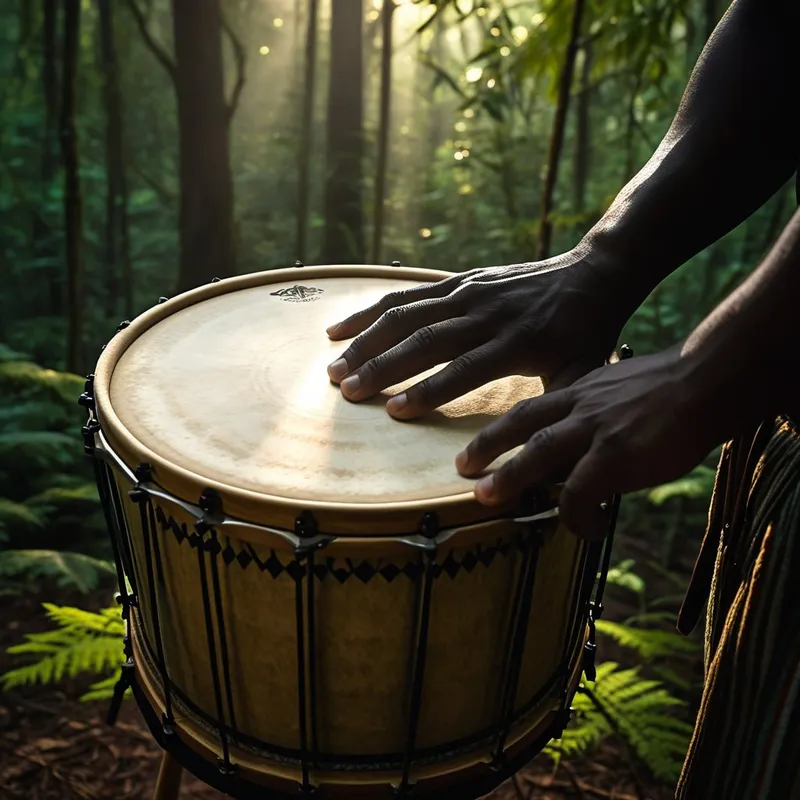
This myth originates in the spiritual heart of the Yoruba people, whose sophisticated cosmology was violently dispersed across the Atlantic during the transatlantic slave trade. The Batá drums, and the myth of their divine origin, survived this Middle Passage not as mere folklore, but as a crucial technology of the soul. In the brutal reality of enslavement in Cuba, Trinidad, and beyond, where African languages and direct worship were often forbidden, the drums became a clandestine lifeline.
The myth was passed down not through books, but through initiation. It was held by the Añá fraternities, priest-drummers who were consecrated to the spirit of the drums themselves. To learn the rhythms—the Oru del Igbodu—was to learn the mythology. Each pattern was a chapter, a hymn, a direct evocation. The societal function was profound: it preserved a pantheon, a history, and a metaphysical framework. It maintained an open channel to the ancestors (Egungun) and the orishas in a world designed to strip away identity. The drumming ceremony became a vessel of collective memory, spiritual resistance, and psychic reassembly for the African diaspora.
Symbolic Architecture
At its core, the myth of the Batá is about the incarnation of voice and the sacredness of communication. The drums symbolize the necessary vessel—the body—through which the intangible spirit (the orisha) can become manifest and effective in the world.
The drum is the throat of the divine, and the rhythm is its spoken soul.
The three drums represent a cosmic and psychological hierarchy: the Iya (Mother) is the unconscious, the deep, foundational pulse of being. The Itotele is the mediating ego, translating and responding. The Okonkolo is the conscious mind, the precise and initiating spark. Together, they model a complete psychic system in dialogue. The hunter-turned-drummer represents the human capacity to become a conscious conduit, to translate inspiration (the dream vision) into form (the carved drum) and then into dynamic, relational action (the rhythm that calls the gods). The myth teaches that true speech is not about asserting a separate self, but about tuning an instrument of self to resonate with larger, transpersonal forces.

The Dreamer's Resonance
When this myth pattern stirs in the modern dreamer, it often signals a profound crisis or opportunity of communication. It may manifest as dreams of finding a mysterious, pulsating object; of hearing a compelling, undeniable rhythm from a hidden source; or of one’s own voice becoming impossibly deep, resonant, or powerful.
Somatically, this can correlate with a tension or awakening in the throat chakra, a feeling of having a "lump in the throat" that wants to become song, or a rhythmic throbbing in the chest or hands. Psychologically, the dreamer is navigating the transition from the "great silence"—a state of inner knowing that lacks expression, a spiritual feeling without a language—toward finding their authentic voice. This is not merely about speaking more, but about speaking truth: aligning one’s personal expression with a deeper, archetypal current. The dream may expose the fear that one’s true voice, once released, will call forth powerful, uncontrollable forces (the orishas) from within the psyche.

Alchemical Translation
The individuation process mirrored here is the alchemy of the Logos. It is the journey from being a passive recipient of inner contents (the silent awareness of the gods) to becoming an active, skilled creator who gives those contents a voice that can interact with the world.
To pick up the baton is to accept the responsibility of form. To strike the drum is to commit to the consequences of sound.
First, one must receive the "dream vision"—the intuitive, often inarticulate call from the Self (Olodumare). This leads to the "carving of the drum": the often arduous, disciplined work of crafting a vessel for that call—be it through art, a relationship, a career, or a personal code. This is the Iroko wood of our character and the antelope skin of our sensitivity, shaped by effort. Then comes the critical, terrifying moment of initiation: letting the hands fall and making the first sound. This is the act of manifestation, which inevitably calls forth the archetypal powers (the orishas) within. The thunder of Shango (righteous anger, power), the fluidity of Oshun (creativity, pleasure), the depth of Yemoja (nurturance, emotion)—all may erupt through the new form.
The modern individual’s "Batá" is any practice or mode of expression that truthfully translates their inner, silent knowing into the shared, rhythmic field of relationship. The myth teaches that our deepest purpose may not be to find our voice, but to become the drum—a sacred, hollowed-out instrument through which something far greater than our solitary ego can speak, heal, and create.
Associated Symbols
Explore related symbols from the CaleaDream lexicon: