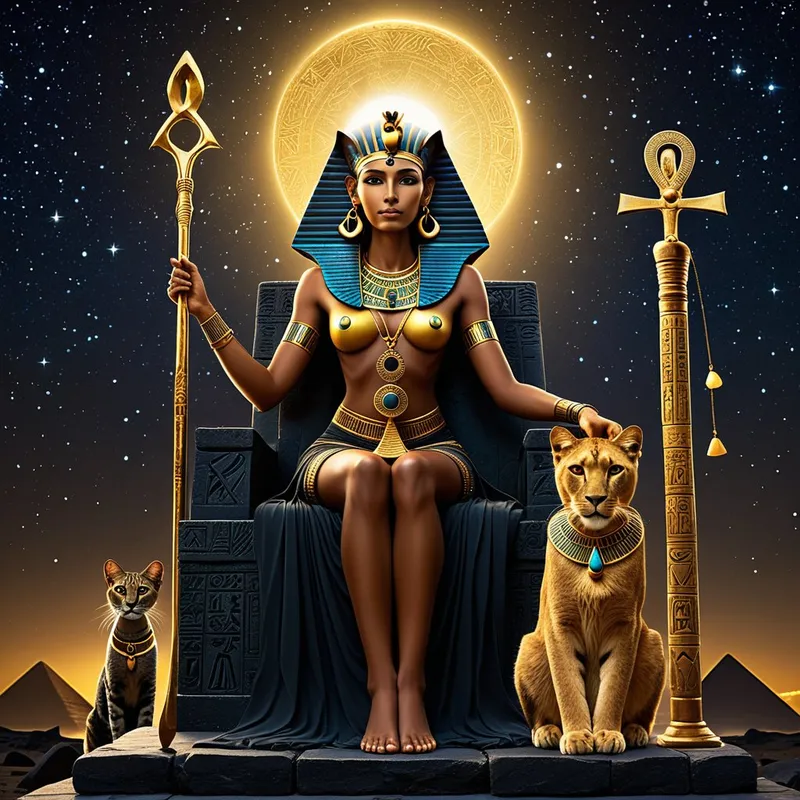
Bastet Myth Meaning & Symbolism
The tale of the fierce lioness who became the gentle protector, embodying the sacred balance between untamed power and nurturing domesticity.
The Tale of Bastet
In the time when the sun was a young god and the Nile’s black earth first breathed life, there walked a daughter of Ra whose breath was the desert wind and whose gaze was the noonday sun. She was Sekhmet, the Powerful One. Her roar shook the mountains, and her wrath was a sandstorm that could scour the bones of rebels from the earth. She was the unleashed fury of her father, a cleansing fire sent to punish humanity for its arrogance.
But the story whispers of a change, not of defeat, but of a profound turning.
It began in the aftermath of a great cleansing. The scent of copper hung heavy in the air, and the land lay silent, too silent, beneath Ra’s unblinking eye. The rebellion was dust, but Sekhmet’s thirst was unquenched. Her dance of destruction had become a cycle that threatened to consume creation itself. A great weariness, deeper than the desert night, settled upon Ra. Not regret, but the profound responsibility of a creator who must also preserve.
So, the cunning god Thoth, he who measures the stars and knows the secrets of the heart, spoke a plan into being. Upon the banks of the Nile, at the place where the first papyrus sprouted, he and the other gods prepared a lake not of water, but of beer, stained deep red with ochre and pomegranate juice to mimic the hue of blood. They poured it in great vats across the field of her rampage.
As the red sun dipped low, Sekhmet returned, her jaws aching for more. She saw the vast, crimson lake and let out a roar of triumph. She bent her great head and drank, and drank, and drank. The potent, drowsy liquor filled her not with power, but with a heavy, golden languor. The fire in her veins cooled to a gentle warmth. The sharp edges of her rage softened and blurred. She lay down among the reeds, her mighty limbs becoming fluid, her ferocious snout rounding into a delicate muzzle. The lioness stretched and sighed, and in that sigh was the first purr to ever grace the world.
When she rose, the transformation was complete. The scorching sun-disk had become the gentle, life-giving rays of dawn. Where once stood the Devourer now stood Bastet. Her eyes held the same ancient knowledge, but now it was tempered with a playful, protective light. She picked up the sistrum, and its shaking made a sound like rain on leaves and laughter in a safe house. She became the Lady of the East, the protectress of the hearth, the guardian of women in childbirth and secrets shared in confidence. Her sacred animal was no longer only the lion of the wilderness, but the cat who chose to curl by the fire, a sovereign of the domestic sphere who had not forgotten the wild power from which she was born.

Cultural Origins & Context
The veneration of Bastet is rooted in the rich, fertile soil of Lower Egypt, centered in her cult city of Bubastis. While her origins likely stretch back to a local lioness goddess, her evolution into the cat-headed protector is a testament to the Egyptian genius for synthesizing cosmic principles with daily life. Her myths were not grand, singular epics like those of Osiris, but were woven into the fabric of festival, ritual, and household practice.
Her stories were passed down through temple hymns, the instructions of priestesses, and the lived reality of families who kept cats as her sacred avatars. The great festival of Bastet, described by Herodotus, was a massive, joyous pilgrimage to Bubastis involving music, dancing, and celebratory release—a far cry from the somber tones of other cults. This was her societal function: to embody and protect the joys of life, the security of the home, fertility, and the benevolent aspects of feminine power. She was a goddess accessible in the purr of a cat, the safety of a locked door, and the communal celebration of life’s pleasures.
Symbolic Architecture
Bastet’s myth is a masterclass in the alchemy of instinct. She represents the sacred domestication not as a taming, but as a conscious integration of primal force.
The most potent protection does not come from walls, but from the conscious choice of the lioness to guard the hearth instead of storm the desert.
Her journey from Sekhmet to Bastet symbolizes the transformation of raw, undifferentiated aggression (the nigredo or blackening of the alchemical process) into focused, protective power. The red beer is the crucial solvent—it represents intoxication, but also trickery, ritual, and the intervention of consciousness (Thoth) to redirect a runaway complex. The cat, her sacred symbol, is the perfect emblem of this integration: a creature of sublime softness and lethal precision, of absolute independence that chooses companionship, a hunter who naps in a sunbeam.
She is the guardian of boundaries—of the home, of the body (especially in childbirth), and of the intimate, private self. Her sistrum’s sound was believed to repel chaotic forces (isfet), making her a goddess who creates sacred, harmonious space through vibration and presence, not just brute force.

The Dreamer's Resonance
To dream of Bastet, or of cats with an unusual, knowing presence, is often to encounter the psyche’s work on the caregiver-protector archetype. The dream may present a situation where one’s boundaries are being tested, or where a fierce, defensive anger (the Sekhmet energy) is simmering.
Somatically, one might feel a tension between the desire to lash out and a deep, almost physical need to create safety and comfort. The dream-Bastet appears when the unconscious is attempting to transmute raw defensive rage into a more nuanced, sustainable protective capacity. She may manifest as a cat leading the dreamer to a safe, warm place, or as a figure who calms a storm. The dream is a signal that a powerful instinctual force is ready to be integrated, not repressed—to be put in service of nurturing what one loves, rather than merely destroying what one fears.

Alchemical Translation
For the modern individual navigating a world that often demands either unchecked aggression or passive vulnerability, Bastet’s myth offers a path of psychic transmutation. The process begins with acknowledging the inner Sekhmet—the righteous wrath, the capacity for fierce defense, the part of us that feels it must burn everything down to be safe.
Individuation requires us to drink the red beer of self-reflection, to intoxicate our blind fury with the bittersweet liquor of awareness, until it lies down and changes its form.
The “Thoth” in us—our observing intellect, our capacity for strategy and wisdom—must devise the ritual to redirect this energy. This is the albedo, the whitening. We learn to channel the power of “no” into the creation of sacred boundaries. We take the heat of our anger and transform it into the warm, radiant protection of our values, our relationships, and our inner sanctum.
To embody Bastet is to achieve a sovereign balance. It is to know you have claws, but to sheathe them unless the sanctity of your “home” (be it physical, emotional, or psychic) is truly threatened. It is to find pleasure and joy not as frivolities, but as essential, protective magics that sustain life. Her final gift is the realization that true strength is protean: it can be the sun’s scorching judgment or the sun’s nurturing light, and the wise soul learns which the moment requires. She is the archetype of the integrated Self, where the wild and the domestic purr in unison, guarding the mystery of life itself.
Associated Symbols
Explore related symbols from the CaleaDream lexicon: