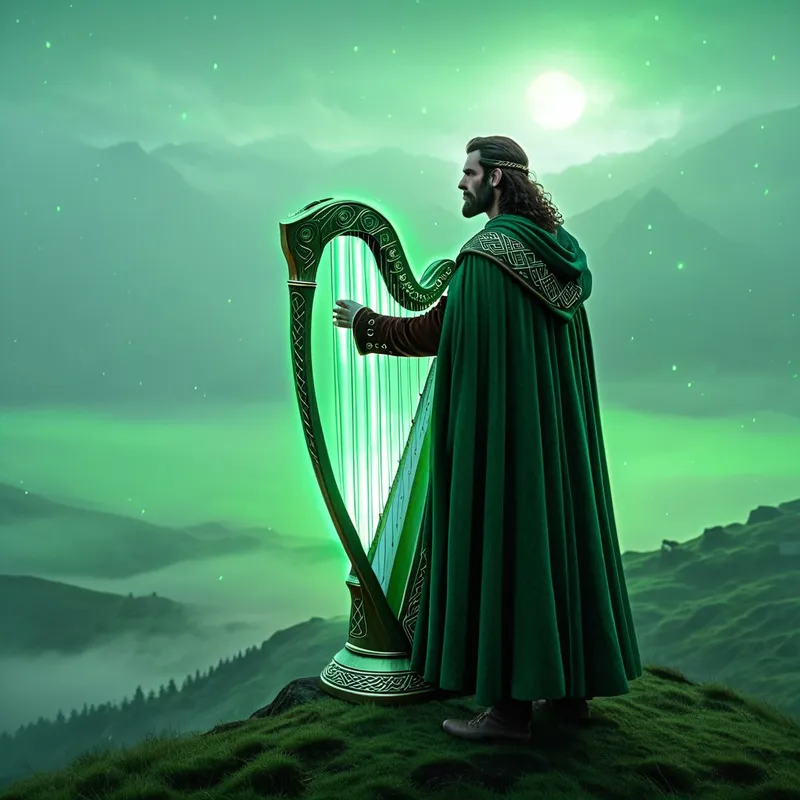
Bards' Harp Myth Meaning & Symbolism
A tale of a stolen harp, a silenced bard, and a perilous journey to the Otherworld to reclaim the stolen music of the soul.
The Tale of Bards’ Harp
Listen. Listen to [the wind](/myths/the-wind “Myth from Various culture.”/) in the oaks and you might still hear the echo of it. In the days when [the world](/myths/the-world “Myth from Tarot culture.”/) was younger and [the veil](/myths/the-veil “Myth from Various culture.”/) between the lands was thin as morning mist, there lived a bard whose name is now the name of all [bards](/myths/bards “Myth from Celtic culture.”/). His fingers on the harp strings could make the stags weep and the hawks fall still in [the sky](/myths/the-sky “Myth from Persian culture.”/). His music was not just sound; it was the very binding of joy to sorrow, of memory to hope.
But in the [Sídhe](/myths/sdhe “Myth from Celtic / Irish culture.”/), in [the hollow hills](/myths/the-hollow-hills “Myth from Celtic culture.”/) where the Aos Sí hold their endless revels, a king grew jealous. This was Bodb Derg, and his own feasts felt hollow to him. He coveted the mortal’s gift. So, on a night when [the moon](/myths/the-moon “Myth from Tarot culture.”/) was a sliver and [the bard](/myths/the-bard “Myth from Celtic culture.”/) slept by his hearth, shadows slipped from the mound. They did not take gold or life. They took the harp.
The bard awoke to a silence so profound it was a wound. His hands, which knew the dance of the strings, hung useless. His hall, once vibrant with song, was a tomb. The people’s hearts grew heavy; the seasons seemed to lose their rhythm. The bard knew the touch of [the Otherworld](/myths/the-otherworld “Myth from Celtic culture.”/) in this theft. Despair threatened to claim him, but a fiercer fire—the fire of a story not yet finished—burned it away.
He took his staff of oak and set his face towards the oldest hills. He walked beyond the boundaries of tilled fields, into the wildwoods where the paths are made by deer and the eyes in the thickets are not all animal. He found the entrance to the sídhe, a doorway of earth and stone veiled by fern and glamour. With no weapon but his resolve, he stepped into the twilight within.
The hall of Bodb Derg was a cavern of impossible beauty, lit by cold, self-born gems. The Aos Sí danced to a silent music, and there, on a crystal dais, hung his harp. But it was ensorcelled. It would not sing for a mortal hand. The Faerie King smiled a thin, challenging smile. “Claim it if you can, singer of dust.”
The bard stood in that alien splendor, his mortal heart pounding a lonely rhythm. He did not reach for it with his hands. He closed his eyes and reached for it with his memory. He remembered the warmth of the sun on the barley, the sound of a child’s laugh, the ache of love and the peace of loss—the true music of the human world. He spoke three names: the name of his first song, the name of his deepest grief, and the name of his homeland.
At the third name, the harp shuddered. A single, clear note rang out, sharp as a spearpoint in the silence. The glamour shivered. The bard stepped forward, and this time, when his fingers touched the wood—his wood, worn smooth by his own life—the harp leaped to his embrace. Without a glance back at the stunned court, he turned and walked from the mound, playing a tune of return so potent that the very roots of the hills trembled. He brought the music back to the world of light, and it has never left us since.
Cultural Origins & Context
This story, in its essence, is a core bardic myth, less about a single historical figure and more about the archetypal identity and sacred duty of the poet in Celtic society. The bard was not an entertainer but a custodian of fírinne (truth) and clú (renown). His harp was his lorg, his instrument of power, capable of satirizing kings into disgrace or healing the sick with “three noble strains.”
The myth would have been told within the oral tradition, likely by bards themselves as a foundational narrative of their craft. Its societal function was multifaceted: it established the divine/magical source of poetic inspiration (often from the Sídhe), it underscored the peril of this gift (its vulnerability to envy and theft), and most importantly, it modeled the ultimate source of the bard’s authority. True power did not come from the artifact alone, but from the bard’s unbreakable connection to the lived experience of his people and land—his memory. The journey to the [Otherworld](/myths/otherworld “Myth from Celtic culture.”/) mirrors the bard’s own psychological journey into the depths of tradition and the unconscious to retrieve the “old songs.”
Symbolic Architecture
The myth presents a profound map of the creative [psyche](/myths/psyche “Myth from Greek culture.”/). The [Harp](/symbols/harp “Symbol: The harp is a stringed instrument symbolizing harmony, spirituality, and creativity, often associated with divine inspiration and emotional depth in music.”/) is not merely an [instrument](/symbols/instrument “Symbol: An instrument symbolizes creativity, communication, and the means by which one expresses oneself or influences the world.”/); it is the integrated voice of the [soul](/symbols/soul “Symbol: The soul represents the essence of a person, encompassing their spirit, identity, and connection to the universe.”/), the [capacity](/symbols/capacity “Symbol: A measure of one’s potential, limits, or ability to contain, process, or achieve something, often reflecting self-assessment or external demands.”/) to weave disparate experiences—joy, sorrow, [memory](/symbols/memory “Symbol: Memory symbolizes the past, lessons learned, and the narratives we construct about our identities.”/)—into a coherent, beautiful, and [life](/symbols/life “Symbol: The symbol of ‘Life’ represents a journey of growth, interconnectedness, and existential meaning, encompassing both the joys and challenges that define human experience.”/)-affirming whole.
The stolen harp is the soul in a state of alienation, where one’s native music is held captive by a complex—a pattern of thought or emotion (here, the jealousy of the Otherworld king) that resides in the unconscious.
The Sídhe represents the unconscious itself—a [realm](/symbols/realm “Symbol: The symbol of ‘Realm’ often signifies the boundaries of one’s consciousness, experiences, or emotional states, suggesting aspects of reality that are either explored or ignored.”/) of immense [beauty](/symbols/beauty “Symbol: This symbol embodies aesthetics, harmony, and the appreciation of life’s finer qualities.”/), power, and potential, but also of amoral forces and peril. It is both the [source](/symbols/source “Symbol: The origin point of something, often representing beginnings, nourishment, or the fundamental cause behind phenomena.”/) of inspiration and the [realm](/symbols/realm “Symbol: The symbol of ‘Realm’ often signifies the boundaries of one’s consciousness, experiences, or emotional states, suggesting aspects of reality that are either explored or ignored.”/) where inspiration can be lost. The [Bard](/symbols/bard “Symbol: Bards represent the power of storytelling, music, and the transmission of culture and history.”/)’s [journey](/symbols/journey “Symbol: A journey in dreams typically signifies adventure, growth, or a significant life transition.”/) is one of active descent, a voluntary confrontation with the psychic [depths](/symbols/depths “Symbol: Represents the subconscious, hidden emotions, or foundational aspects of the self, often linked to primal fears or profound truths.”/) where what is most valuable to [the ego](/myths/the-ego “Myth from Jungian culture.”/) has been hidden.
The [climax](/symbols/climax “Symbol: The peak moment in a narrative or musical composition, representing resolution, transformation, or ultimate expression.”/) holds the key. The bard does not fight or bargain. He remembers. He invokes the three names—of art, of wound, and of home. This is the [alchemy](/symbols/alchemy “Symbol: A transformative process of purification and creation, often symbolizing personal or spiritual evolution through difficult stages.”/) of the myth: creative power is restored not by seizing, but by re-membering, by consciously reconnecting the fragments of one’s authentic experience. The harp only responds to the [truth](/symbols/truth “Symbol: Truth represents authenticity, honesty, and the quest for knowledge beyond mere appearances.”/) of his lived life.
The Dreamer’s Resonance
When this myth stirs in modern dreams, it often signals a profound crisis of voice and authenticity. To dream of a lost or broken instrument, of being silenced, or of a beautiful yet inaccessible object in a strange, enchanting landscape, is to touch this archetypal pattern.
The somatic experience might be a tightness in the throat, a numbness in the hands, or a feeling of hollow stillness in the chest—the body remembering the “stolen harp.” Psychologically, the dreamer is likely navigating a period where their innate creativity, their unique mode of expression, or their emotional truth has been co-opted or suppressed. This could be by external forces (a draining job, a jealous relationship) or, more commonly, by an internal “Faerie King”—an inner critic, a perfectionist complex, or a depressive state that glamorizes numbness and steals away the energy for authentic expression. The dream is both a diagnosis of the theft and a whisper of the required journey: one must go into the unfamiliar territory of the psyche (the depression, [the shadow](/myths/the-shadow “Myth from Jungian culture.”/)) to reclaim what is theirs.
Alchemical Translation
The myth of the Bard’s Harp is a perfect model for the Jungian process of individuation, specifically the stage of reclaiming one’s unique voice from the collective and personal unconscious.
The process begins with the theft, the painful recognition that one’s essential nature has been lost to unconscious identification—with societal roles, parental complexes, or traumatic adaptations. The music is gone; only sterile silence or borrowed tunes remain.
The journey to the Sídhe is the courageous dive into shadow work and active imagination. It is entering the inner “hollow hill” where our disowned powers and stolen potentials are held. The Faerie King is the personification of the psychic complex that holds our treasure hostage—often through envy (of others’ wholeness) or a desire to keep us in a state of beautiful, silent suffering.
The alchemical transformation occurs in the moment of invocation, not confrontation. The modern individual, in the depths of their analysis or introspective work, must do what the bard did: cease trying to wrestle the complex into submission and instead offer it the profound truth of their own experience. They must name their first joy (their innate spirit), their deepest grief (their wound), and their true home (their core Self).
When this is done, the complex loses its power. The harp—the integrated personality, the authentic voice—returns to the service of consciousness. One does not become a different person; one becomes more profoundly oneself. The music played on the return is the music of a life lived in alignment, a creativity that springs not from egoic striving, but from the soul’s reclaimed sovereignty. The myth tells us that our true voice is never truly destroyed; it only awaits the courageous journey of remembrance.
Associated Symbols
Explore related symbols from the CaleaDream lexicon: