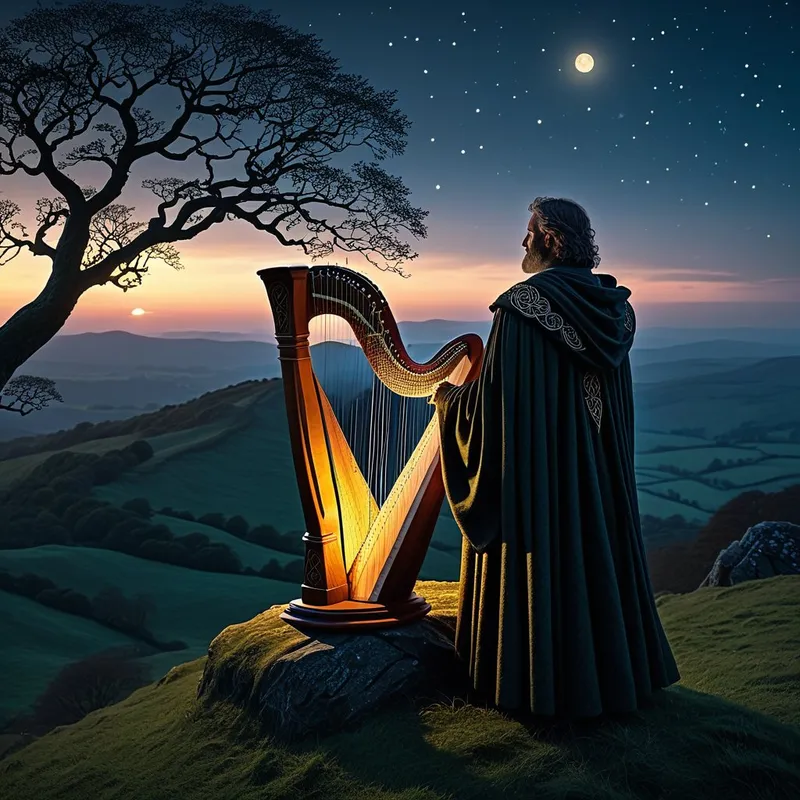
Bards Myth Meaning & Symbolism
The Celtic Bard is a keeper of memory and shaper of destiny, whose words weave the fabric of history and the soul's deepest truths.
The Tale of Bards
Listen. The wind does not blow through the nemeton without a voice. The river does not rush over stone without a song. And the people do not know who they are unless the memory is sung into their bones. This is the charge of the Bard.
In the time when the world was younger and the veil between the seen and unseen was as thin as morning mist, there was a king. His name is lost, for a king without a bard is a king without a shadow—insubstantial, soon forgotten. He ruled from a hill of stone, his warriors fierce, his cattle countless. Yet, a silence gnawed at the heart of his hall. The feasts were loud, but the stories were stale, repeated until they were empty shells. The people knew the deeds of yesterday, but not the dreams of tomorrow. The land itself grew quiet.
From the western sea, where the sun drowns each night in a bath of fire, a man came walking. He carried no sword, only a branch of silver fid na ndruad and a harp of willow and horsehair. His cloak was the grey of a rain-heavy sky. He stood at the king’s gate and did not bow. “I am the memory you have lost,” he said, his voice not loud, yet it filled the silent spaces between the stones. “I am the tongue of the river and the breath of the oak. Grant me hospitality, and I will give your name back to the wind.”
The king, amused and arrogant, challenged him. “Sing then, stranger. Sing of my greatest deed.”
The bard closed his eyes. His fingers touched the harp strings, and the sound was not music as they knew it. It was the creak of the ship that bore the king’s grandfather from across the sea, the scream of the eagle that witnessed his father’s first battle, the soft cry of his mother in childbirth. He sang not of a single deed, but of the lineage of blood and choice that coiled like a serpent to create the man now sitting on the throne. He sang of a secret shame, a moment of cowardice in a forgotten forest that the king had buried deep within himself. The hall grew cold. The king’s face was as pale as birch bark.
Enraged, the king drew his sword. “You bring poison, not praise! You are no bard of mine!”
The stranger did not flinch. He plucked a single, dissonant chord. “I am the Bard. I do not serve your pride. I serve the truth of what is. You asked for your greatest deed. Is not the facing of a hidden shame a greater battle than any fought with a sword?”
He began to sing again, but now the song changed. It wove the king’s shame into the pattern, not as a flaw, but as the crucial knot that tightened the weave of his courage. He sang the king not as a perfect hero, but as a whole man—fearful and brave, weak and strong. He sang the kingdom into being, its people connected to the land, their stories part of the cycle of seasons. The song built, a tapestry of sound, until the very stones of the hall seemed to hum in resonance. The king’s sword fell from his hand, its clatter part of the rhythm.
When the last note faded, the silence that returned was different. It was fertile, expectant. The king looked at his people and saw them anew, not as subjects, but as characters in a living story. He looked at the bard and saw his own soul reflected. “Stay,” the king whispered, his arrogance washed away. “Be the memory of this place. Sing what is, what was, and what may yet be.”
And the bard stayed. From that day, the king ruled not by fear of the sword, but by fidelity to the story—the true story, which the bard guarded, shaped, and sang into the world, making it real.
Cultural Origins & Context
The figure of the Bard was not a mere entertainer in the early Celtic world of Ireland, Wales, and Scotland. They were a pillar of a highly oral society, a member of the Aos Dána (People of the Arts/Gifts). Their primary function was mnemonic and social. In a culture without widespread written records, the bard was the living library, the custodian of genealogy, law, history, and tribal lore. Their training was famously rigorous, spanning up to twelve years to memorize thousands of verses and complex poetic forms.
Their power was immense and sanctioned. A bard’s praise could solidify a chieftain’s legitimacy, ensuring his fame would travel and his reign prosper. Conversely, a bard’s satire—Aer—was feared as a potent weapon. It was believed a sufficiently powerful satire could raise blisters on the face of its target, ruin reputations, and even cause physical illness or death. This reflects a profound cultural belief: words did not just describe reality; they actively shaped and could injure it. The bard was the technician of this primal, creative force, standing between the ruler and the people, between the present moment and the ancestral past, holding the power to define both.
Symbolic Architecture
At its core, the myth of the Bard is about the terrifying and creative power of consciousness to name, shape, and integrate experience.
The Bard does not chronicle events; he consecrates them into existence through the ritual of memory and speech.
The king in the tale represents the ego—the ruling consciousness that believes itself to be the sole author of its life, seeking only flattering narratives. The bard is the archetypal voice of the Self, or perhaps the function of individuation itself. He arrives from the "western sea," the direction of the Otherworld, the unconscious. He carries the tools not of war, but of perception (the silver branch) and emotional resonance (the harp).
His first song, which reveals the king’s hidden shame, symbolizes the unavoidable confrontation with the shadow. The ego’s first reaction is rage and denial—to slay the messenger. But the bard’s second, more complex song is the act of integration. He does not erase the shame; he rewrites it into the larger narrative of the king’s life, transforming a source of weakness into a point of depth and humanity. This is the alchemy of truthful storytelling: it makes us whole, not perfect. The bard’s ultimate role is to weave the disparate threads of personal history, collective ancestry, and potential future into a coherent, living myth for the individual and the tribe.

The Dreamer's Resonance
When the archetype of the Bard stirs in modern dreams, it often signals a profound psychological process: the psyche’s imperative to narrativize raw experience. One might dream of finding an ancient, stringed instrument they must learn to play, or of being in a situation where they must speak a difficult, foundational truth to a figure of authority. The dreamer may hear a compelling, unknown song or poem that seems to explain the hidden logic of their life.
Somatically, this can feel like a pressure in the throat chakra—a need to give voice to something unspoken. Psychologically, it is the process of moving from being a passive character buffeted by life events to becoming the active author—or at least the scribe—of one’s own story. Resistance to this bardic call often manifests as dreams of being mute, of broken instruments, or of speaking words that no one hears. The dream is presenting the task: to gather the fragments of one’s personal myth—the triumphs, the shames, the mundane moments—and begin the work of singing them into a cohesive whole. It is the call to conscious self-remembering.
Alchemical Translation
The bard’s journey models the individuation process perfectly. The starting ore is the chaotic, unexamined life (the king’s silent, prideful hall). The nigredo, or blackening, is the confrontation with the shadow (the sung revelation of shame). The ego’s resistance is the necessary friction for the work.
The alchemical vessel is the poem itself—the structured, disciplined container of verse that holds and transforms the base material of experience.
The albedo, or whitening, is the bard’s second song—the act of reframing and integrating the shadow material, seeing it as part of a meaningful pattern rather than a flaw to be discarded. The king’s surrender of his sword (his defensive ego-identity) is crucial here.
Finally, the rubedo, or reddening, is the creation of the new, living narrative. The hall is not just quiet again; it is resonant with a new, fertile silence. The king rules by a new authority—not the authority of perfection, but of authenticity, woven by the bard’s art. For the modern individual, this translates to the hard, creative work of psychotherapy, journaling, art, or deep reflection. It is moving from saying “this happened to me” to understanding “this is part of my story, and it means this.” We become the bard of our own psyche, not by fabricating a heroic epic, but by faithfully, courageously singing the true song of ourselves—the integrated, complex, and wholly human melody—into being. We cease to be passive subjects of fate and become, in part, the poets of our destiny.
Associated Symbols
Explore related symbols from the CaleaDream lexicon: