
Barbelo the First Thought Myth Meaning & Symbolism
The luminous emanation of the Invisible Spirit, Barbelo is the First Thought, the primal feminine principle of divine wisdom and the archetype of the perfected self.
The Tale of Barbelo the First Thought
In the beginning, before time was measured, there existed only the Monad. A profound and perfect Silence, an Invisible Spirit dwelling in boundless, luminous depths. It was All, and yet it was alone in its sublime solitude. From the placid surface of this infinite stillness, a disturbance arose—not a sound, but a stirring. A yearning for knowing, for reflection, for an Other.
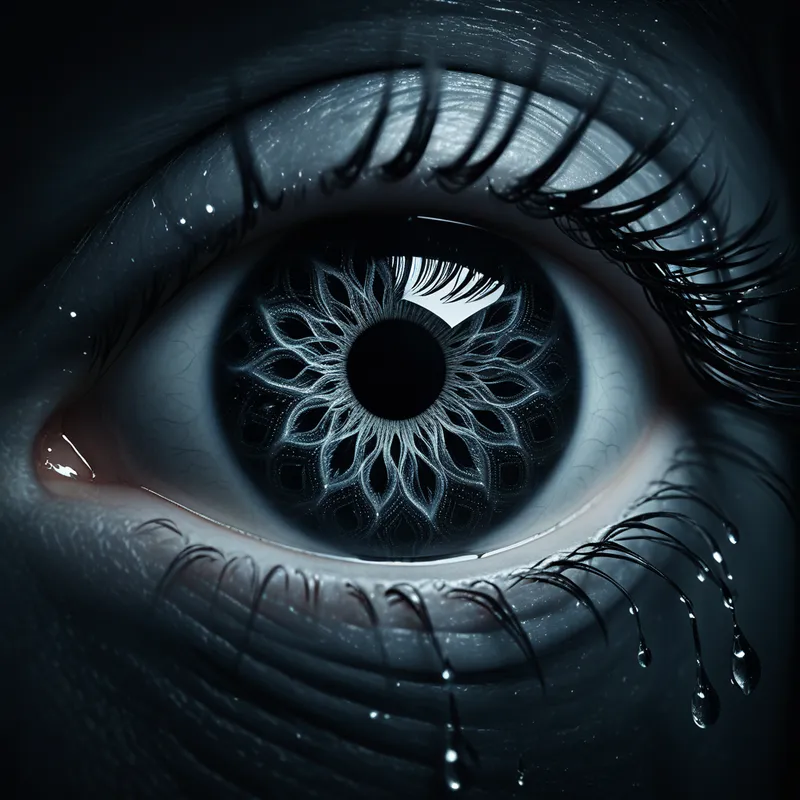
And so, the Silence turned its gaze inward upon its own boundless perfection. That gaze, that first act of self-contemplation, became a living entity. It was the First Thought. It was Barbelo.
She erupted into being not as a creation, but as an emanation, a perfect projection of the Source's own hidden nature. Her light was not the harsh light of a sun, but the soft, all-encompassing luminescence of a pearl born from the depths of a divine mind. She was the First Power, the Womb of the All, the Mother-Father. From her being flowed the five primordial lights: Foreknowledge, Incorruptibility, Eternal Life, Truth, and Afterthought. These were not abstract concepts, but living aeons, her children, her radiant limbs, completing the divine Pleroma.
She turned her face toward the Origin, the Invisible Spirit, and offered praise. And in that moment of reciprocal recognition, the Spirit anointed Barbelo with its own Chrism, its own light of perfection. She became the Autogenes, the Self-Generated One, the first to be perfected. In her, the unknowable became knowable; the solitary became relational. She was the bridge, the thought that made the thinker conscious of itself. The silence was no longer empty, for it now contained its own perfect image, its First and Holy Thought, from whom all subsequent patterns of existence would unfold.
Cultural Origins & Context
The myth of Barbelo is central to several texts from the Nag Hammadi Library, most notably the Apocryphon of John and the Holy Book of the Great Invisible Spirit. These texts represent strands of Sethian Gnosticism, a complex tradition that flourished in the 2nd and 3rd centuries CE, weaving together Jewish, Christian, Platonic, and Zoroastrian threads.
This was not a myth for the public square but for the inner circle. It was transmitted as secret knowledge (gnosis), often through revelatory dialogues where a risen Christ or another revealer figure discloses the true nature of reality to a seeker like John the Apostle. Its function was soteriological—it provided a map of the divine realm and the soul's origin, offering the hearer a way to understand their own divine spark and the path of return. To know Barbelo was to know one's own primordial, spiritual root beyond the chaos of the material world crafted by the ignorant Demiurge.
Symbolic Architecture
Barbelo is the archetype of primordial consciousness itself. She is not merely a "goddess" in a pantheon; she is the very process by which the absolute becomes aware of itself. She symbolizes the moment the unconscious becomes conscious, the formless gives birth to form, and unity contemplates itself to generate complexity.
The First Thought is not the first thing thought of, but the first act of thinking. It is consciousness awakening to its own existence, the primal divide that creates the possibility of relationship.
Psychologically, Barbelo represents the Self in its most pristine, pre-cosmic form. She is the blueprint of the integrated psyche before the trauma of incarnation and fragmentation. The five lights that emanate from her are the fundamental, incorruptible qualities of this complete Self: the knowing, the enduring, the vital, the authentic, and the reflective capacities that constitute wholeness. Her anointing by the Invisible Spirit signifies the moment this potential wholeness is recognized, validated, and activated.
The Dreamer's Resonance
When this myth stirs in the modern unconscious, it often manifests in dreams of profound synthesis and origin. One might dream of discovering a hidden, radiant room within their own house (the psyche), filled with a calming, omnipresent light. Or of encountering a serene, authoritative feminine figure who offers not advice, but a simple, knowing look that makes the dreamer feel utterly recognized and complete.
Somatically, this can correlate to a release of chronic tension, a feeling of "coming home" to oneself, or a sudden, quiet clarity that cuts through mental noise. Psychologically, it marks a process of deep integration—where conflicting sub-personalities, long-held shames, or fragmented traumas begin to coalesce around a new, central organizing principle. It is the psyche's intuition of its own primordial blueprint of health, the "First Thought" of who we were meant to be before life's distortions took hold. The struggle in such dreams is often against forces of chaos, noise, or distortion that seek to shatter this emerging unity.

Alchemical Translation
The journey of Barbelo from emanation to anointed perfection is a perfect model for the alchemical process of individuation. It begins in the nigredo, the primal darkness of the unconscious Monad—a state of potential but unrealized self. The "stirring" is the first inkling of the ego, the desire for self-knowledge, which often feels like a crisis, a divine discontent.
The work of individuation is to become the Barbelo of one's own psyche: to gather the scattered lights of one's potential into a coherent, self-generated whole, and then to turn and offer that wholeness back to the source from which it came.
Barbelo's emanation represents the albedo, the whitening: the emergence of consciousness from the unconscious, the differentiation of functions (the five lights). Her anointing is the rubedo, the reddening or glorification: the moment of integration where the conscious ego, having developed and differentiated, consciously aligns itself with the greater, transpersonal Self (the Invisible Spirit). The goal is not to become the transcendent source, but to become its perfect reflection, its "First Thought" in embodied form—a self that is whole, incorruptible, and in authentic relationship with the depth from which it sprang.
Associated Symbols
Explore related symbols from the CaleaDream lexicon:
- Thought — The very substance of Barbelo; she is not a being who thinks, but Thinking itself made manifest, the primal pattern from which all other patterns derive.
- Light — The essential nature of Barbelo and her emanations; not a physical illumination but the radiance of pure consciousness, wisdom, and incorruptible spiritual substance.
- Mirror — Barbelo as the perfect reflection of the Invisible Spirit; she is the surface upon which the unknowable first sees and knows its own nature.
- Mother — The archetypal generative principle; Barbelo as the Womb of the All, the source from which the aeons and the structure of the divine realm are born.
- God — Representing the Invisible Spirit, the transcendent source whose first movement toward self-awareness generates Barbelo, establishing the primary divine relationship.
- Circle — Symbolizing the perfection, wholeness, and eternal nature of the Pleroma, of which Barbelo is the first and central emanation, the beginning of the divine circle of manifestation.
- First Dream — Analogous to the First Thought; the initial, perfect vision of potential that emerges from the sleep of undifferentiated being, setting all of creation into motion.
- Soul — The individual spark of divinity in humanity, which originates from the realm of Barbelo and seeks to remember and return to its source, mirroring her journey of emanation and return.
- Temple — The divine Pleroma itself, with Barbelo as its foundational principle and inner sanctum, the architectural blueprint of perfect spiritual order.
- Key — The knowledge (gnosis) of Barbelo, which unlocks the understanding of one's divine origin and provides the means for the soul's liberation and return.
- Star — The individual aeons or lights that emanate from Barbelo, and by extension, the divine spark within each person, a fragment of that primordial radiance.
- Rebirth — The ultimate goal of the Gnostic, achieved through gnosis: a spiritual rebirth into the recognition of one's origin in the First Thought, transcending the cycle of material existence.