Baku Myth Meaning & Symbolism
A benevolent chimera born from divine compassion, the Baku devours nightmares, offering a sacred model for psychic digestion and transformation.
The Tale of Baku
Listen, and let the night air carry you back. Before the world was lit by wires, when darkness was a vast and living cloak, children would whisper a prayer into the gathering dusk. They feared the descent into sleep, for that was when the yokai of worry and dread would slip from the cracks in the world to feast upon their quiet minds. Nightmares, with claws of cold fear and breath of despair, would settle upon their chests, a weight no child should bear.
In the high, celestial plains where the kami dwell, a council was held. The cries of tormented dreamers, thin and sharp as winter wind, had reached even there. Amaterasu, the sun goddess, whose light banished the shadows of the waking world, could not pierce the private darkness of the soul. The deities saw that a new kind of compassion was needed, one that could walk the borderlands of consciousness, a guardian not of the day, but of the deep, vulnerable night.
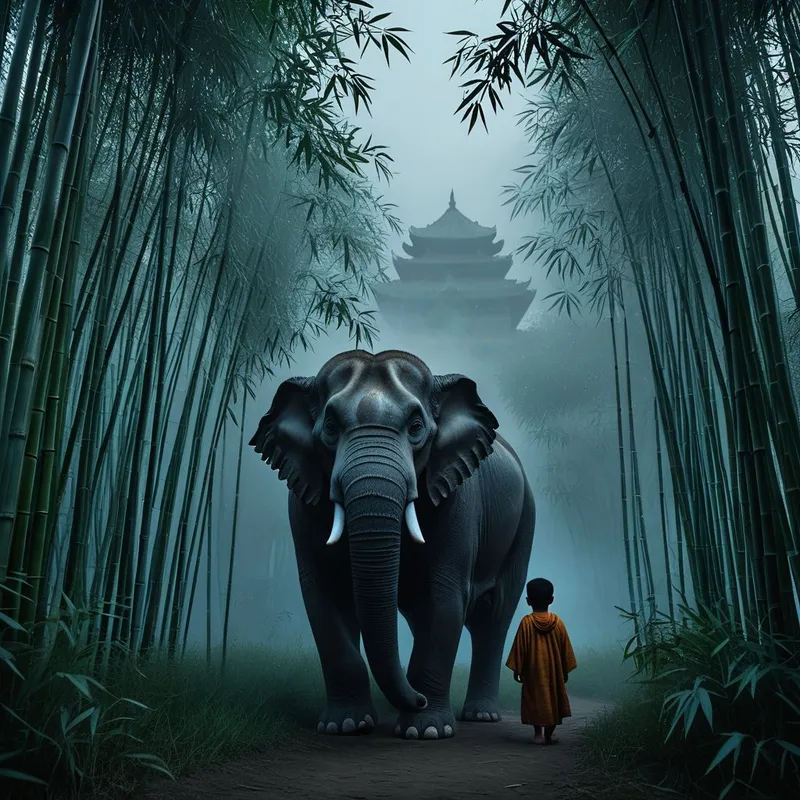
And so, from a place of profound mercy, they fashioned a new being. They took the wise, remembering head of the elephant, the strong, protective body of the bear, the steadfast, enduring tail of the ox, and the fierce, swift paws of the tiger. They breathed into this patchwork form a singular purpose: to be a consumer of evil. Not to fight it, not to banish it with light, but to draw it in, to make the poisonous dream its sole sustenance. They named it Baku.
It was given a sacred instruction: to wander the edges of the human world, listening for the quickened breath, the stifled whimper of a dreamer in thrall to a nightmare. Upon hearing the plea, "Baku, come eat my dream," it would manifest—a gentle giant in the moonlit room, a silhouette of impossible anatomy. It would lower its great, trunk-like nose to the dreamer's brow. And then, with a soft, powerful inhalation, it would draw the nightmare out. The swirling black mist of terror, the formless shapes of anxiety, all would be pulled from the mind’s eye, swallowed whole into the Baku’s fathomless belly. Where the nightmare had been, only a calm, empty space remained—a clean slate of sleep. Having fed, the Baku would melt back into the shadows, its hunger a holy service, its form a testament to the gods' ingenuity in crafting a protector from the very essence of the beasts they revered.
Cultural Origins & Context
The Baku’s origins are as hybrid as its form, flowing into Japan from Chinese folklore and Buddhist tradition, where it was known as a mo. Over centuries, it was adopted and adapted, becoming a uniquely Japanese solution to a universal human problem. It moved from esoteric religious texts and fusuma screens in temples into the practical magic of the everyday.
Its primary societal function was as a folkloric palliative, a psychological technology for an age before psychology. Parents told their children of the Baku to offer comfort and a sense of agency against nighttime fears. The act of whispering the invocation, "Baku, come eat my dream," was a potent ritual. It transformed passive terror into an active request, shifting the child from victim to petitioner in a sacred transaction. The myth was propagated through oral tradition, in bedtime stories and warnings, and later immortalized in ukiyo-e prints, where artists depicted the benevolent beast at its work. It served as a cultural container for anxiety, personifying the process of nightmare relief and embedding the idea that even our darkest inner experiences could be met, managed, and metabolized by a compassionate, externalized force.
Symbolic Architecture
The Baku is not a warrior; it is a digestor. Its power lies not in destruction, but in ingestion. This is its first and greatest symbolic lesson.
The true alchemy is not in rejecting the shadow, but in developing the psychic stomach to digest it.
Its composite nature is its genius. The elephant offers memory and wisdom—the nightmare is not forgotten but contextualized. The bear provides protective strength and the capacity to hibernate, to go into the dark place and emerge anew. The ox contributes patient labor, the slow, steady work of processing. The tiger brings the necessary ferocity to confront the terrifying content without being destroyed by it. The Baku is thus a symbol of the integrated Self, a being greater than the sum of its parts, specifically assembled for a sacred task: the transformation of psychic poison.
The nightmare it consumes represents the undigested material of the psyche—repressed fears, unmetabolized trauma, free-floating anxiety. The Baku models a process of active reception. It does not argue with the nightmare’s content, nor does it try to rationalize it away with daylight logic. It acknowledges the nightmare’s reality as an energetic form and makes it food. This symbolizes the profound psychological move from resistance to acceptance, from fear of a content to curiosity about its function.
The Dreamer's Resonance
When the pattern of the Baku emerges in a modern dreamer’s life—whether through dreaming of such a creature, feeling a presence that alleviates dread, or through a compelling draw to the myth itself—it signals a critical phase of psychic processing. Somatically, it may correlate with a release of tension held in the solar plexus or chest, the physical seats of anxiety. Psychologically, the individual is likely grappling with an "undigested" experience.
This is not about literal nightmares, but the waking nightmares of unresolved grief, chronic worry, or a pervasive sense of threat that one cannot locate. The Baku’s appearance in the inner landscape suggests the unconscious is attempting to build or activate an internal structure capable of this digestion. The dreamer is in the process of learning to host their own discomfort, to stop projecting it outward as blame or internalizing it as shame, and to instead hold it within a larger, more compassionate container of the Self. The plea, "Baku, come eat my dream," translates to the modern imperative: "I am ready to no longer be terrorized by this. I am ready to metabolize this experience."

Alchemical Translation
The individuation journey requires us to reclaim all disowned parts of ourselves, especially the frightening and the foul. The Baku provides a precise model for this alchemical transmutation. The process has three stages: Invocation, Ingestion, and Integration.
First, Invocation. One must consciously call forth the capacity to face the darkness. This is the courage to look at the nightmare, to name it, and to actively seek a process for its transformation. It is the end of passive suffering.
Second, Ingestion. This is the perilous, internal work. Using the composite strengths of the Baku—the wisdom to see the nightmare’s origin, the strength to hold its charge, the patience to stay with the process, and the fierceness to prevent identification with it—the psychic material is drawn in. It is allowed to exist within the system without immediately being expelled (denial) or causing systemic collapse (overwhelm).
The goal is not to have no nightmares, but to develop the Baku within—the psychic organ that renders nightmares nourishing.
Finally, Integration. What was toxic waste is broken down and transmuted into something useful. The energy bound in fear becomes available for vigilance or creative passion. The insight hidden in trauma becomes a source of empathy and depth. The Baku itself, having done its work, becomes a permanent inner archetype—a built-in, compassionate function of the mature psyche that knows how to handle distress. The individual no longer fears the contents of their own unconscious because they have internalized the myth. They have become, in part, their own Baku, capable of turning the lead of nocturnal terror into the gold of profound self-knowledge and resilience. The myth completes its journey from a story told to comfort a child to a living, breathing structure within the adult soul.
Associated Symbols
Explore related symbols from the CaleaDream lexicon: