Bagua Myth Meaning & Symbolism
The primordial Bagua, born from cosmic observation, maps the eight fundamental forces of reality, offering a key to navigating life's eternal transformations.
The Tale of Bagua
Before history was written, when the world was a canvas of mist and potential, the great sage-emperor Fu Xi walked the banks of the Yellow River. His heart was heavy with the chaos of the world—the unpredictable floods, the sudden fires, the shifting winds, the silent growth of things. The people lived in fear of the unseen patterns that governed their lives, a world of bewildering change.
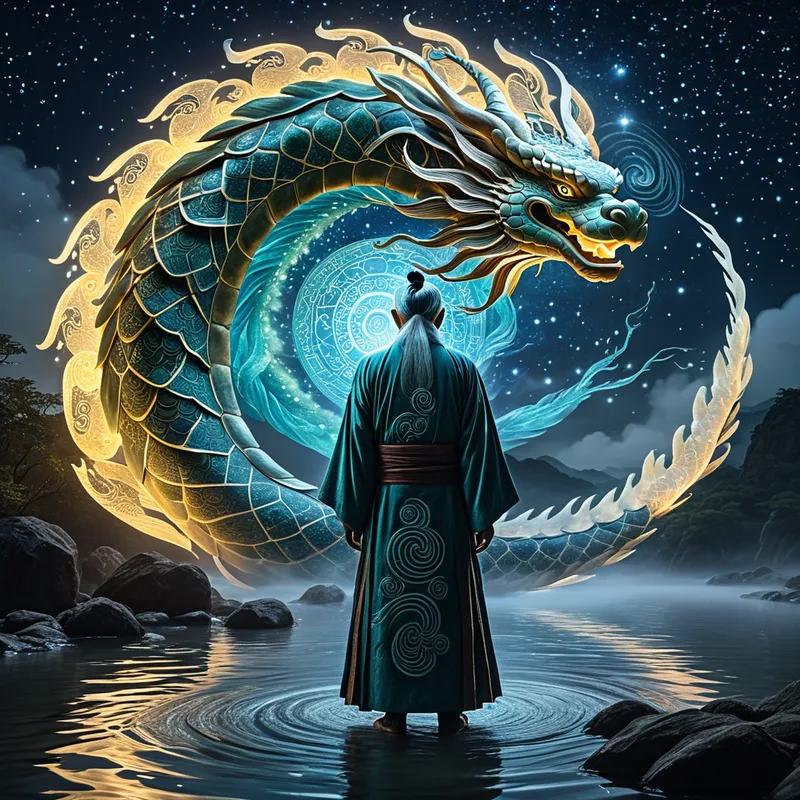
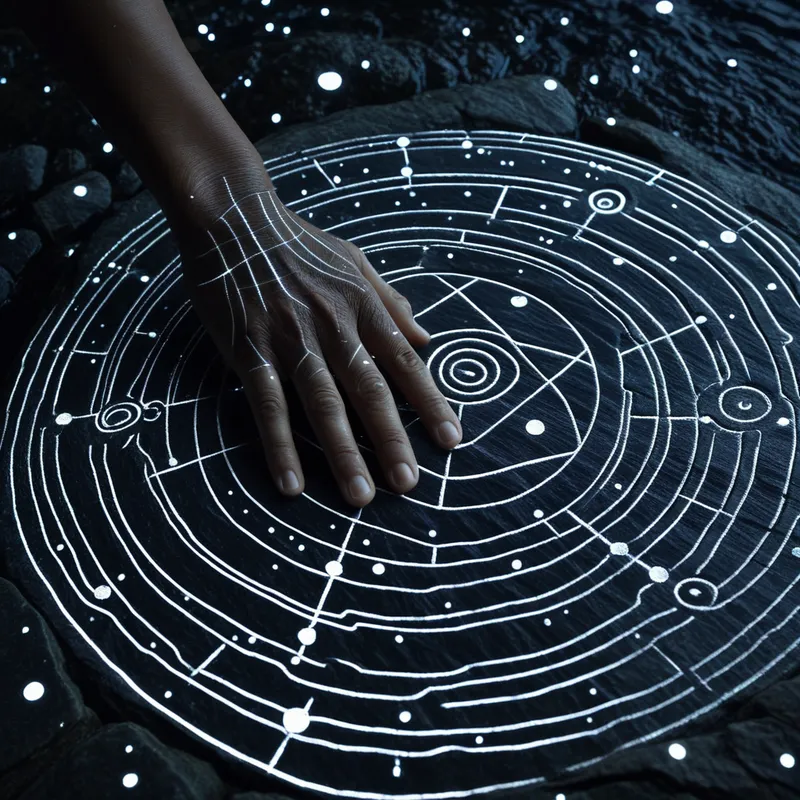
One day, as the sun bled into the horizon and the first stars pricked the violet sky, the waters of the river began to churn. Not with threat, but with a profound, humming resonance. From the depths emerged a being of myth—a majestic Dragon-Turtle. Its shell was not like that of any ordinary creature; it was a map of the cosmos itself, inscribed with a pattern of broken and unbroken lines. Some lines were solid, like the unyielding mountain. Others were split, like the flowing river. They were arranged in eight groups of three, a silent, potent language.
Fu Xi stood transfixed. He saw in those lines the echo of everything. The solid triple line was the sky itself, vast and unbroken. The split triple line was the earth, receptive and yielding. Between them, he saw the six children: the roaring thunder, the clinging wind, the flickering fire, the still lake, the rushing water, the immovable mountain. Here was the conflict of existence made manifest—not as a battle, but as a dance of complementary forces. The rising action was not a clash of swords, but the dawning of comprehension in the sage’s mind.
He spent nights with his eyes on the shell, his fingers tracing the patterns in the sand. He felt the crackle of Zhen in a spring storm, the gentle persistence of Xun in growing bamboo, the brilliant clarity of Li in a cooking flame, the deep joy of Dui in a child’s laughter, the perilous flow of Kan in a river gorge, the steadfastness of Gen in a peak at dawn. The resolution was the gift he gave to humanity: the Bagua. It was not a weapon, but a mirror. A mirror held up to the universe, and in its reflection, humanity found not chaos, but an order so profound it encompassed all change.
Cultural Origins & Context
The myth of Fu Xi and the Dragon-Turtle is part of China’s foundational lore, recorded in texts like the <abbr title=""Appended Judgments," a commentary on the I Ching">Yì Zhuàn. It is not a story of gods on Olympus, but of a culture hero—a sage-king—who discerned the underlying principles of reality through profound observation of nature and celestial revelation. This origin positions the Bagua not as a divine invention, but as a discovered truth, a cosmic code revealed to a mind prepared to receive it.
The primary vehicle for this myth is the I Ching, or Book of Changes. For millennia, it was consulted by emperors for statecraft, by generals for strategy, and by individuals for guidance. The myth served a crucial societal function: it provided a cosmological framework that made the universe intelligible and navigable. It transformed fate from a capricious force into a pattern that could be understood, respected, and harmonized with through wisdom and ethical action. The story was passed down by scholars, diviners, and philosophers, embedding itself not just in religion, but in medicine, martial arts, architecture (Feng Shui), and state ideology.
Symbolic Architecture
At its core, the Bagua is a symbolic architecture of the psyche and the cosmos. It represents the fundamental binary of existence—the yang (unbroken, active, light) and the yin (broken, receptive, dark)—and their infinite permutations. The eight trigrams are not static symbols; they are dynamic archetypal states, phases in the eternal cycle of transformation.
The Bagua is the universe’s first language, spoken in the grammar of polarity and change.
The central figure, Fu Xi, represents the awakened human consciousness that can perceive this underlying order. The Dragon-Turtle is the embodied unconscious of the world itself, the anima mundi or world soul, offering up its secrets. The river is the flow of time and life, the medium through which deep wisdom surfaces. The myth teaches that order is not imposed upon chaos from the outside, but is its inherent, latent structure, waiting to be recognized.
Psychologically, each trigram correlates to a fundamental force within the human experience: the creative impulse (Qian), the nurturing capacity (Kun), the initiating shock (Zhen), the penetrating insight (Xun), the illuminating awareness (Li), the joyful connection (Dui), the focused depth (Kan), and the contemplative stillness (Gen). The complete system is a mandala of the Self, depicting the full spectrum of psychic energy.
The Dreamer's Resonance
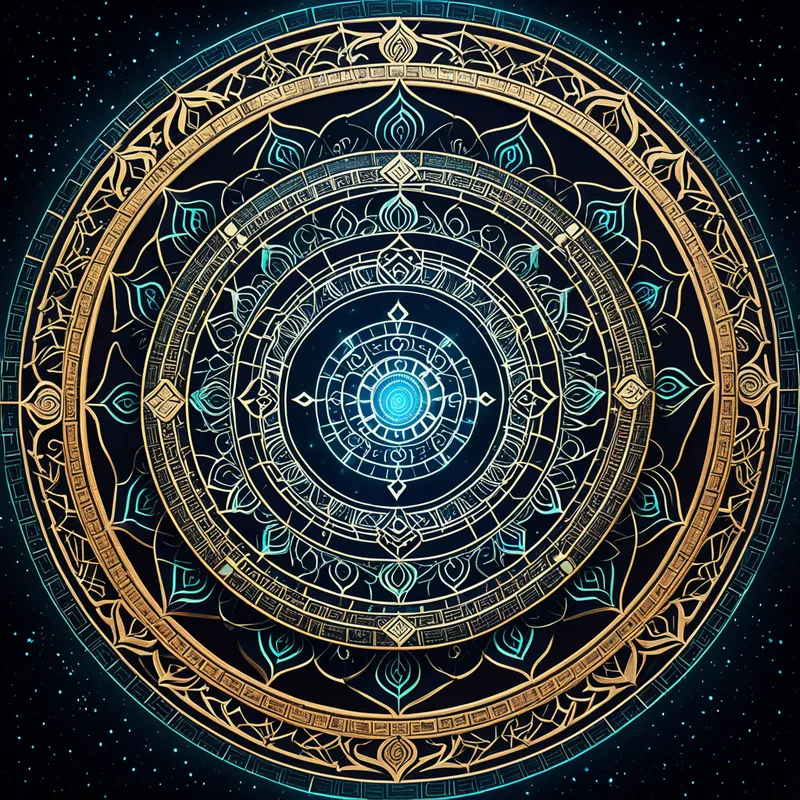
When the Bagua appears in modern dreams, it rarely manifests as a literal diagram. Instead, one might dream of a complex, mesmerizing pattern on a floor, a wall, or a piece of jewelry that feels profoundly significant. One might dream of standing at a crossroads with eight distinct paths, each radiating a different “feeling”—one stormy, one bright, one deeply quiet. The somatic experience is often one of awe, a sense of being in the presence of a vast, intelligent design.
This dream signals a psychological process of seeking orientation within a period of life transition or inner chaos. The dreamer’s psyche is attempting to map their internal landscape, to name the conflicting forces at play within them. Is the raging Kan of fear and uncertainty dominating? Where is the grounding, nurturing Kun? The dream presents the Bagua as the psyche’s own innate navigational system, activating to show that what feels like disintegration is actually a reconfiguration of elements into a new, more conscious order.
Alchemical Translation
The myth models the alchemical process of psychic transmutation—individuation—with elegant precision. The initial state is the prima materia: the undifferentiated chaos of the unexamined life (the turbulent river). The catalyst is the encounter with the Self (the Dragon-Turtle), the deep, ancient wisdom of the unconscious that seems alien and numinous. The sage’s act of observation and contemplation is the opus, the long work of analysis and integration.
To receive the Bagua is to undertake the ultimate alchemy: the transformation of bewildering experience into comprehensible wisdom.
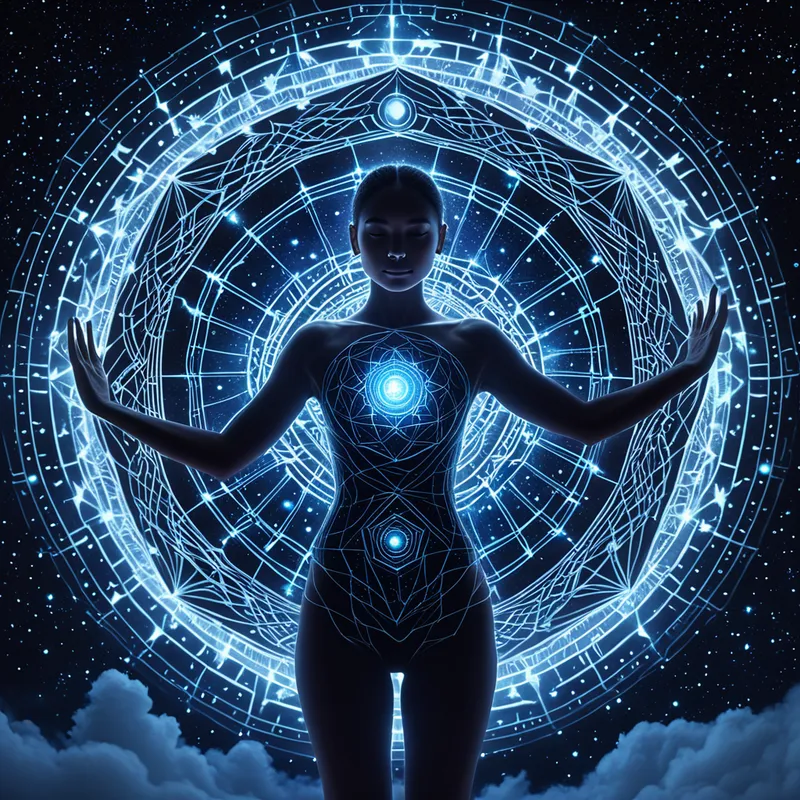
The eight trigrams represent the stages and facets of this inner work. One must pass through the abyssal waters of the shadow (Kan), find stillness for introspection (Gen), allow the illuminating fire of consciousness to clarify (Li), and finally integrate these into a joyful, expressive whole (Dui). The goal is not to eliminate one force in favor of another, but to recognize their necessary interplay, to find the dynamic balance point at the center of the mandala—the Taiji. For the modern individual, this translates to moving from being a passive victim of life’s changes to becoming a conscious participant in one’s own transformation, using the map of inner archetypes to navigate the journey toward wholeness.
Associated Symbols
Explore related symbols from the CaleaDream lexicon:
- River — The flowing medium of time and life from which cosmic wisdom emerges, representing the continuous process of change and revelation.
- Dragon — The celestial, transformative power and ancient wisdom embodied in the Dragon-Turtle, symbolizing the connection between heaven, earth, and deep knowledge.
- Circle — The perfect form of the Bagua arrangement, representing the cyclical nature of all processes, wholeness, and the eternal return.
- Mountain — Directly对应 the trigram Gen, symbolizing stillness, meditation, immovability, and the inner stability required to perceive cosmic order.
- Water — Corresponding to the trigram Kan, it symbolizes the unconscious, the abyss, danger, and adaptive flow, the primal substance from which life and insight arise.
- Fire — Corresponding to the trigram Li, it represents consciousness, illumination, clarity, and the clinging awareness that brings definition to form.
- Sky — Corresponding to the trigram Qian, it is the archetypal creative force, the father principle, and the realm of pure potential and action.
- Earth — Corresponding to the trigram Kun, it is the archetypal receptive force, the mother principle, and the grounding, nurturing capacity that gives form to potential.
- Mirror — The Bagua itself functions as a cosmic mirror, reflecting the true structure of reality and the self, enabling profound self-reflection and divination.
- Order — The ultimate gift of the myth, the deep, patterned structure underlying apparent chaos, which provides a framework for meaning and ethical navigation.
- Vision — The sage's capacity to see the pattern on the turtle's shell, representing the moment of profound insight that bridges the human and the cosmic.
- Star — The celestial inspiration and cosmic mapping inherent in the Bagua, linking earthly patterns to the order of the heavens.
- Conundrum Box
- Octagon
- Herringbone Floor