
Badr Basim and the Sea Myth Meaning & Symbolism
A prince, born of the sea, must descend into its perilous depths to rescue his beloved, confronting monstrous guardians and his own divided nature.
The Tale of Badr Basim and the Sea
Listen, and let the scent of salt and ambergris carry you to a time when the world was woven from wonder. In the land of Persia, a king named Shahriman wept for an heir. His prayers, carried on desert winds, were finally answered not by the God of the sky, but by the sovereign of the abyss. His queen, a woman of surpassing beauty, was revealed as Jalila, a princess of the vast, unseen kingdom beneath the waves. She gave him a son, radiant as the full moon, and named him Badr Basim—"Full Moon of the Dawn." But with the child's birth, her heart was torn; the call of the deep, the pull of her own kind, was a tide too strong to resist. With a last, salt-tinged kiss upon the boy's brow, she vanished back into the foam, leaving the king with a son who carried the sea in his veins.
Badr Basim grew, a prince of the land with the restless spirit of the ocean. His destiny, however, was written not on parchment, but in the reflection of a magical Mirror. Gazing into it, he beheld not his own face, but the luminous visage of Jauhara, princess of the Green Sea and daughter of the great Sea-King. His soul was ensnared. No earthly beauty could compare. Driven by this vision, he turned his back on his terrestrial throne and embarked on a Journey that would lead him to the world's watery edge.
There, he sought the aid of his maternal grandmother, a wise and powerful queen of the sea-jinn. She gifted him a magical ointment that would grant him the ability to breathe water and walk the ocean floor, and a warning that echoed like a deep-sea current: the path to Jauhara was guarded by terrors that could crush a mortal's mind. With the rubies of courage set in his heart, Badr Basim anointed himself and plunged into the unknown.
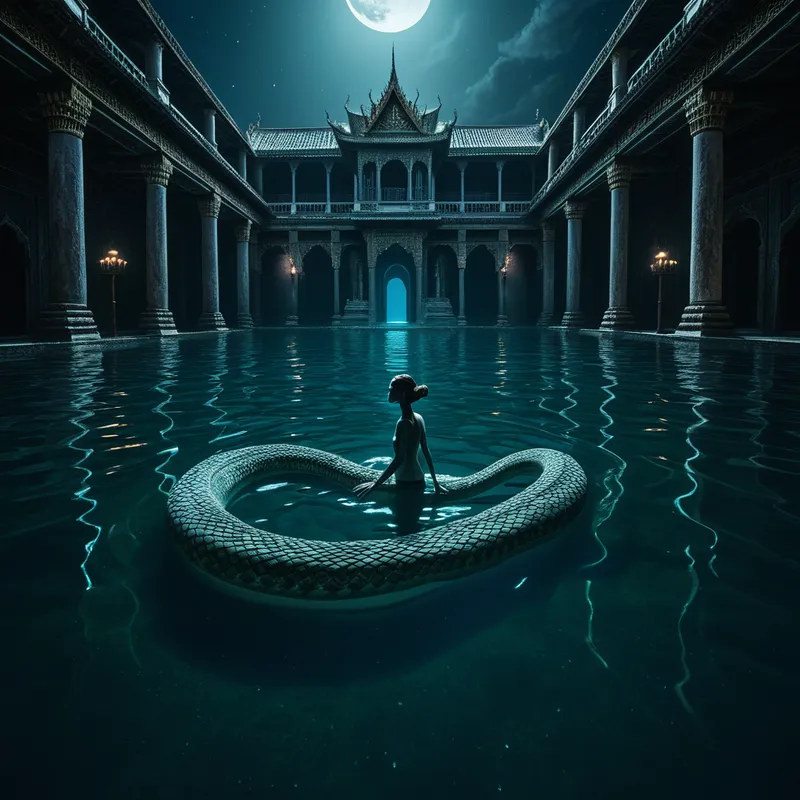
The descent was a baptism into another cosmos. He passed through forests of towering kelp where fish like living jewels darted, and over plains of white sand that stretched into eternal blue. But the guardians were waiting. First, a monstrous Fish with jaws wide enough to swallow ships, which he outwitted by hiding in a cleft of rock. Then, a beast with the head of a lion, the body of a whale, and the tail of a serpent, whose roar shook the very water. Badr Basim, using cunning over brute force, slipped past as it battled with a giant squid. Finally, he faced the most formidable sentinel: a Serpent of immense size, coiled around the gates of the pearl-and-coral palace, its eyes like cold green lanterns. Remembering his grandmother's whispered secrets, he spoke words of power—an ancient greeting of the sea-folk—and the beast, recognizing the royal blood within him, lowered its head and allowed him passage.
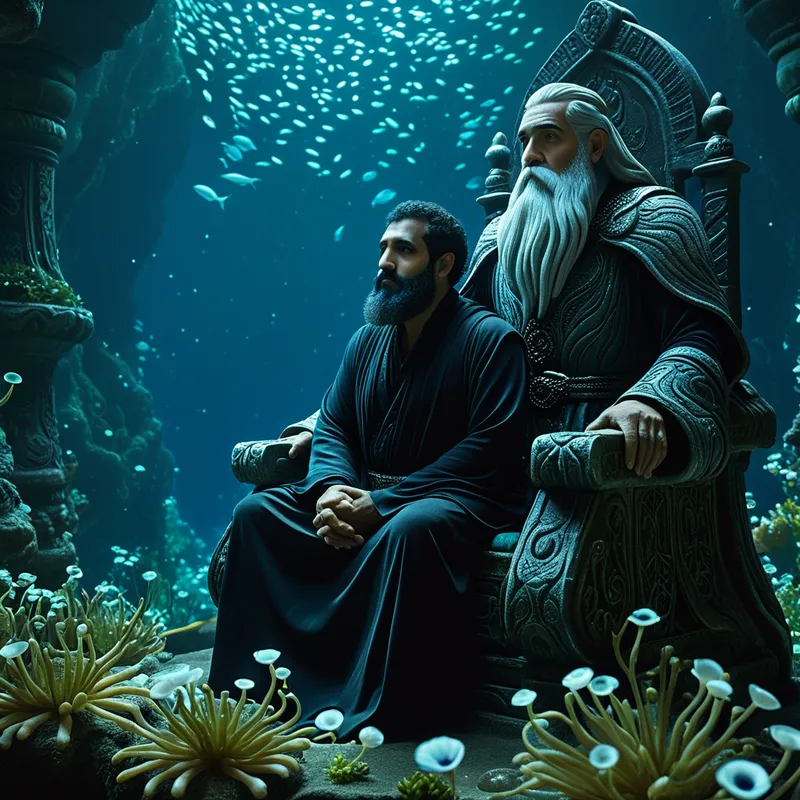
Within the radiant court of the Sea-King, he found Jauhara. But his trials were not over. Her father, a majestic and stern figure, set impossible tasks to prove his worth: to fetch a legendary pearl from the belly of a abyssal clam, to tame a seahorse of lightning speed, and to answer riddles of the deep that tested his wisdom as much as his valor. Through each, Badr Basim proved he was not merely a man of the land, but a true scion of both worlds. His love, persistent as the tide, and his rightful heritage eventually won the day. The Sea-King bestowed his blessing, and Badr Basim and Jauhara were united, their marriage a sacred covenant between the world above and the world below, a healing of the rift that had begun with his own birth.
Cultural Origins & Context
The tale of Badr Basim is a jewel from the vast treasure chest of the One Thousand and One Nights. It belongs to a stratum of stories that blend pre-Islamic Arabian lore, Persian epic sensibility, and the cosmopolitan imagination of the Abbasid era. Narrated within the frame story by the legendary Scheherazade, it served as more than mere entertainment; it was a vehicle for exploring complex identities in a world where trade routes connected deserts to oceans, and where cultures mingled as fluidly as the tides.
Told in the intimate space of the royal chamber, its function was multifaceted. For a maritime and desert people, the sea was both provider and profound mystery—a source of livelihood and a realm of unimaginable danger and magic. This myth gave narrative shape to that relationship, personifying the sea's duality as both nurturing mother (in Jalila) and challenging, sovereign father (in the Sea-King). It also modeled a crucial social and psychological narrative: the integration of disparate lineages. For a culture with deep ties to genealogy and tribe, Badr Basim's successful navigation of his dual heritage offered a template for reconciling different bloodlines, social standings, or even the clash between settled urban life and the nomadic or maritime unknown.
Symbolic Architecture
At its heart, this is a myth of the individuation Journey. Badr Basim represents the conscious ego, born of a known, "terrestrial" world (the father-kingdom), yet inherently incomplete, haunted by the absence of the unconscious, oceanic realm (the mother-source).
The call of the beloved seen in the mirror is the call of the soul—the Self—from the depths of the unconscious. One does not find wholeness by staying in the familiar light of day.
The descent into the sea is the quintessential plunge into the unconscious. The magical ointment symbolizes a necessary, conscious preparation or willingness to engage with this alien medium—one cannot navigate the depths with a terrestrial mindset. The three guardians—the devouring Fish, the chimeric beast, the threshold Serpent—are classic manifestations of the personal and collective shadow, the terrifying but ultimately transformable aspects of the psyche one must confront and integrate to proceed. The Sea-King himself is an archetypal figure of the Self in its awe-inspiring, often daunting, aspect. The impossible tasks are the ordeals the ego must undergo to prove it is worthy of union with the soul's deepest essence (Jauhara).

The Dreamer's Resonance
When this myth stirs in the modern Dream, it often manifests as dreams of deep water, of finding hidden rooms or palaces underwater, or of being pursued or tested by aquatic creatures. The somatic feeling is one of pressure, of breathing in a foreign element, or of incredible, weightless freedom.
Psychologically, this signals a profound process of soul-work. The dreamer is being called to explore a neglected or repressed aspect of their own nature—perhaps a creative source, an emotional depth, or a lineage (cultural or familial) they have disowned. The feeling of being "of two worlds" is key. The dream may present a conflict between a secure, dry-land life and a compelling, mysterious, but risky call from the depths. The guardians that appear—whether as sharks, tangled weeds, or dark figures in the water—represent the specific fears, complexes, or memories that guard the threshold to this deeper self. To dream of successfully navigating these depths and finding a treasure or a beloved there indicates a powerful movement toward psychic integration.
Alchemical Translation
The alchemical process mirrored here is solutio—dissolution in the primal waters. The fixed, crystalline identity of the terrestrial prince (the ego) must be dissolved in the salty, chaotic waters of the unconscious (the sea) to be reconstituted into a more complete, fluid, and resilient form.
The pearl won from the abyssal clam is the philosopher's stone born of the union of opposites: the grit of earthly experience embraced by the soft, nurturing, yet formidable substance of the deep self.
Badr Basim's journey is a map for psychic transmutation. First, there is the recognition of lack (the vision in the mirror). Then, the willingness to be transformed (applying the ointment). The confrontation with shadow (the guardians) is not about slaughter, but about cunning, respect, and the use of innate resources (his sea-blood). The engagement with the central authority of the psyche (the Sea-King's tasks) requires the ego to submit to a higher order of meaning, to develop skills and wisdom it did not previously possess. The final sacred marriage (hieros gamos) is the culmination: the conscious mind (Badr) is wedded to the anima, the soul-image (Jauhara), under the auspices of the Self (the Sea-King). This creates a new, sovereign inner reality that honors both one's conscious history and one's unconscious depths, capable of ruling the inner kingdom with wisdom drawn from both realms.
Associated Symbols
Explore related symbols from the CaleaDream lexicon:
- Ocean — The vast, unconscious psyche itself—the source of life, mystery, danger, and ultimate destiny, representing everything unknown within and without.
- Journey — The essential path of individuation, the descent into the self that is both a physical quest and a profound psychological ordeal and revelation.
- Serpent — The primal guardian of the threshold between worlds, embodying the transformative power of the deep unconscious that must be confronted and integrated.
- Mirror — The tool of self-reflection and soul-recognition, revealing not the surface ego but the deeper, destined image of the beloved or the Self.
- Fish — The often monstrous contents of the personal unconscious that must be encountered and navigated during the soul's descent into its own depths.
- Mother — The nurturing yet elusive source, the realm of origin (the sea) that calls one back for completion, represented by Badr's jinn-mother, Jalila.
- Father — The structuring principle and the figure who sets trials, here split between the terrestrial king and the Sea-King, representing different aspects of authority and law.
- Sacrifice — The necessary surrender of the old, land-bound identity to embrace the fluid, demanding reality of the deeper self and its requirements.
- Love — The animating force of the quest, representing the soul's irresistible pull toward wholeness and union, which makes the perilous journey worthwhile.
- Hero — The archetypal pattern embodied by Badr Basim, who ventures into the unknown to retrieve a treasure (integration) for the benefit of his entire being.
- Dream — The medium through which the call of the sea is often heard in modern life, a personal echo of the ancient, mythic journey into the depths.