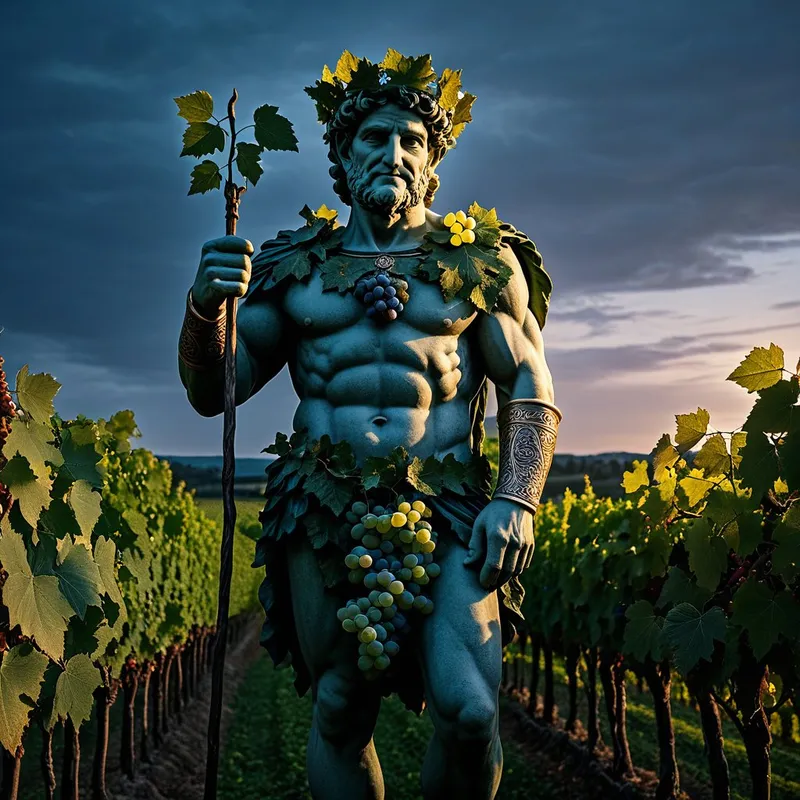
Bacchus Myth Meaning & Symbolism
The story of the twice-born god of ecstasy, whose wild rites reveal the terrifying and liberating power of the unconscious breaking into ordered life.
The Tale of Bacchus
Hear now the tale of the god who arrives not with the dawn, but with the twilight—the god of the unraveling, the twice-born, the liberator. In the land of Thebes, under a king’s stern and rational rule, a stranger came. He was beautiful, with the softness of youth and the ancient, knowing eyes of a beast. His hair was dark and crowned with ivy and the fat, purple clusters of the vine. In his hand, he carried the thyrsus, a wand that was also a weapon. They called him Bacchus.
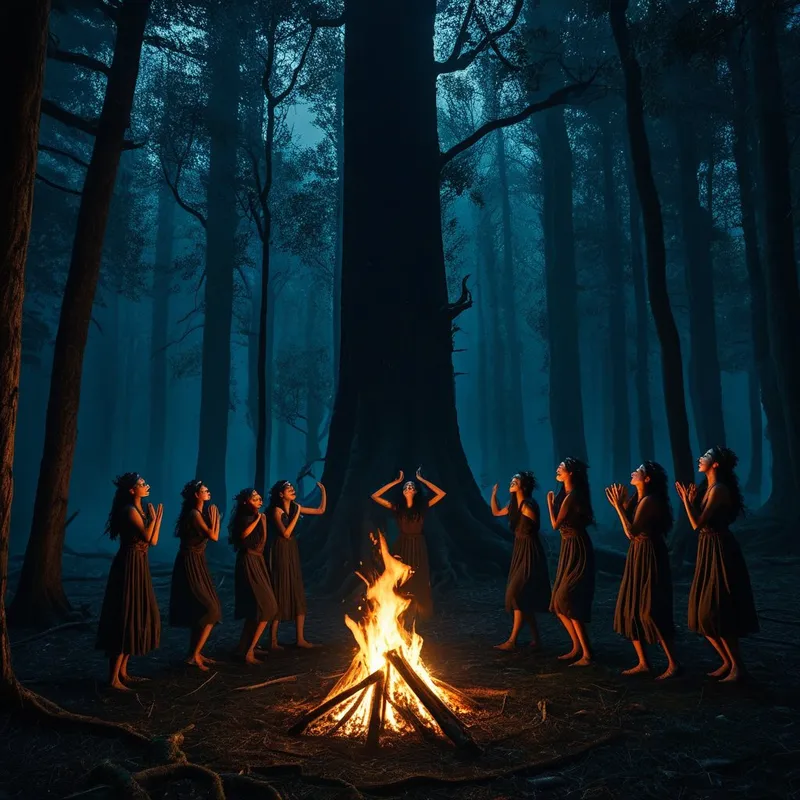
He brought with him a retinue not of soldiers, but of souls unbound: wild-eyed women, the Maenads, who had left their looms and their children to follow the sound of his flutes and the beat of the deep, driving drum. Their cries were not of grief, but of a terrifying joy. They wore fawn skins and carried serpents that coiled like living bracelets. Where they danced, milk and honey sprang from the earth, and wine flowed from the soil itself.
But in Thebes, King Pentheus sat on his throne of order. He heard the strange music from the mountain, saw his own mother and aunts among the throng, and his soul filled with cold, rational disgust. This was not piety; this was madness, a disease to be quarantined. He had the beguiling stranger seized and bound in the palace dungeon, a testament to the power of law over chaos.
Yet in the dark cell, the bonds fell like rotten threads from the god’s limbs. The stone walls sprouted fragrant vines. The air grew thick with the scent of wine and damp earth. Bacchus appeared before Pentheus not as a prisoner, but as an inquisitor cloaked in gentle persuasion. He offered the king a chance to see the mysteries with his own eyes, to witness the sacred rites hidden in the forest’s heart. Consumed by voyeuristic scorn and a deeper, unrecognized longing, Pentheus agreed. The god disguised him in the linen robes and fawn-skin of a Maenad, a pathetic mockery of the sacred dress.
Guided by the now-invisible god, Pentheus climbed the mountain, his heart pounding with a mix of contempt and illicit excitement. He hid in a pine tree, peering down into the moon-drenched clearing. There he saw them: the women, his mother Agave foremost among them, moving with a power that was not human. They were not drunk on wine alone, but on the god’s very presence. Their thyrsus staves, tipped with pine cones, struck the rock, and fountains of water and wine erupted. They called for a sacrifice to the god.
Then, a hush. The god’s voice, a whisper in the wind, pointed to the tree. “Behold the spy who mocks our rites.” A collective frenzy seized the women. They did not see a king, nor a son. In their god-filled eyes, they saw a mountain lion, a beast to be torn apart for the glory of Bacchus. With superhuman strength, they uprooted the tree. Pentheus, screaming for his mother to recognize him, was set upon. Agave, leading the charge, seized his arm. The others took his legs. And in a horrific, ecstatic unity, they rent him limb from limb. Agave, triumphant, impaled the head of the “lion” on her thyrsus and carried it back to Thebes, singing praises to the god, only to be shattered back into reality by her father’s horrified cry. The revel was over. The god had been recognized, not through worship, but through absolute, devastating encounter.
Cultural Origins & Context
The figure of Bacchus entered the Roman pantheon through extensive contact with Greek culture, absorbing and adapting the far older, wilder Greek cult of Dionysus. Unlike many gods who presided over clear civic functions, Bacchus represented a potent, destabilizing force from the margins. His worship was not initially centered in the state temples of the Forum, but in private, nocturnal mysteries and rural festivals like the Bacchanalia.
For centuries, these rites existed in a tense relationship with the Roman state, which prized disciplina and gravitas—discipline and seriousness. The myth of Pentheus was not just a story; it was a dire warning of what happened when rigid, patriarchal authority (patria potestas) tried to suppress the raw, instinctual, and collective energies of life itself. The infamous Senate decree of 186 BCE, the Senatus consultum de Bacchanalibus, sought to brutally suppress the Bacchic cult, seeing it as a subversive conspiracy. This historical event mirrors the mythic conflict, showing how the Roman psyche both craved and feared the dissolution Bacchus offered. The myth, passed down through poets like Ovid in his Metamorphoses, served as a cultural safety valve and a profound reminder: there are forces within and without that cannot be governed by senate decree.
Symbolic Architecture
Bacchus is not merely the god of wine; he is the archetypal embodiment of the unconscious psyche in its raw, untamed, and transformative aspect. He represents everything the conscious, daylight ego seeks to repress: irrationality, emotional flood, instinctual drive, creative frenzy, and the dissolution of boundaries.
The thyrsus is both a fertile wand and a weapon; it reveals that creation and destruction are two faces of the same divine force.
Pentheus symbolizes the hyper-rational, inflated ego, the part of the personality that believes it can bind and imprison the instincts. His dungeon is the prison of repression. His desire to spy on the Maenads reveals the shadow’s seductive pull—the ego is both repulsed by and secretly drawn to what it denies. The Maenads themselves represent the contents of the personal and collective unconscious—drives, complexes, and energies—that, when denied a conscious relationship, become autonomous, personified, and ultimately destructive. Their rending of Pentheus is a brutal allegory for psychic disintegration when the ego refuses to acknowledge the power and reality of the unconscious. Bacchus’s triumph is not a victory of “good” over “evil,” but the inevitable eruption of the repressed.
The Dreamer's Resonance
When the pattern of the Bacchus myth stirs in modern dreams, it signals a profound pressure from the depths of the psyche. This is not the gentle call of the anima or the wise old man, but the uprising of the Dionysian shadow.
Dreams may feature uncontrollable feasts where food turns to ash or wine to blood, signifying hungers that conscious life cannot satisfy. They may involve being pursued or captivated by a wild, ecstatic crowd (the Maenad complex), reflecting a fear of being overwhelmed by repressed emotions or group dynamics. A dream of being bound in a place that then erupts with organic, uncontrollable growth (vines breaking stone) points directly to the Pentheus experience: the ego’s structures are being challenged by a vital, instinctual force demanding recognition. The somatic experience accompanying such dreams is often one of deep agitation, a racing heart, a feeling of expansion or dissolution—the body registering the psychic earthquake before the mind can comprehend it. The dreamer is going through a process of involuntary enantiodromia—the swing of the psyche toward its opposite, where too much order breeds the seeds of its own chaotic unraveling.
Alchemical Translation
The alchemical journey modeled by the Bacchus myth is the nigredo—the necessary, dark dissolution of the old, rigid personality structure (Pentheus) so that a more fluid, authentic self can be born. This is not a gentle individuation but a violent initiation.
To meet Bacchus is to consent to the fermentation of the soul, where the solid ego of the grape is shattered to release the intoxicating spirit.
The modern individual’s “Penthean” tower is the constructed identity of pure rationality, career, social persona, or rigid morality that has walled off the instinctual, creative, and emotional self. The god arrives as a crisis: a creative block that erupts into manic inspiration, a depression that feels like a suffocating dungeon, an addiction that mimics the god’s ecstatic and destructive gift, or a sudden, overwhelming passion that upends a orderly life. The task is not to become a Maenad in literal frenzy, but to do what Pentheus could not: consciously acknowledge the god’s power. This means sacrificing the hubris of total control and allowing the unconscious a seat at the table. It is to take the wine not as an escape, but as a sacrament—a symbolic ingestion of the transformative spirit. The goal is to integrate the thyrsus, to hold the creative, fertile power (the vine) in tandem with the terrifying, destructive potential (the rending), and to find a sacred space—perhaps in art, in depth psychology, in embodied practice—where the ecstatic can be channeled without total self-annihilation. In this alchemy, the twice-born god offers the possibility of being reborn not from a mortal womb, but from the dark, fertile vat of one’s own shattered certainties.
Associated Symbols
Explore related symbols from the CaleaDream lexicon: