Bacabs the Four Sky Bearers Myth Meaning & Symbolism
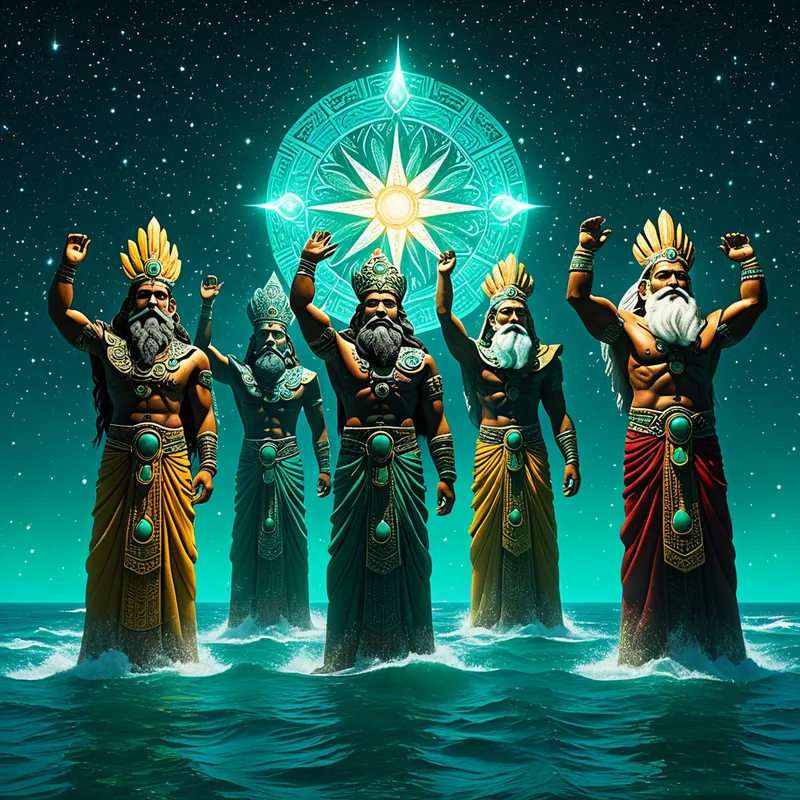
A Maya creation myth where four divine brothers, the Bacabs, lift the sky from the primordial sea, establishing the four corners of the ordered world.
The Tale of Bacabs the Four Sky Bearers
In the time before time, there was only the dark, endless sea and the empty, starless vault. The world was unformed, a dream waiting to be dreamed. From the silent depths of that primordial ocean, the Kukulkan stirred, and with him, the thought of a world. But a world needs a house. A sky needs pillars.
And so, from the substance of the deep, four brothers were called into being. They were the Bacabs. They were not born of woman, but of necessity. They were ancient even as they were new, their faces etched with the knowledge of the burden to come. One was red as the life-blood of dawn. One was white as the bone of the moon. One was black as the obsidian of night. One was yellow as the sacred maize.
The great serpent Kukulkan spoke a word that was also a command, a vibration that shook the foundations of the deep. "Lift," it said. And the four brothers, standing at the four unseen corners of creation, planted their feet upon the back of the great caiman that floated in the abyss. They bent their mighty backs, their muscles corded like the roots of the first Ceiba. They placed their shoulders against the sodden, heavy belly of the sky—a sky that was not yet sky, but a damp, oppressive blanket of cloud and potential.
A groan echoed through the void, the sound of cosmic tendons stretching. The sea churned. The brothers strained. The red Bacab in the East pushed upward with the strength of the rising sun. The white Bacab in the North pressed with the relentless, grinding patience of ice. The black Bacab in the West heaved with the final, surrendering power of sunset. The yellow Bacab in the South lifted with the fertile, persistent push of growth.
Slowly, agonizingly, the vault began to rise. Waters cascaded from its surface, becoming the first rains. Light, trapped beneath, began to filter through—not the light of a sun, but the first, faint glow of existence. The sky peeled away from the face of the waters. As it rose, it dried, hardening into the firmament of stars, the path of the sun, the home of the storm. The brothers held it aloft, their arms trembling but unyielding. They became the living pillars, the cantiles of the cosmos. At their feet, the land emerged from the receding sea, and the world had its four corners, its stable directions, its sacred order. They did not speak. Their act was their testament. They are holding still.
Cultural Origins & Context
The myth of the Bacabs is woven into the very fabric of Classic and Postclassic Maya cosmology, most notably preserved in the pages of the Chilam Balam and echoed in the surviving art and architecture of the region. They are often conflated with or serve as the aged, post-creative aspects of the Chaacs, and are intimately linked to the cosmic directions.
This was not a story told merely for entertainment around a fire. It was a foundational narrative recited by priests and shamans (H'men) during rituals of renewal, at the dedication of temples, and in ceremonies meant to reinforce the cosmic order. The Maya lived in a world perpetually threatened by chaos—drought, war, the cyclical death of the sun each night. The Bacabs represented the eternal, unwavering force that kept that chaos at bay. Their imagery was carved into corners of temples, their colors painted on pottery, a constant reminder that the world's stability was not a given, but a divine effort that required recognition and sustenance through ritual.
Symbolic Architecture
At its heart, the myth of the Bacabs is not about movement, but about steadfastness. It is the psychology of structure emerging from chaos, of consciousness erecting a stable inner world from the formless waters of the unconscious.
The four pillars are the first act of differentiation, the primal separation of heaven and earth that creates the psychic space where life and thought can occur.
The four brothers represent the essential, non-negotiable foundations of a coherent psyche or a functional society. The cardinal directions symbolize orientation—the ability to know where one is. Their distinct colors (red, white, black, yellow) speak to the integration of different primal qualities or states of being: vitality, purity, the unknown, and illumination. They are not a singular hero, but a quaternity, a complete and balanced system. Psychologically, they map onto the four functions of consciousness as described by Jung—thinking, feeling, sensation, and intuition—which must work in concert to "hold up" the light of ego-awareness against the pressing weight of the unconscious.
Their eternal labor signifies that order is not a static achievement, but a continuous, living process. The sky—representing the realm of spirit, ideals, and consciousness—is inherently heavy. It constantly threatens to collapse back into the undifferentiated sea of the unconscious. The Bacabs are the innate, often unconscious, structural forces within the psyche that perform this vital maintenance work, allowing for the drama of individual life to unfold on the stable "earth" they make possible.
The Dreamer's Resonance
When this myth stirs in the modern dreamer, it rarely appears as a literal tableau of Maya gods. Instead, it manifests as an architecture of resilience. One might dream of four immense columns in a crumbling building that nonetheless stand firm. Or of holding up a ceiling that is also the sky during a terrifying storm. The somatic sensation is one of immense, steady pressure—a weight on the shoulders, a tension in the spine—coupled with a profound, unshakeable strength.
This dream pattern emerges during life phases where the individual's foundational structures are under threat or are being consciously rebuilt. It may surface after a profound loss (the collapse of a personal "world"), during a period of intense psychological deconstruction (therapy, spiritual crisis), or when taking on a great responsibility that requires unwavering stability. The dream is not about escape, but about the discovery of an inner, fourfold support system. It reassures the dreamer that even in chaos, there are innate, archetypal forces within—perhaps previously unrecognized—that are capable of bearing the load. It is the psyche's way of modeling endurance, of showing that one can be under immense pressure and not break, because one is, at the core, held by the four corners of one's own being.

Alchemical Translation
The alchemical journey, or the process of individuation, begins with the prima materia—the chaotic, unconscious state symbolized by the primordial sea. The first and most critical operation is not questing outward, but establishing the vas or vessel within which the great work can safely proceed. This is the labor of the Bacabs.
Individuation requires a sacred space, a temenos, which must be carved out of the unconscious and vigilantly maintained. The four sky-bearers are the architects of that inner temple.
For the modern individual, the "alchemical translation" of this myth is the conscious construction and maintenance of a stable psyche. The "sky" one must hold aloft is one's own sense of meaning, values, and conscious awareness. The "four pillars" are the core practices, relationships, beliefs, and self-knowledge that provide balanced support. The East pillar (red) might be one's daily rituals and vitality practices. The North (white) could be one's intellectual rigor and ethical framework. The West (black) may represent the honest confrontation with shadow and mortality. The South (yellow) embodies creative expression and emotional nourishment.
The process of transmutation—turning lead into gold—cannot occur in a chaotic environment. It requires the ordered, sacred space that the Bacabs provide. Their eternal labor teaches that the work of self-realization is not a one-time heroic feat, but a lifelong commitment to being the pillar. One does not simply find stability; one becomes it. By internalizing the Bacabs, we learn that we are both the supported and the supporter, the world and the force that keeps it from collapsing. In holding up our own sky, we participate in the ongoing creation of our cosmos.
Associated Symbols
Explore related symbols from the CaleaDream lexicon:
- Sky — The celestial vault held aloft by the Bacabs, representing the realm of consciousness, spirit, and ordered cosmos that is separated from the chaotic unconscious.
- Earth — The stable world that emerges at the feet of the Bacabs, symbolizing the grounded reality, the physical plane, and the conscious ego that can only exist under a supported sky.
- Four — The sacred number of the Bacabs, embodying completeness, stability, the cardinal directions, and the foundational structure of both the cosmos and the psyche.
- Pillar — The literal and symbolic form of the Bacabs, representing unwavering support, strength, and the axis that connects the earthly and celestial realms.
- Order — The primary achievement of the Bacabs' labor, the establishment of cosmic and psychic structure out of primordial chaos.
- Tree — Echoing the Ceiba, this symbolizes the axis mundi, the central pillar of the world that the four Bacabs collectively create and protect.
- Water — The primordial sea from which the world is lifted, representing the undifferentiated unconscious, the source of all potential and the ever-present threat of dissolution.
- God — The Bacabs as divine, eternal forces performing a necessary cosmic function, representing the archetypal, transpersonal power of structure and sustenance.
- Temple — The sacred space created by the stable world, with the four Bacabs acting as the cornerstones of both physical and psychic sanctuaries.
- Chaos — The formless, pre-creational state of the sea and unsupported sky, which the Bacabs eternally hold at bay, representing the unstructured unconscious.