Awen Myth Meaning & Symbolism
The tale of how the divine breath of poetic inspiration, Awen, was won from the cauldron of the goddess Ceridwen by the bard Taliesin.
The Tale of Awen
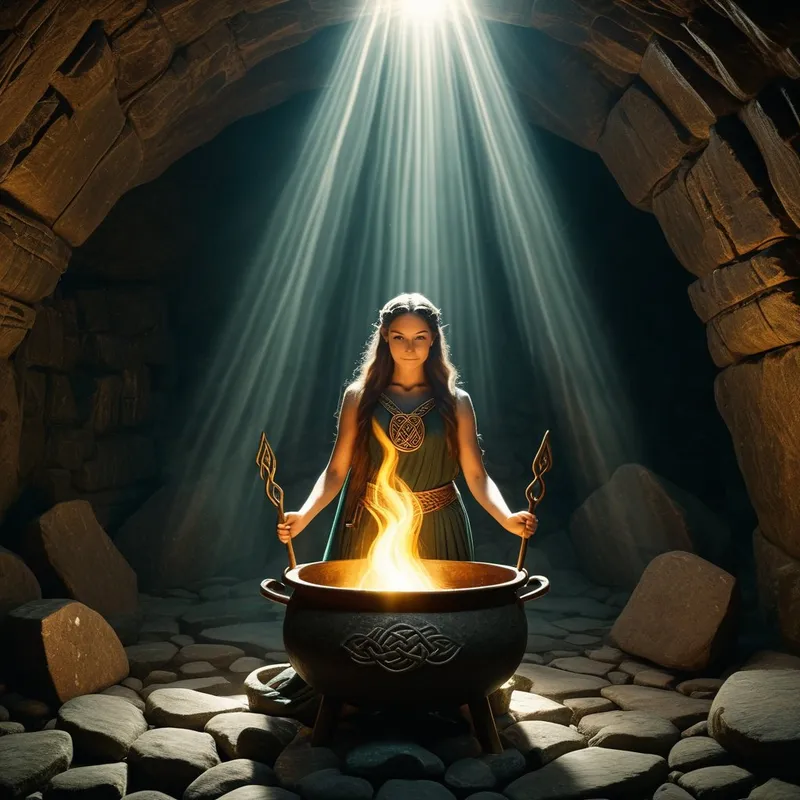
Listen now, and let the fire’s crackle be your drum, the wind’s sigh your harp. In the deep, green heart of the Isle of the Mighty, where mist clings to the oak and the hawthorn whispers old secrets, there lived a goddess of formidable power. Her name was Ceridwen. She was keeper of a cauldron, not one for stew, but for the brew of all wisdom and inspiration. Within its black iron belly, she stirred a potion of such potency that it took a year and a day to concoct, requiring the constant attention of a blind man to tend the fire and a young boy, Gwion Bach, to stir the brew.
Ceridwen crafted this draught for her son, Morfran, who was deemed uncomely and dull. Three precious drops from that cauldron would grant the receiver the Awen—the breath of the gods, the fire of prophecy, the essence of all poetry and song. The rest was a deadly poison. As the year and a day drew to its climax, the cauldron bubbled and hissed. The three destined drops, glowing like liquid stars, leapt from the rim and scalded the thumb of young Gwion as he stirred. Instinctively, he put his thumb to his mouth.
In that instant, the entire world shifted. The taste was honey and lightning, mead and memory. He knew the names of every star and the sorrow in every stone. He saw the past and the future woven together. And he knew, with a cold terror, that Ceridwen would see his theft and her rage would be boundless. He fled the cavern as the cauldron cracked with a sound like a breaking world.
Thus began the Great Chase. Gwion, with the Awen coursing through him, became the hare, swift and desperate. Ceridwen, in her fury, became the greyhound, relentless and swift. He dove into a river and became a fish; she became an otter. He took to the air as a bird; she became a hawk. Finally, exhausted, he saw a barn piled high with winnowed wheat. He became a single grain among millions. Ceridwen, the hawk, became a great, black-crested hen. She pecked and pecked until she found him, that one grain, and swallowed him whole.
But the story does not end in the belly of the hen. For the Awen cannot be destroyed, only transformed. Ceridwen, now in her own form again, found herself with child. She carried that child, knowing it was Gwion, and when he was born, he was so radiant, so beautiful, that she could not bear to kill him. Instead, she sewed him into a leather bag and set him adrift on the sea.
The bag was found by a prince, Elffin, who upon opening it, did not find a babe, but a boy with a brow shining with wisdom. The boy spoke, not with a child’s tongue, but with the voice of the Awen itself: “I am Taliesin.” And so the one who tasted the three drops was reborn, not as a servant, but as the greatest of all bards, his very being the vessel for the divine, flowing inspiration.

Cultural Origins & Context
The tale of Taliesin and Ceridwen’s cauldron is preserved in the Llyfr Taliesin, a medieval Welsh manuscript. It is a cornerstone of the Mabinogion tradition. This was not a myth for the common hearth, but for the hall of the chieftain and the sacred grove. It was the province of the Druids and, later, the Beirdd. The story functioned as a charter myth for the poetic tradition itself, explaining the terrifying, dangerous, and ultimately divine origin of true inspiration. It taught that Awen was not a gentle muse, but a fierce force of nature that demanded a death of the old self before granting its gifts. The bard was not merely an entertainer, but a shape-shifter who had navigated the underworld of the unconscious and returned, transformed, to speak truths that could reshape reality.
Symbolic Architecture
At its heart, this myth maps the perilous journey of consciousness seeking gnosis—direct, experiential knowledge. The cauldron of Ceridwen is the unconscious itself, simmering with latent potentials, archetypes, and primordial wisdom. The “three drops” are the concentrated essence of this wisdom, the moment of illumination. They are not won by study, but by accident, ordeal, and ingestion—a symbolic knowing by being.
The Awen is not found; it finds you. It is a scalding gift that chooses its vessel through a trial of fire, flight, and dissolution.
The subsequent chase is the psyche’s turbulent reaction to this influx of energy. The ego (Gwion) must flee the overwhelming power of the unconscious (Ceridwen) in a series of rapid shape-shifts—the frantic attempt of a fragile identity to cope with a revelation too large to hold. The final transformation into a grain and being swallowed represents the necessary, total dissolution of the old, limited self. The rebirth as Taliesin signifies the emergence of a new, integrated consciousness, where the inspired self (the bard) is born from the womb of the very force that sought to destroy the ignorant self.
The Dreamer's Resonance
When this myth stirs in the modern dreamer, it often manifests as dreams of frantic pursuit, of changing form to escape a consuming darkness. You may dream of being a small animal hunted by a larger predator, of swimming desperately through murky waters, or of hiding, utterly vulnerable, in a vast landscape. Somatically, this can feel like anxiety upon waking, a racing heart, or a sense of constriction in the chest.
Psychologically, this is the process of the conscious mind grappling with an emerging content from the unconscious that feels threatening to the status quo. It is the “chase” phase of integration. The dream-ego’s transformations are attempts to adapt, to find a shape that can survive the encounter with this powerful new energy—be it a creative impulse, a repressed memory, or a call to a new life direction. The dream is not a warning to stop, but a map of the turbulent, instinctual process of psychic growth already underway.

Alchemical Translation
The myth of Awen is a perfect allegory for the alchemical process of individuation. The prima materia, the base lead of the personality (Gwion, the ignorant servant), is placed into the vessel (the cauldron of the unconscious) and subjected to the nigredo—the blackening, the year and a day of boiling struggle. The three drops are the albedo, the whitening, the moment of sublime illumination.
The chase is the citrinitas, the yellowing, where the brilliant insight must be integrated through conflict and the death of the old ego. Being swallowed is the final dissolution.
The gestation in Ceridwen’s womb is the secret, invisible work of the unconscious reorganizing the psyche. The final birth as Taliesin is the rubedo, the reddening, the creation of the Philosopher’s Stone—the realized, inspired Self. For the modern individual, this translates to the often painful but essential journey where a flash of inspiration or a deep psychological insight demands we abandon our comfortable, limited identity. We are chased by our own potential until we surrender to being consumed by it. Only then can we be reborn, not as who we were, but as who we are meant to become: a vessel through which something greater than ourselves can flow and speak. The bard is not born; he is forged in the cauldron of his own transformation.
Associated Symbols
Explore related symbols from the CaleaDream lexicon: