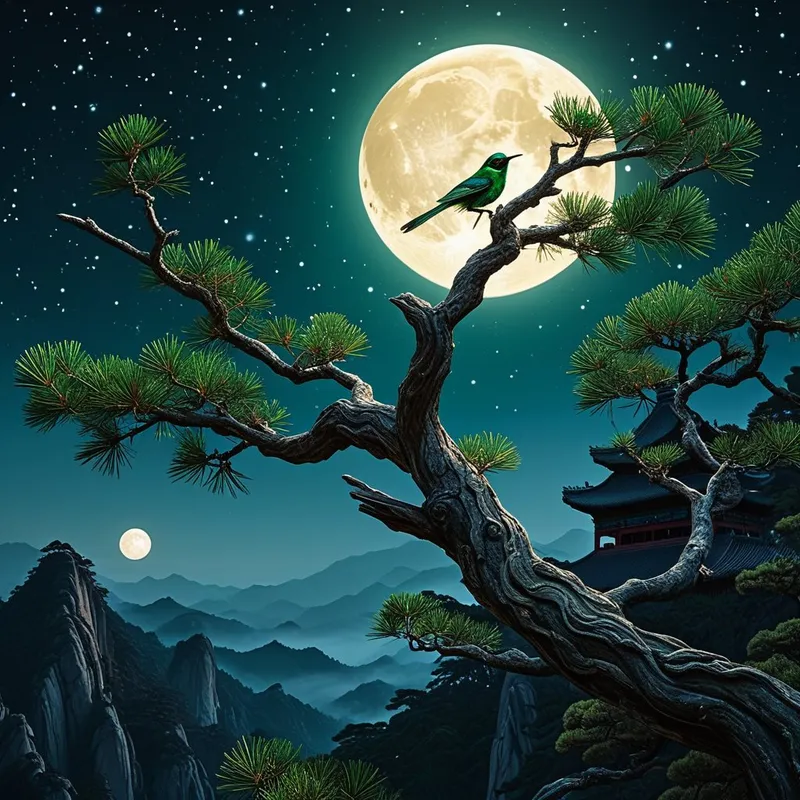
Autumn Cricket Myth Meaning & Symbolism
A celestial cricket's song weaves the fabric of autumn, a myth of sacrifice, time, and the soul's necessary descent into darkness for renewal.
The Tale of Autumn Cricket
Listen, and let the chill of the coming night settle upon your skin. The story begins not with a bang, but with a fading—the slow, golden sigh of the Xia Shen, weary from his long reign of heat and growth. The world hung in a balance of ripeness and rot, the fields heavy with grain, the air thick with the scent of over-sweet fruit. Yet, a profound silence threatened it all. For in this pivotal turn, the music that bound the world to the wheel of time was about to cease.
The Jade Emperor looked down from the Celestial Court and saw the danger. The vibrant, life-sustaining songs of spring and summer—the chorus of frogs, the hum of bees, the trill of swallows—were fading into memory. Without a new song, a bridge of sound to carry the world’s spirit from abundance to repose, the silence would become a void. The harvest would freeze un-gathered, the seeds of next year would sleep too deeply, and the soul of the earth would be lost in a seasonless limbo.
From the ranks of minor spirits and humble creatures, a volunteer arose. It was Qiu Qu, the Autumn Cricket. Not a dragon of terrible power, nor a phoenix of glorious rebirth, but a small being of the soil and the twilight. Its voice was a modest thing, a simple chirp. The Celestial Court murmured with doubt, but the Jade Emperor, in his fathomless wisdom, saw the truth in its offer. The song needed was not one of conquest, but of accompaniment; not a fanfare, but a lullaby for the waking world.
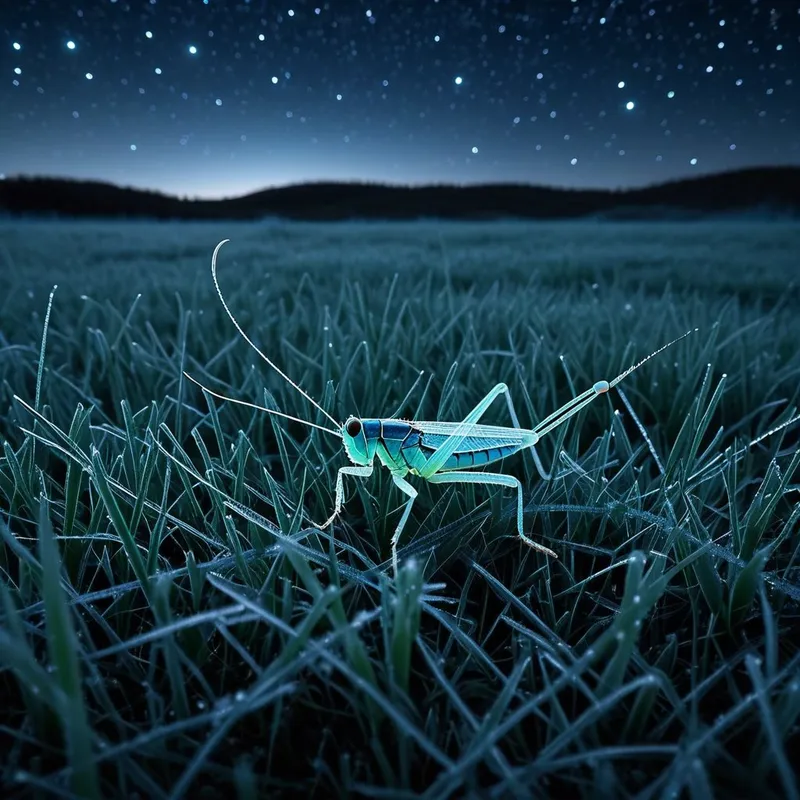
Thus, Qiu Qu descended as the first true frost etched patterns on the late-night grass. It found a perch on a browning stalk, drew in the cold, thinning air, and began to sing. Its song was not joyous, but profoundly beautiful—a rhythmic, clicking lament that spoke of shortening days, of gratitude for the harvest, and of the courage required to let go. It was a thread of consciousness spun into the growing dark.
Night after night, as the moon waxed and waned, the cricket sang. Its energy, its very life essence, was woven into each note. It sang until its vibrant green shell dulled, until its movements grew slow. It sang as the last leaf fell, its melody becoming the only heartbeat in the sleeping world. Finally, with the arrival of the deepest cold, the song ended. Qiu Qu had spent itself completely, its body returning to the earth it had sung to sleep. But its work was done. The psychic bridge was built. The world had safely crossed into winter’s dream, held in the memory of that steadfast song, awaiting the distant promise of another spring.
Cultural Origins & Context
The figure of the Autumn Cricket is woven deeply into the fabric of Chinese agrarian and literary tradition. Unlike the grand, state-sanctioned myths of founding emperors or cosmic battles, this myth belongs to the folklore of the hearth, the field, and the scholar’s garden. It was passed down not by priests, but by farmers who heard in the cricket’s autumnal chorus a reliable calendar, a signal to complete the harvest and prepare for winter. For the literati, especially during the Tang and Song dynasties, crickets kept in delicate cages became beloved companions; their song was a muse for poetry, a symbol of autumn’s poignant beauty, and a reminder of life’s fragility.
This myth served a crucial societal function: it anthropomorphized and made sacred the necessary decline of the natural world. In a culture with a deep philosophy of cyclical change, such as expressed in the Yijing, the sudden silence of summer creatures could evoke anxiety. The Autumn Cricket myth provided a comforting narrative. It assured people that the fading was not a meaningless death, but a purposeful, even heroic, act of stewardship performed by a humble spirit, ensuring the continuity of the great cycle.
Symbolic Architecture
Psychologically, the Autumn Cricket is an emblem of the conscious ego’s role in mediating a difficult transition. The cricket is not the season itself, but the singer of the season. It represents that part of the psyche which must find voice and meaning in times of loss, decline, and inevitable ending.
The true sacrifice is not of life, but of a former way of being. The cricket’s song is the ego’s brave narration of its own dissolution for the sake of the whole.
The lush, active energy of summer symbolizes a period of extraverted expansion, achievement, and conscious identity at its peak. The coming winter represents the unconscious, a state of introversion, potential, and latent life where conscious control must recede. The dangerous “silence” is the threat of psychic dissociation—a depressive break where the conscious mind cannot relate to the deepening inner process. The cricket’s voluntary song is the act of relating to the descent. It is the act of journaling through grief, of speaking honestly about a failure, of consciously acknowledging an ending rather than denying it. Its physical decline mirrors the necessary “loss of energy” we feel when we consciously engage with a depressive or transformative phase, spending our familiar vitality to forge a new relationship with the dark.

The Dreamer's Resonance
When this myth stirs in the modern dreamer, it often manifests in dreams of small, persistent creatures in transitional spaces—a cricket on a windowsill as one packs to move house, a lone bird singing in a leafless tree, a heartbeat heard in a silent room. The somatic feeling is one of poignancy and a deep, rhythmic melancholy. There is no terror, but a profound weight.
Psychologically, this dream pattern signals that the individual is in a liminal state between life chapters. It is the psyche’s confirmation that one is actively, if painfully, “singing the bridge” across a personal autumn. This could be processing the end of a career, the shifting dynamics of an aging family, the quiet close of a creative project, or the conscious acceptance of a personal limitation. The dream honors the exhausting, essential work of holding conscious awareness during this process. The sadness felt is not pathology, but the authentic cost of this psychic alchemy. The dream asks the dreamer to recognize their own inner Qiu Qu—the part of them that is faithfully, tirelessly, and at great personal cost, making meaning of the change.

Alchemical Translation
The alchemical process mirrored here is mortificatio—the blackening, the dissolution, the necessary decay that precedes renewal. In the journey of individuation, we are not meant to remain in perpetual summer (the persona’s perfect bloom). We are called to autumn, to a phase where the fruits of our conscious efforts are harvested and the structures of our identity must gracefully decompose to feed the roots of the deeper Self.
Individuation demands the cricket’s sacrifice: the willing surrender of the light we know to become the steward of the darkness we must learn to trust.
The modern individual translates this myth by consciously engaging in their own “autumnal songs.” This is the practice of active acceptance. It is the retirement speech that honors a lifetime of work while embracing uncertainty. It is the therapeutic process of revisiting an old wound with compassionate witness, rather than rage or denial. It is the artist who destroys a comfortable style to find a more authentic voice. The “song” is any act of conscious, creative meaning-making applied to an ending. By spending our familiar psychic energy in this way, we do not avoid the winter of the soul—we sanctify our passage into it. We ensure that our conscious mind is not severed from the unconscious transformation occurring within. In doing so, we perform the ultimate caregiver archetype’s duty: not by preventing the death of an old form, but by lovingly midwifing the Self through its essential cycle of death and rebirth, trusting that our faithful song in the gathering dark is what guarantees the eventual, inevitable spring.
Associated Symbols
Explore related symbols from the CaleaDream lexicon: