Athena Myth Meaning & Symbolism
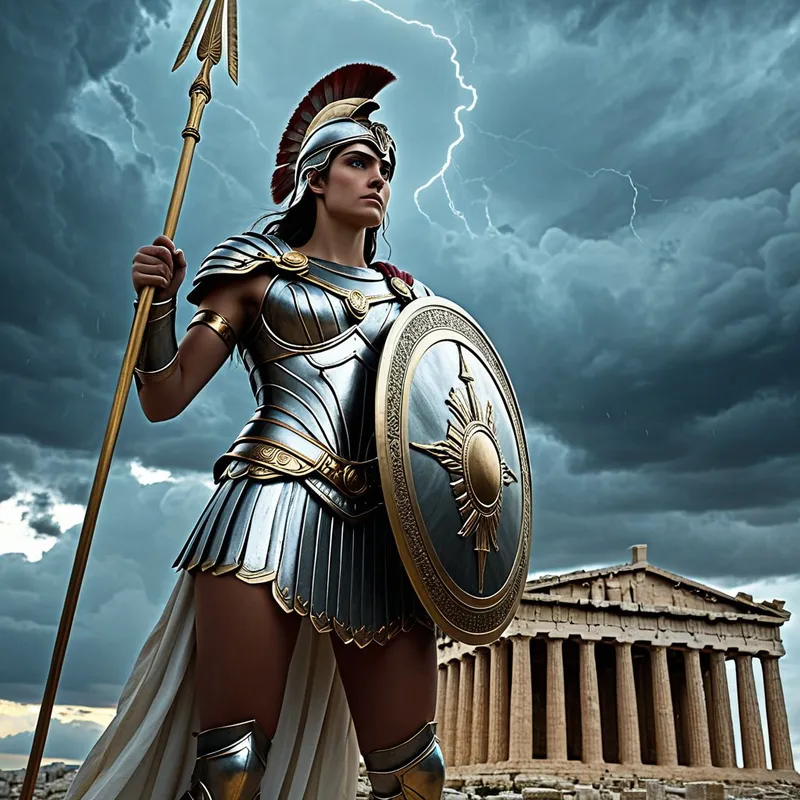
The goddess born not from a womb, but from the mind of Zeus, fully armed, embodying the union of strategic intellect and sacred force.
The Tale of Athena
Listen, and hear the tale of a birth that shook the heavens. In the time when the Titans were but a memory and Zeus held the thunderbolt, a prophecy echoed in the deep places of the world. It was said that the child of the Titaness Metis would surpass her father in wisdom and power. Zeus, who had overthrown his own father, knew the weight of such words. He felt the future turning against him.
So, with a cunning that mirrored the prophecy itself, he acted. When Metis was with child, he spoke to her with honeyed words, and in a moment of play, he persuaded her to change her form, to become small. She transformed into a fly, a glittering, buzzing thing. And Zeus, in one swift motion, opened his mouth and swallowed her whole. The deed was done. The mother of the prophesied child was now a prisoner within the god-king’s own belly. A terrible silence followed. Zeus sat upon his throne, a new and strange weight growing inside his skull, a pressure behind his eyes. He had contained the threat, or so he believed.
But wisdom cannot be digested. It cannot be silenced. It gestates.
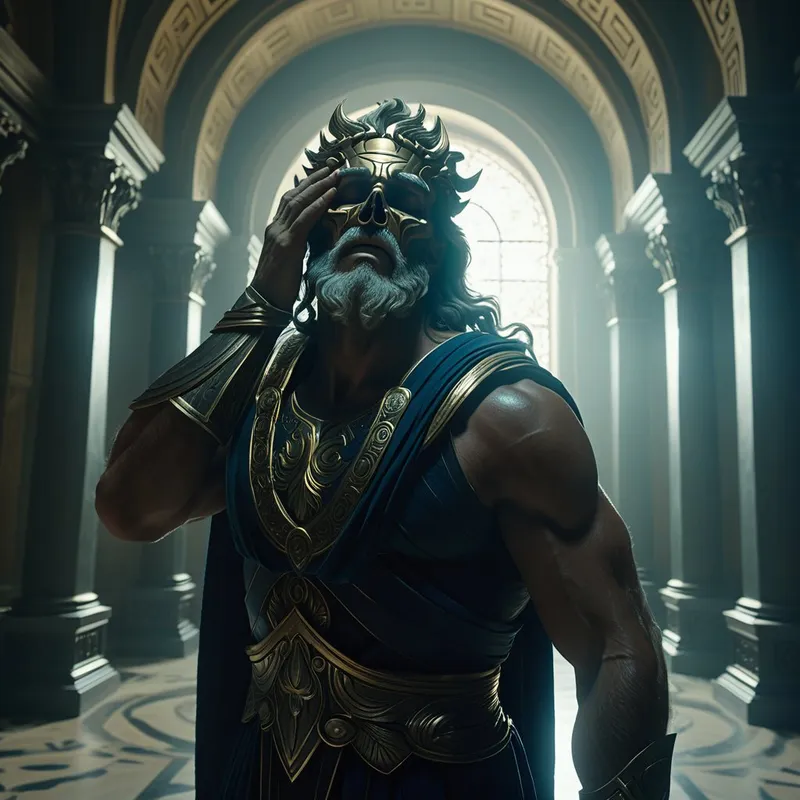
The pressure became an agony, a pounding like the forge of Hephaestus inside his head. For days, for years—time is nothing to the gods—Zeus wandered the slopes of Olympus in torment, clutching his brow. The pain crescendoed until it was unbearable. In his final desperation, he called to the smith-god. “Cleave my head!” he roared. “Release what is within!”
Hephaestus, with a mighty double-edged axe, hesitated for only a heartbeat before bringing it down upon the sovereign’s skull. The sound was not of cracking bone, but of a thunderclap contained. And from the great fissure, there erupted not blood, but a light so brilliant it blinded the watching gods. From that light came a cry—a war cry that was also a song of pure intellect. And she emerged: a goddess full-grown and fully armed. Clad in gleaming, golden armor that shone with its own inner light, a sharp-tipped spear in one hand, a shield embossed with the terrifying face of the Gorgon in the other. Her gray eyes, the color of a storm-cleared sky, held the calm of perfect thought and the fire of righteous force. She was Athena, and her first act was to step onto the sacred ground, causing the earth itself to tremble with her step. The pain in Zeus’s head vanished, replaced by a profound clarity. He looked upon his daughter and saw not a rival, but the perfect expression of his own sovereign authority, tempered by a wisdom he himself could not possess. She was born of his mind, and she would be its greatest counsel.
Cultural Origins & Context
The myth of Athena is a cornerstone of the ancient Greek religious and cultural imagination, with roots stretching back to the Mycenaean civilization (circa 1600–1100 BCE), where she appears in Linear B tablets as a protector of the palace. By the time of Homer and Hesiod (8th century BCE), her character was fully formed, woven into the epic narratives that defined Hellenic identity. Her primary cult center was Athens, where she was worshipped as the city’s patron and protector in the magnificent Parthenon.
The myth was not merely a story but a foundational charter. It was recited by poets, enacted in festivals like the Panathenaia, and visually encoded in temple sculptures and vase paintings. Its societal function was multifaceted: it legitimized the patriarchal order of Olympus (Zeus as ultimate source), while simultaneously carving out a supreme, respected space for the “masculine” virtues of strategy, law, and crafts—all embodied in a female form. Athena became the divine model for the civilized state, representing the triumph of reasoned strategy over brute chaos, and of skilled craft over raw nature.
Symbolic Architecture
Athena’s birth is not a biological event but a psychological and cosmological one. It is the myth of consciousness itself emerging from the seat of sovereignty.
True wisdom is not inherited; it is an eruption from within the seat of authority, born fully formed and ready for battle.
The swallowing of Metis represents the internalization of primal, cunning wisdom (Metis’s name means “craft” or “skill”). Zeus does not destroy it; he attempts to assimilate it. The resulting headache is the psychic tension of unintegrated knowledge, a pressure that demands resolution. The axe of Hephaestus symbolizes the catalyzing, often violent, act of insight that breaks open the hardened structures of the ego-mind. From this rupture, a new faculty is born: not raw instinct (Metis), but sophia—applied wisdom, strategic intellect, and clear-sighted judgment.
Athena’s armor and weapons signify that this wisdom is not passive. It is armed reason, meant for protection, justice, and the defense of civilized order. Her patronage of weaving represents the other side of this coin: the strategic, patient craft of creating complex, beautiful, and functional wholes from disparate threads—be it a tapestry, a law, or a society.

The Dreamer's Resonance
When the pattern of Athena’s birth appears in modern dreams, it signals a profound somatic and psychological process: the painful gestation and imminent emergence of a new cognitive or authoritative capacity. The dreamer may experience motifs of intense pressure in the head, visions of light bursting from confined spaces, or finding powerful, ready-made tools (a pen, a key, a blueprint) in unexpected places.
Somatically, this can correlate with tension headaches, a feeling of “fullness” in the mind, or insomnia driven by relentless, organizing thoughts. Psychologically, the individual is struggling to give birth to a new form of self-authority. They may be wrestling with an internalized “father complex”—a dominant, internal voice of rule or tradition—that must be fractured not to be destroyed, but to release a more sophisticated, self-possessed aspect of the psyche. The dream is an announcement: a sovereign intelligence, long in gestation, is ready to be deployed in the world.

Alchemical Translation
The alchemical journey modeled by Athena’s myth is the transmutation of prima materia—the chaotic, prophetic threat of the future—into the lapis philosophorum—the armored, wise self. For the modern individual, the process begins with the “swallowing of Metis”: we internalize a powerful insight, a skill, or a traumatic knowing that we feel we must hide or control. This leads to the nigredo, the blackening: the depressive, painful pressure of unexpressed potential, the headache of a life not yet lived.
The axe that cleaves the skull is the courageous act of self-confrontation that allows the imprisoned self to see the light of day.
The call for Hephaestus’s axe is the critical moment of surrender and active seeking. It is asking for help, engaging in therapy, or committing to a disciplined practice that promises to “split you open.” This is the albedo, the whitening, the searing light of revelation. The emergence of Athena is the rubedo, the reddening: the integration. The born-again self is not a helpless infant but a functional, armored adult capacity. It is the part of you that can strategize your life, defend your boundaries with calm precision, and craft your existence with skillful artistry. You do not become Zeus; you become the embodied, active wisdom that Zeus could only contain. The father-complex is not killed; it is successfully transcended, its raw power now channeled through the clear, gray eyes of your own sovereign mind.
Associated Symbols
Explore related symbols from the CaleaDream lexicon:
- Head
- Mind
- College
- Thought
- Classes
- Professor
- Brain
- Lucid
- System
- Study
- Information
- Forehead
- Degree
- Style
- Principal
- Total
- Election
- Tennis
- Uniform
- Meditation
- Mental
- Tip
- Chin
- Response
- Buddha
- Serious
- Knowledge
- Supervisor
- Birth
- Counselor
- Attitude
- Advice
- Psychology
- Overall
- Focus
- Totally
- Chart
- Owl
- Stroke
- Goddess
- Intention
- Ironing Board
- Umbrella Stand
- Artificial Neural Network
- Online Learning
- Glistening Olive Oil
- Patterned Tie
- Stylish Cardigan
- Chic Blazer
- Wrinkled Forehead
- Left Hand
- Drawing Lines
- Woven Whimsy
- Ice Blue
- Cerulean Blue
- Orbiting Satellite
- Illuminated Starburst
- Azurite Stone
- Malachite Piece
- Fluorite Cube
- Rutilated Quartz
- Topaz Brooch
- Sodalite Sphere
- Sodalite Cube
- Carbon Spiral
- Argon Light
- Ruthenium Gaze
- Argentum Vision
- Barium Light
- Molecular Model
- Lustrous Rhodium
- Glistening Yttrium
- Moonlit Aster
- Translucent Camellia
- Praying Mantis Stance
- Praying Mantis
- Velvet Ant
- Giant Mechanical Owl
- Spiritual Anansi
- Skillful Tailor
- Strategic Manager
- Editor’s Red Pen
- Tailgate Party
- Fashion Designer's Sketchbook
- Knight's Armor
- Librarian's Card Catalog
- Tennis Racket
- Exercise Mat
- Billiard Table
- Fencing Gear
- Coach's Clipboard
- Fencing Sword
- Billiards Table
- Ninja Stars
- Artistic Easel
- Churchill's Cigars
- Isaac Newton's Apple
- Coco Chanel's Suit
- Socrates' Toga
- Medusa's Head
- Suffragette Ribbon
- Marie Curie's Lab Coat
- Winston Churchill's Cigar
- Malala's School Books
- Churchill's War Room
- Jane Austen's Letters
- Celestial Easel
- Fine Art Photography
- Artistic Vision
- Literary Critique
- Bookstore Encounter
- Epic Sage
- Veiled Wire Cutter
- Safety Goggles
- Umbrella Lap Desk
- Wall-mounted Shelves
- Scandinavian Chair
- Glistening Desk
- Artistic Sculpture Stand
- Electric Mixer
- Egg Separator
- Silk Headband
- Headband
- Visor
- Amethyst Hairpin
- Armored Personnel Carrier
- Police Cruiser
- Circuit Board
- Streamlining Laptop
- Binder Clip
- Desk Organizer
- Push Pin
- Bookmark
- Clipboard Holder
- Pen Holder
- Report Cover
- Cascading Sticky Tabs
- Moonlit Sharpie
- Laser Tag Gun
- Crystalized Ideas
- Key to Insight
- Textured Canvas
- Geometric Clouds
- Owlshooting Star
- Crab Shell
- Mediterranean Olive Grove
- Loom Weaving Tool
- Flax Fiber
- Cypress Bark
- Spear Thrower
- Sparks of Creativity
- Leather Tanning Pit
- Decorative Weaving
- Woad Dyes
- Snowy Owl Flight
- Owl Feathers
- Night Owl's Call
- Buddha Statue
- Samurai Armor
- Sage
- Warrior
- Animus Shadow
- Animus Drive
- Neural Network
- Pardon
- Quantifier
- Derivation
- Definiteness
- Texture
- Inventory
- Emergent
- Minmax
- Neuron
- Antibody
- Truss
- Editor
- Geburah
- Diploma
- Isolation
- Prevention
- Cotton
- Precision
- Accuracy
- Detachment
- Prodigy
- Crystallizing
- Logic
- Insight
- Analysis
- Crisp
- Calculator