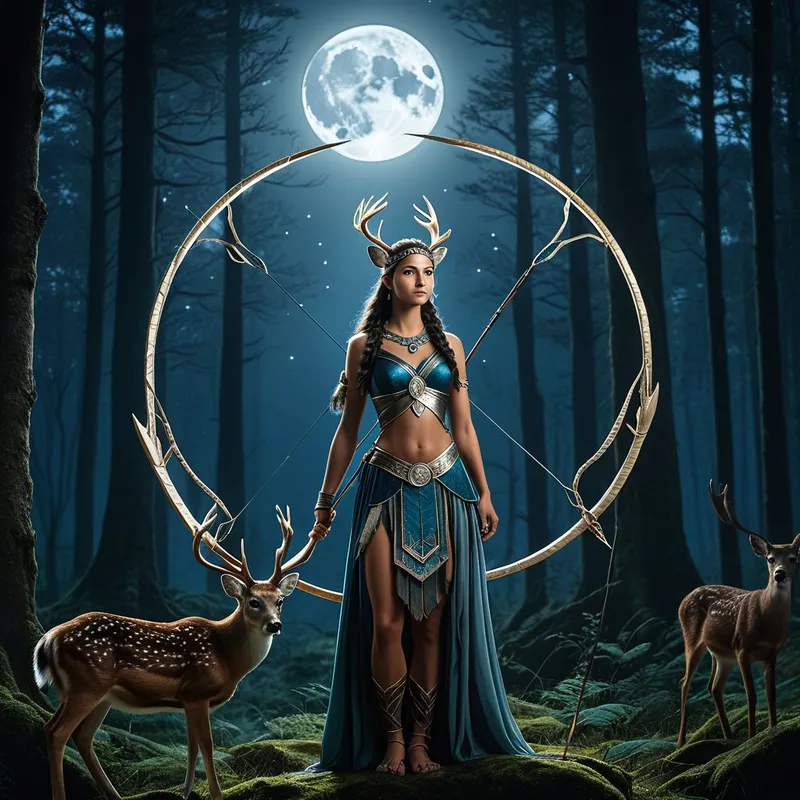
Artemis Myth Meaning & Symbolism
The myth of the virgin huntress Artemis, who rules the liminal wilds, embodies sacred autonomy, fierce protection, and the untamed feminine spirit.
The Tale of Artemis
Let the hearth-fire dim. Listen. Before the clamor of cities, there was the deep, breathing silence of the forest. And in that silence, a cry was heard—not of fear, but of fierce, claiming joy. It was the first cry of Artemis, born of Zeus and the Titaness Leto. While her twin Apollo sought the golden heights of Olympus, Artemis turned her face to the silver-dappled earth.
As a child, she climbed onto her father’s knee, a small girl with eyes like pools of night. “Grant me,” she said, her voice clear as a mountain spring, “to remain always a maiden. Give me a bow and arrow, and a short tunic to run in. Give me the mountains and the untouched woods as my domain. Give me sixty ocean nymphs as my companions, and twenty river nymphs to tend my sandals and hounds.” Zeus, thunder in his heart, laughed with delight and granted it all.
So she became the Lady of the Wild Things. Her footsteps were silent on the pine needles; her arrows flew truer than fate. She ran with the deer, not to slaughter, but in sacred kinship. Her nymphs were her choir, their laughter the sound of rushing streams. She was the protector of the young—of cubs, fawns, and human girls on the threshold of womanhood. Her light was not the sun’s revealing glare, but the moon’s cool, discerning gaze, illuminating the hidden paths.
But woe to those who violated her sacred space. Hear the tale of Actaeon. On a hot, still afternoon, the hunter strayed deep into a grove forbidden to mortals. Pushing aside the laurel branches, he froze. There, in a crystal pool, Artemis and her nymphs bathed. The world held its breath. The goddess, sensing the profane gaze, did not scream. She simply flicked water from her fingertips. Where the droplets fell on Actaeon’s skin, a terrible itching began. Antlers burst from his brow. His neck elongated, his hands became hooves. He tried to cry out, but only a stag’s bleat emerged. His own hounds, catching the scent of prey, turned on him. The last thing he saw was the indifferent moon reflected in the water, as his world dissolved into fang and fury.
And yet, she was also Lochia. When her own mother Leto struggled in the agonies of childbirth, denied rest by the jealous Hera, it was young Artemis who was born first and immediately became midwife for her twin Apollo. Thus, she who never knew a lover’s touch became the guardian of life’s most primal threshold. She was the paradox: the untamed virgin who presided over the ultimate act of creation, the fierce huntress who was a tender protector. Her domain was the liminal space—between childhood and adulthood, between wilderness and civilization, between life and death.

Cultural Origins & Context
The figure of Artemis is one of the most ancient in the Greek pantheon, with roots likely stretching back to pre-Hellenic mother goddesses and Mistresses of Animals from Anatolia and Crete. Her worship was not centralized in grand urban temples like Athena’s Parthenon, but scattered across the wild places: in sacred groves, at mountain springs, and in caves. Her most famous temple, at Ephesus, depicted her in a form more akin to a Near Eastern fertility goddess, covered in protuberances symbolizing life and abundance, showing how her image absorbed local traits.
Her myths were passed down by poets like Homer and Hesiod, but her rituals were lived. Young girls, arktoi (she-bears), would dance in her honor before marriage, performing a ritual return to the wild state she embodied. Her festivals were often nocturnal, involving torchlit processions. She was a goddess of the people’s edge-lands, invoked by hunters for success, by women for safe childbirth, and by communities to protect their boundaries from the chaos beyond. She represented a necessary, respected, and feared force of nature that civilization needed to acknowledge and propitiate.
Symbolic Architecture
Artemis is not merely a goddess of hunting. She is the archetypal principle of autonomous wholeness. Her virginity (parthenos) is not a rejection of sexuality per se, but a fierce defense of psychical integrity. She belongs to no one but herself. Her symbolic architecture is built on sacred boundaries.
The wilderness she rules is not a place of mere chaos, but of an order older than human law—the order of instinct, cycles, and ruthless, beautiful balance.
Her bow is the instrument of this integrity. It defines a space—the reach of her will, the clarity of her aim. It separates the chosen target from the protected whole. The deer, her sacred animal, symbolizes the graceful, elusive spirit of the wild that she both hunts and shelters. The moon she carries is the light of objective consciousness in the subjective, instinctual night. It does not warm, but it reveals contours, shadows, and paths. She is the guardian of the adolescent psyche, that fragile, burgeoning self struggling to define its boundaries against the encroaching demands of society (often symbolized by forced marriage in myth).
The tragedy of Actaeon is the psyche’s response to the violation of this sacred, interior space. To gaze upon the naked, autonomous Self without reverence is to be disintegrated, consumed by one’s own unconscious instincts (the hounds).
The Dreamer's Resonance
When Artemis appears in modern dreams, she rarely comes as a literal goddess. She manifests as the feeling of her domain. You may dream of being alone in a vast, beautiful, but intimidating forest, feeling a mix of fear and profound peace. You may dream of discovering a hidden, pristine clearing or a secret spring. You may find yourself holding a weapon you don’t know how to use, tasked with protecting something vulnerable.
These dreams signal a process of boundary-setting and self-definition. The somatic feeling is often one of heightened alertness, a tingling in the skin—the body’s instinctual radar activating. Psychologically, it is the moment when an individual, often after a period of compliance or diffusion, feels the urgent, non-negotiable need to say “this is me, and this is not me.” It can arise when personal space (physical, emotional, or creative) is being invaded, or when one is preparing to protect a nascent, vulnerable aspect of the self—a new idea, a creative project, or a reclaimed identity. The dream may also surface during life transitions, echoing Artemis’s role as a guide from one state to another, demanding we carry our wild integrity with us across the threshold.
Alchemical Translation
The alchemical process modeled by Artemis is the separatio—the crucial operation of distinguishing and isolating the pure substance from the dross. In the psyche, this is the labor of individuation where one must withdraw from collective expectations and identifications to discover what is authentically, innately one’s own.
To invoke Artemis is to enter the temenos, the sacred precinct of the Self, and to perform the ruthless, loving act of protection required there.
The modern individual’s “wilderness” is the inner landscape of instinct, intuition, and unlived potential. The “hunt” is not for external prey, but for the truths of one’s own nature. The silver bow is the focused attention and discipline required to set boundaries against the inner critics and outer demands that would scatter this focus. The nymph companions represent the integrated, instinctual energies (creative, emotional, somatic) that are loyal to the core Self, not to the persona.
The ultimate alchemical triumph is not to conquer the wild, but to become its conscious sovereign. It is to achieve what Marie-Louise von Franz called “the virginity of the soul”—a state of psychic completeness where one is related to, but not possessed by, another. One learns to be, like Artemis, both the protector and the protected, the hunter and the sanctuary, embodying a fierce, compassionate wholeness that can navigate both the deep woods and the edges of the human world without losing its essential, untamed light.
Associated Symbols
Explore related symbols from the CaleaDream lexicon: