
Arnaqquassaaq the Old Sea Woman Myth Meaning & Symbolism
A myth where a hunter's compassion for a sea spirit restores the world's balance, revealing the sacred covenant between humanity and the animal soul.
The Tale of Arnaqquassaaq the Old Sea Woman
Listen. The world was cold and silent. The wind, inua, had forgotten how to whisper to the ice. The great sea, Tariaksuq, lay still as a slab of stone, its dark skin unbroken by seal or walrus. The people grew thin. Their bellies were hollow drums, their eyes windows to a coming death. The animals, the tunraq, had withdrawn their gift. The hunt had failed.
In this hunger-time, a hunter walked alone on the shore-fast ice. His name is lost, for in this story, he is every hunter. His breath was a ghost in the air, his hope a dying ember. He saw a strange shape far out on the ice, a dark smudge against the endless white. He approached, harpoon ready, but his weapon lowered.
It was not a seal. It was a being, a woman of the sea, but ancient and terrible in her misery. Her long hair was matted with filth, tangled with kelp and the leavings of the deep. She was Arnaqquassaaq, and she wept tears that froze upon her cheeks. She was stuck, her great body half in the water, half on the ice, immobilized by her own neglect and the world’s imbalance.
The hunter did not flee. He did not raise his weapon. He saw her suffering, a mirror to his own. He knelt. From his kayak, he took a sealskin bag of fresh water. Gently, with hands cracked by the cold, he began to wash her. He combed the filth from her hair with his fingers, strand by heavy strand. He cleaned the grime from her skin, which was like old, weathered leather. He spoke no grand words, only the soft, rhythmic sounds one might use to calm a frightened child.
For three days and nights, he tended to her. He melted snow for water. He offered her what little blubber he had for her stone lamp, the qulliq, which hung cold and empty at her side. He performed this act of care not for reward, but because it was the only true thing left to do in a broken world.
As the last tangle was freed from her hair, a shudder passed through the Old Sea Woman. A light returned to her deep-set eyes. She looked at the hunter, and in her gaze, he saw the swirling storms and calm depths of all the oceans. Without a word, she slid fully into the water. For a moment, there was only the lap of waves against ice.
Then, the sea erupted with life. Seals burst through breathing holes, fat and plentiful. Walruses bellowed. Whales sounded, their spouts painting the sky with rainbows. The wind began to sing again. The world, held in the thrall of her despair, was released by his compassion. Arnaqquassaaq had returned to her home, and in doing so, she restored the sacred flow of life to the people. The hunter paddled home, not with a kill, but with the knowledge that he had fed the source of all food.

Cultural Origins & Context
This myth, in its many regional variations, is a cornerstone of Inuit spiritual ecology. It was not merely a story for entertainment, but a vital maligait—a teaching story embedded with survival instructions. Told by elders around the flickering light of the qulliq during the long winter nights, its function was deeply pragmatic and profoundly sacred.
It served as the mythological foundation for the complex rituals of the hunt. The sea animals were not simply resources; they were sentient tunraq who gave themselves willingly to respectful hunters. Arnaqquassaaq, often called Sedna or Nuliajuk in other dialects, is the ultimate inua of the marine world, the keeper of this covenant. The myth explains scarcity not as random misfortune, but as a direct consequence of broken relationship—of human disrespect, taboo violation, or the neglect of ritual gratitude. The hunter’s act of cleansing is the archetypal ritual of atonement and restoration, a model for the correct attitude required to sustain life.
Symbolic Architecture
At its core, the myth is a masterful depiction of a psychic ecosystem. Arnaqquassaaq represents the Great Archetype of the Feminine as the source of all life, but also as the deep, unconscious psyche itself. Her matted hair is not just dirt; it is the accumulated psychic detritus—the repressed shame, ignored taboos, and ungrateful consumption—of the collective.
The unconscious does not punish; it simply ceases to nourish when its conditions for relationship are violated.
The frozen, lifeless sea is a portrait of a psyche in stasis, where the flow of instinct, creativity, and vitality has been blocked. The hunter embodies the conscious ego, facing not an external monster, but the neglected, suffering aspect of his own psychic foundation. His weapon, the tool of taking, becomes useless. The only effective tool is care—the humble, somatic act of washing, of attending to the polluted source.
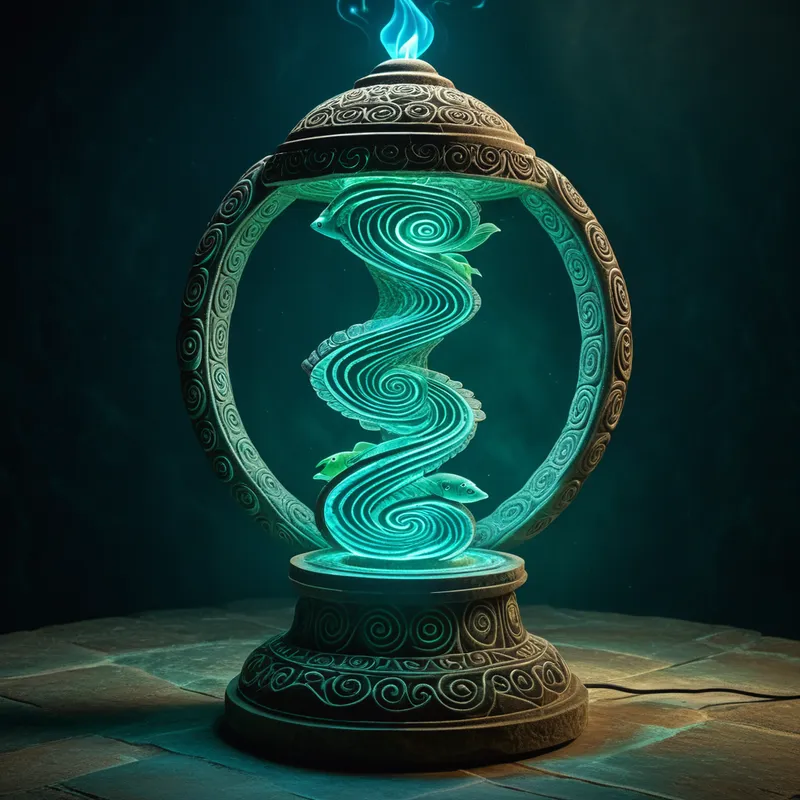
The qulliq is a central symbol. It is the warmth of the home, the light of consciousness, and the transformative fire of spirit. Its emptiness signifies a loss of inner warmth and spiritual light. By tending to it, the hunter rekindles the inner flame that makes relationship and perception possible.
The Dreamer's Resonance
When this myth stirs in modern dreams, it often manifests as profound encounters with a neglected, "dirty," or wounded feminine power. One might dream of a filthy, clogged fountain or spring; a magnificent but ill-kept animal; a powerful older woman living in squalor; or a feeling of being stuck in a murky, stagnant body of water.
Somatically, this can correlate with chronic fatigue, creative blockages, or a sense of emotional and spiritual barrenness—a "famine of the soul." The dream is signaling that the dreamer’s relationship to their own depths, their instinctual life, or their capacity for nurturing and being nurtured, is fouled. The psychic Arnaqquassaaq is immobilized by the dreamer’s own unconscious neglect, perhaps through over-intellectualization, perpetual busyness, or the repression of deep grief or rage. The dream is an invitation to stop trying to "hunt" for solutions externally, and instead to turn inward with a posture of cleansing care.
Alchemical Translation
The myth maps the alchemical process of individuation with stark clarity. The initial state is nigredo—the blackening, the famine, the frozen sea of despair. The conscious ego (the hunter) is impotent and starving.
The confrontation with the filthy, suffering Sea Woman is the encounter with the Shadow, specifically in its archetypal, feminine form. This is not a battle but a recognition of shared plight. The act of washing is the albedo—the whitening. It is the labor of purification, not through grandiosity, but through humble, repetitive, physical attention. It is the analysis of dreams, the honest confession, the patient tending to long-ignored wounds.
Transmutation begins not in the fire of ambition, but in the water of compassionate attention.
The restoration of the qulliq's flame is the citrinitas—the yellowing, the dawning of a new inner light, a new understanding. Finally, the release of the animals and the abundance of the sea represent the rubedo—the reddening, the return of full-blooded life, creativity, and psychic energy to the now-integrated personality. The hunter is not made a king; he is made whole. His reward is participation in a flowing, reciprocal world. He has learned that the soul’s abundance is released not by force, but by fostering the conditions—cleanliness, respect, gratitude—under which it willingly gives of itself.
Associated Symbols
Explore related symbols from the CaleaDream lexicon:
- Ocean — The vast, unconscious psyche and the source of all life; its stillness or turbulence directly reflects the state of the relationship with the deep Self.
- Elderly Woman — The archetypal wisdom of the deep feminine, the keeper of life and death, who requires respect and care to bestow her nourishing gifts.
- Water — The element of emotion, the unconscious, and purification; the act of washing with water is the central transformative ritual of the myth.
- Healing — The core process of the narrative, achieved not through battle but through attentive, compassionate service to the wounded source.
- Sacrifice — The hunter's sacrifice of his immediate hunger and his tools of taking, in order to perform an act of giving, which unlocks a greater abundance.
- Ritual — The myth is the template for all correct ritual: an intentional, respectful act performed to maintain balance and relationship with the spiritual world.
- Shadow — Arnaqquassaaq in her filthy, stuck state represents the neglected and repulsive aspects of the psyche that must be integrated for wholeness.
- Mother — The Sea Woman as the ultimate source, the Mother of all marine life, whose well-being is synonymous with the well-being of her children.
- Fish — The nourishing contents of the unconscious that become available when the source is respected; symbols of psychic vitality and instinct.
- Dream — The entire myth operates in the symbolic, non-logical space of the dream, where caring for a filthy spirit restores the physical world.
- Grief — The immobilized state of the Sea Woman can be seen as a manifestation of profound, unattended grief that has frozen the flow of life.
- Light — Represented by the flame of the qulliq; the inner light of consciousness and warmth that must be tended for true perception and relationship.