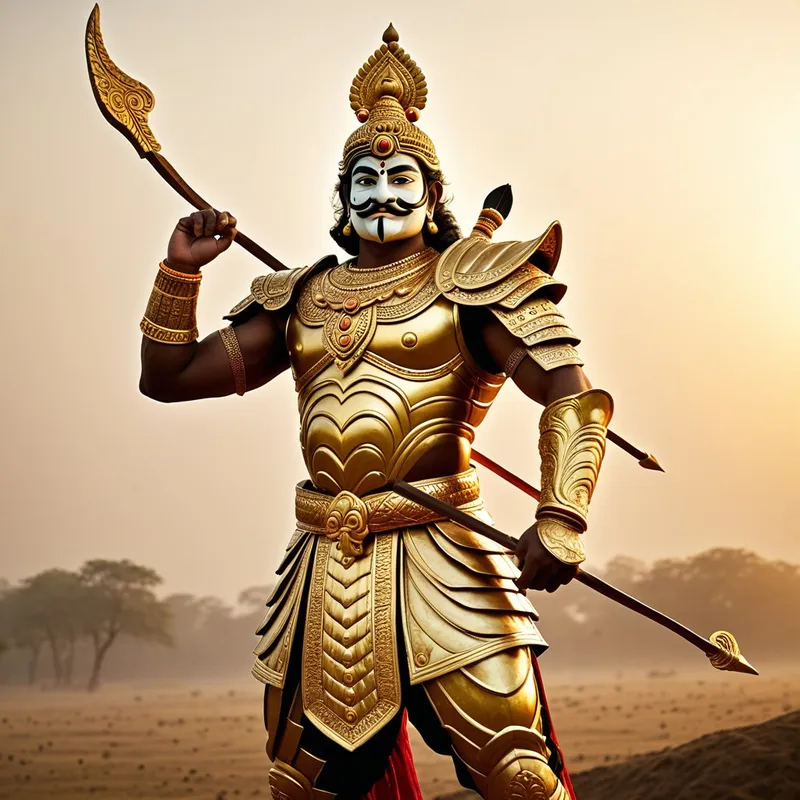
Arjuna Myth Meaning & Symbolism
The story of a peerless archer's crisis of conscience on a sacred battlefield, where his divine charioteer reveals the eternal truths of duty and the soul.
The Tale of Arjuna
Hear now the tale of the great tremor of the soul, the story of the bowman who could not draw his string.
The air on the field of Kurukshetra was thick with the scent of wet earth and impending storm. Two oceans of humanity faced each other, the glitter of a hundred thousand spears like stars fallen to earth. Conches blared, a sound to split the sky. And in the space between these armies, a single chariot stood, drawn by white horses that stamped the ground as if sensing the cataclysm to come.
Within it stood Arjuna, his fingers tracing the familiar curve of his celestial bow, Gandiva. He was the greatest warrior of his age, a prince of the Pandavas, a man whose name was synonymous with unerring aim and unshakeable courage. His charioteer was his friend, his cousin, the prince of Dwaraka—Krishna.
"Take me between the armies, Keshava," Arjuna commanded, his voice steady. "Let me see those who have come to fight, whose hearts burn for war."
The chariot rolled forward, a ship on a sea of silent anticipation. And as it halted, Arjuna looked. He saw not faceless enemies, but faces he knew. There were his revered elders—his grandfather Dhritarashtra's wise counselor, his own teachers who had taught him the arts of war. He saw beloved friends, honored kinsmen, nephews and cousins. In that moment, the grand cause of righteousness, the reclaiming of his stolen kingdom, crumbled to dust. The abstract "enemy" became father, teacher, brother.
A great weakness seized his limbs. His mighty bow, Gandiva, slipped from his grasp, clattering against the chariot floor. His skin burned with fever, his mind reeled. "What victory can be worth this price?" he cried, his voice breaking. "What kingdom, what joy, can be purchased with the blood of my own family? I see only sin, Keshava. I will not fight."
He sank down in the chariot, overwhelmed by grief and moral desolation. The great hero was paralyzed, his weapon useless, his purpose shattered. The epic war, the climax of a lifetime of struggle, awaited his signal. And he had laid down his arms.
Then, the charioteer spoke. And his voice was not the voice of a cousin, but the voice of the universe itself. Krishna smiled, a smile of infinite compassion and boundless knowledge. And from that place of utter human collapse, from the chariot that stood between two worlds, began the song of the soul—the Bhagavad Gita.
Cultural Origins & Context
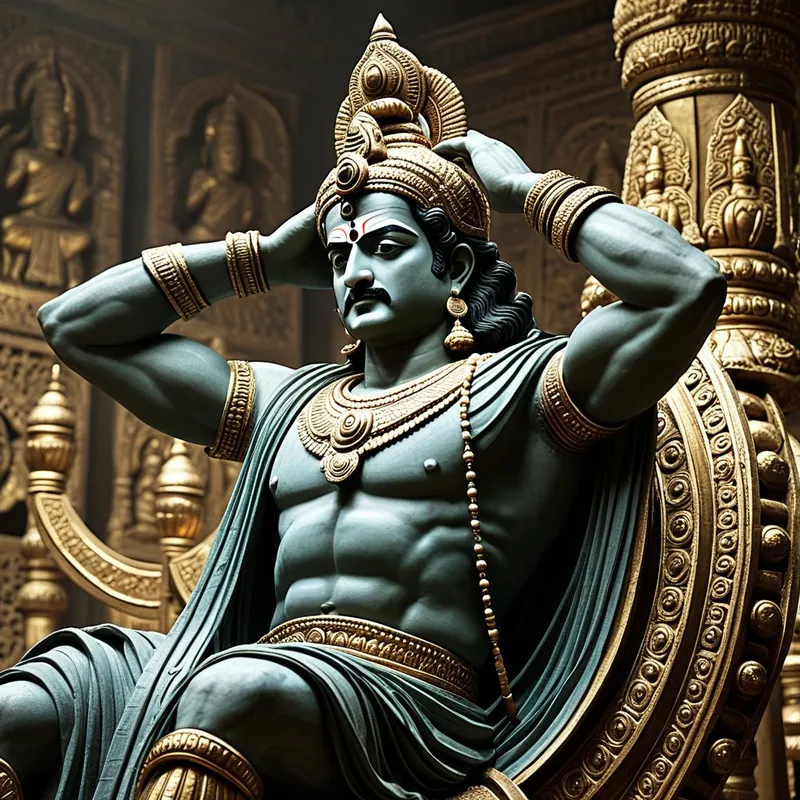
The story of Arjuna is the luminous heart of the Mahabharata, an epic of staggering scale composed over centuries, likely between 400 BCE and 400 CE. It is not merely literature; it is Itihasa, "history" in the deepest sense—a narrative that encodes the cultural, spiritual, and philosophical DNA of a civilization.
Traditionally ascribed to the sage Vyasa, the epic was transmitted orally for generations by bardic reciters known as Sutas. Its societal function was multifaceted: it was a repository of law, a guide to statecraft, a compendium of mythology, and, through the Gita, a supreme spiritual manual. The setting of the Gita—a battlefield—is profoundly intentional. It frames the ultimate spiritual teaching not in a remote forest hermitage, but at the very center of life's most intense, unavoidable, and ethical conflict. It democratizes wisdom, declaring that enlightenment is possible not by abandoning the world, but by fulfilling one's sacred duty within it.
Symbolic Architecture
Arjuna's paralysis on Kurukshetra is the universal human crisis of meaning. He represents the individual consciousness at the precipice of a necessary but terrifying action. The battlefield is not just a field of war; it is the field of life itself, the Dharmakshetra, where the eternal conflict between our higher nature (dharma) and our lower impulses (adharma) plays out.
Krishna, the divine charioteer, symbolizes the transcendent Self, the inner guide or intuition that is always present but often ignored. He does not take up the bow himself; he drives the chariot. This is crucial.
The divine does not live our lives for us, but guides the vehicle of our embodied existence. Our hands must still draw the bow.
The dropped bow, Gandiva, is the abdication of one's unique power and skill in the face of existential confusion. The family Arjuna sees arrayed against him represents the attachments, conditionings, and personal histories that bind the soul and create the illusion of separation and conflict. His despair is the dark night of the soul that precedes any genuine awakening.
The Dreamer's Resonance
When this myth stirs in the modern psyche, it rarely appears as a grand battlefield. It manifests in dreams of profound hesitation at a threshold: standing frozen before a crucial meeting, unable to speak a necessary but painful truth to a loved one, or feeling a deep, somatic paralysis when faced with a career-defining choice. The dreamer may feel their "tools"—their intellect, their voice, their confidence—become heavy and useless, much like Arjuna's bow.
The somatic experience is key: a tightening in the chest, a literal heaviness in the arms, a feeling of being "stuck in the chariot" while life demands movement. This is the psychological process of confronting the Shadow—not as a monstrous stranger, but as the "family" of disowned parts of oneself, past traumas, and societal expectations that feel intimately familiar yet oppositional. The dream signals that a foundational self-concept is being challenged, and the ego is in a state of necessary collapse, preparing for a deeper integration guided by the inner Self (the dream's version of Krishna).

Alchemical Translation
The alchemy of the Arjuna myth models the individuation journey with stark clarity. The first stage is Nigredo, the blackening: Arjuna's despair, his vision of universal destruction, the crushing weight of moral complexity. This is the essential dissolution of the ego's simplistic narratives of good and evil, success and failure.
Krishna's discourse initiates the Albedo, the whitening: the illumination. He reframes reality itself, teaching the immortality of the soul (Atman), the nature of selfless action (Nishkama Karma), and the paths to union with the divine. This is not intellectual knowledge, but a transformative revelation that reorganizes the psyche from its core.
The goal is not to avoid the battle, but to fight with a heart free from attachment to the fruits of action. This is the alchemical gold.
The final stage, Rubedo, the reddening, is Arjuna's quiet declaration at the Gita's end: "My delusion is destroyed. I have regained my memory [of my true nature] through your grace. I am firm; my doubts are gone. I will do your word." He picks up Gandiva. The action is the same—he will fight—but the consciousness performing it is utterly transformed. The individual acts not from personal desire, fear, or ego, but from a place of aligned duty and surrendered wisdom. The psychic energy once bound in paralyzing conflict is liberated and made available for conscious, purposeful engagement with the world. The hero is reborn, not as a conqueror of others, but as a servant of the sacred order within and without.
Associated Symbols
Explore related symbols from the CaleaDream lexicon: