Aristaeus Myth Meaning & Symbolism
A god of rural arts loses his bees, journeys to the watery underworld, and learns that creation requires sacrifice and sacred knowledge.
The Tale of Aristaeus
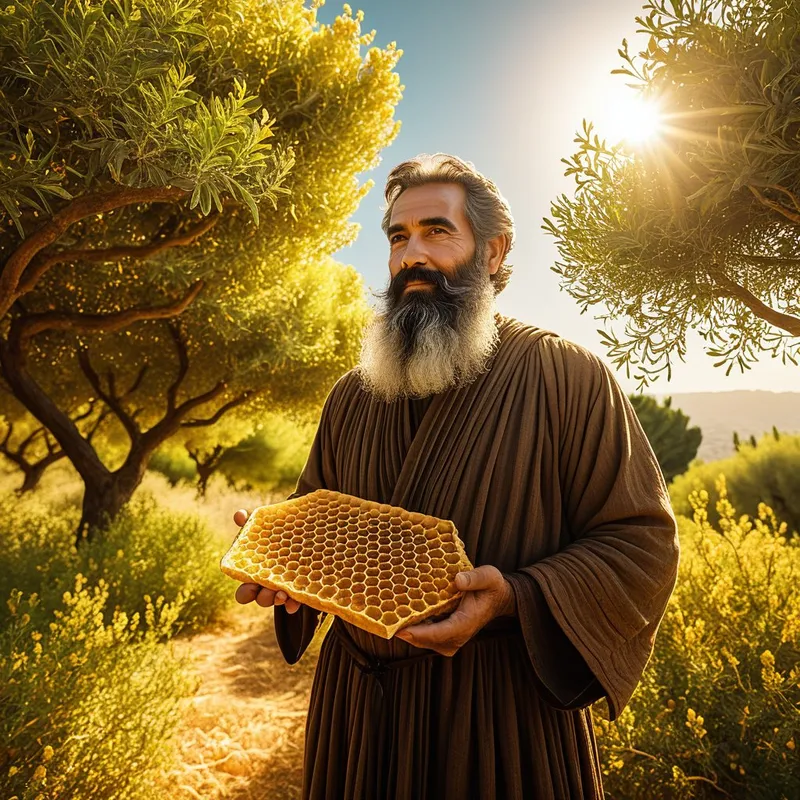
The sun was a tyrant over Boeotia, baking the thyme and rosemary into fragrant dust. In its heat, Aristaeus moved, a son of Apollo and the huntress Cyrene. He was the keeper of the green secrets—the one who taught men to bind the olive, to curdle milk into cheese, and to coax the golden sweetness from the air. His hives thrummed with a prosperous, sunlit music, a testament to his pact with the living world.
But a shadow fell, born of a sin he did not know he carried. For in his youth, his gaze had fallen upon Eurydice. In his pursuit, she had fled, and in her flight, a serpent’s fang had pierced her heel, sending her soul down to the misty halls of Hades. Her death was the seed of a silent curse.
The vengeance came not as a bolt from Zeus, but as a creeping silence. Aristaeus went to his apiaries one morning and found them tombs. No lazy drone, no busy worker, no golden treasure sealed in wax. Only stillness and a few scattered, lifeless bodies. His great work, the humming song of his mastery, was utterly extinguished. Despair, cold and heavy, settled in his chest. The god of green things was bereft.
He went to his mother’s sacred spring, the water-nymph Cyrene, and wept his confusion. She heard him, rising from the depths with water streaming from her hair. “My son,” her voice echoed like a river over stones, “you cannot command this mystery. You must propitiate it. Seek the ancient one, the shepherd of the seals, the Old Man of the Sea. Proteus knows all things, but he will not give his knowledge freely. You must catch him at his noon rest and hold him fast through all his terrifying forms.”
Guided by his mother, Aristaeus journeyed to the far shore, to a cavern smelling of salt and decay. There, amidst his herd of sleeping seals, lay Proteus. As noon’s light speared the cave, Aristaeus sprang. His hands closed on the god, who erupted into a nightmare of transformation—a bristling lion, a slithering serpent, a raging boar, flowing water, a towering tree. Aristaeus, his muscles screaming, held on through the terrifying parade, his will a single, unbroken thread. Finally, exhausted, Proteus resumed his true form and spoke in a voice of grinding tides.
“You seek cause for your loss? You are the cause. For the death of Eurydice, the nymphs, her companions, have sent this plague. They demand honor. You must build four altars in the grove sacred to them. Upon them, you must sacrifice four bulls and four heifers. Then leave the carcasses. Return on the ninth day.”
Heart heavy with both dread and hope, Aristaeus obeyed. He built the altars, performed the sacrifices, and left the offerings to the elements and the nymphs. For nine days, he waited in a state of sacred anxiety. On the ninth dawn, he returned to the grove.
A miracle hummed in the air. From the rotting flesh of the bulls, from the very essence of decay and sacrifice, new life was swarming. From the bellies of the carcasses poured a living torrent of bees, buzzing with a vibrant, resurrected song. They rose in a cloud, then settled into the new hives he had prepared. The silence was broken. The pact was restored. The sweetness had returned, born not from simple skill, but from atonement, sacrifice, and the acceptance of a sacred, terrible law.

Cultural Origins & Context
The myth of Aristaeus is primarily preserved for us in the Georgics, a poetic treatise on agriculture written by the Roman poet Virgil. While filtered through a Roman lens, its roots are deeply Greek, belonging to the vast body of rural lore and aition (origin myths) that governed the practical and spiritual lives of farming communities.
Unlike the grand Homeric epics of heroes and wars, this is a myth of the demiourgos—the skilled craftsman and cultivator. It was a story told by beekeepers, cheesemakers, and olive-growers, a narrative that explained the fragility and sacredness of their arts. It functioned as a practical-spiritual guide, encoding essential knowledge: beekeeping is precarious, success is not a right but a gift from the nymphs and gods of the land, and failure requires not just technical adjustment but ritual purification. The myth provided a framework for understanding blight, disease, and loss as potentially stemming from a broken relationship with the unseen forces of nature, a relationship that must be actively and humbly repaired.
Symbolic Architecture
At its core, the myth of Aristaeus is a blueprint of the creative process in its fullest, most demanding sense. Aristaeus begins as the naive creator, the skilled technician who believes mastery is a form of control. His initial success is a kind of unconscious grace.
The first creation is often a gift; the second must be earned through ordeal.
The catastrophic loss of his bees represents the inevitable “fall” of this naive consciousness. It is the creative drought, the writer’s block, the collapse of a project, the feeling that the well has run dry. The cause is linked to an unconscious shadow—the pursuit of Eurydice. This is not mere happenstance; it symbolizes how a creative drive, when tainted by careless desire or ego (the pursuit without regard for consequence), can poison its own source. The creative act is here shown to be part of a wider, ethical ecology.
His journey to capture Proteus is the descent into the chaotic, shape-shifting waters of the unconscious. Proteus, who knows all things but must be compelled to speak, represents the elusive, transformative wisdom of the deep psyche. To gain this wisdom, the conscious ego (Aristaeus) must “hold on” through terrifying transformations—confronting the lion of rage, the serpent of fear, the dissolving nature of water (emotion), the rigidity of the tree. It is the process of staying present with the chaotic contents of the psyche without fleeing.
The prescribed sacrifice is the pivotal symbol. It is not a bribe, but a propitiation—a making-right. The offering of the finest bulls and heifers represents the surrender of one’s prized vitality, one’s “bullish” strength and generative potential, to the larger order. It is an act of humility that acknowledges a debt to the invisible nurturers (the nymphs). The miracle—bees born from decay—reveals the central alchemical truth:
New life, profound creativity, and true sustenance are born not from pristine beginnings, but from the sacred decomposition of the old self. The most golden honey is distilled from the acceptance of rot and sacrifice.

The Dreamer's Resonance
When this myth stirs in the modern dreamer, it often signals a profound crisis of creation or sustenance. One may dream of a cherished project crumbling to dust, a garden withering overnight, or a vital energy source (like a battery or well) going dead. The somatic feeling is one of hollow emptiness and impotent frustration—the “Aristaean despair.”
The dream may then guide the dreamer toward their own “Protean” encounter. This could manifest as a dream figure of immense age and wisdom who is elusive or terrifyingly unstable, or a sequence where the dream environment itself shifts wildly—a room becoming a forest, then an ocean. The psychological process here is the ego being forced to engage with the chaotic, transformative power of the unconscious, which holds the key to the cure but refuses to give it up easily.
Finally, the dream may present images of potent sacrifice: offering something of great personal value on a simple altar, or witnessing decay give birth to something luminous and buzzing with life. This indicates the psyche working through the necessary surrender, moving from a state of egoic control to one of participatory offering, preparing the dreamer for a renaissance born of humility, not force.

Alchemical Translation
For the individual on the path of individuation, the Aristaeus myth models the opus—the great work—of psychic transmutation. We all begin, in some domain of our life, as the naive creator, enjoying the fruits of an innate talent or favorable circumstance. The “death of the bees” is the necessary crisis that shatters this unconscious paradise. It forces a question: is my creativity, my livelihood, my sense of purpose, merely a technical skill, or is it part of a sacred exchange?
The capture of Proteus is the interior work of shadow integration. We must descend into our own chaotic inner sea and hold fast to the truth of ourselves through all its frightening manifestations—the repressed anger, the fluid grief, the rigid defenses. This struggle yields the crucial insight: the problem is relational and ethical. We have, however unknowingly, neglected or violated our connection to the nurturing, instinctual ground of our being (the nymphs).
The alchemical sacrifice is the most challenging phase. It demands we willingly offer up a part of our identified strength, our prized achievements, or our current self-image on the altar of something greater. We must let it “rot”—that is, we must allow our old mode of operation to decompose in the dark. This is an act of supreme trust.
The transmutation occurs in that liminal, ninth-day space. From the surrendered material, a new form of vitality emerges. The “bees” are the symbols of a regenerated creative spirit. They are no longer merely productive; they are resurrected, imbued with the wisdom of the ordeal. The individual no longer just “makes” or “does”; they participate in a sacred cycle where loss, atonement, and surrender are the non-negotiable ingredients of true, sustainable creation. The sweetness earned is deeper, more resonant, and forever connected to the knowledge of the dark from which it sprang.
Associated Symbols
Explore related symbols from the CaleaDream lexicon: