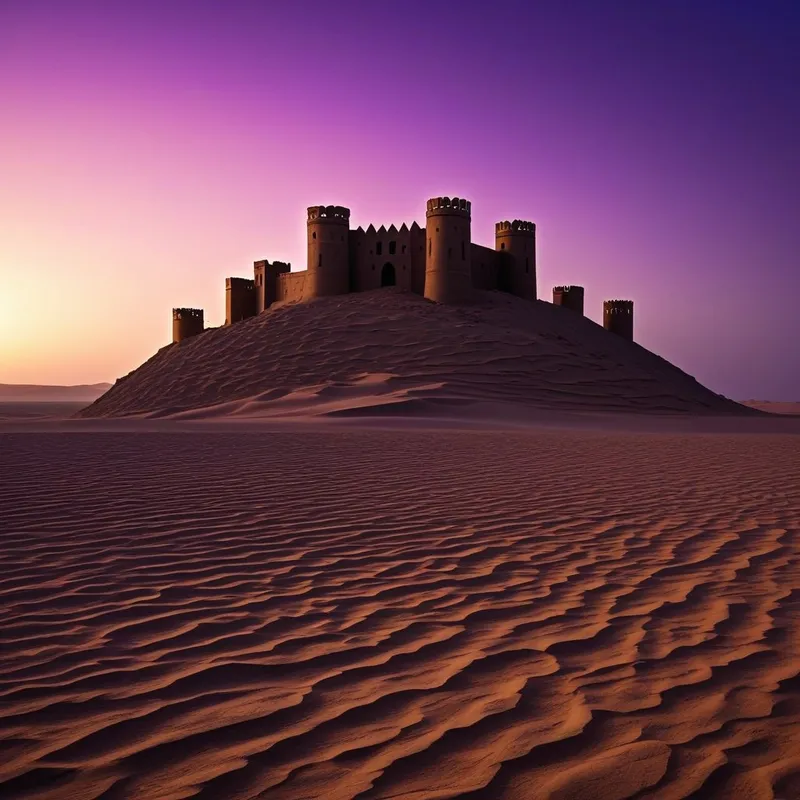
Arg-é Bam Myth Meaning & Symbolism
A myth of a citadel built from desert clay and human will, shattered by a cosmic sigh, teaching the eternal cycle of ruin and sacred reconstruction.
The Tale of Arg-é Bam
Listen, and let the desert wind carry you back. Before the sands knew their own thirst, before the stars had fixed their nightly paths, there was a longing in the heart of the world. It was a longing for a vessel, a form to hold the unformed spirit of a people. From this longing, Nafas stirred.
And so, the Builders came. They were not gods who shaped mountains with a thought, but children of the dust, their fingers calloused from the earth. They heard the whisper in the dry wind: Make a home for the soul. They went to the great plain, where the sun was a hammer and the earth a vast, silent promise. They took the clay, the very flesh of Zamin, and mixed it with the chaff of harvested grain and the salt of their own sweat. They drew water from hidden, secret veins deep below, water that remembered the ancient seas.
Brick by brick, prayer by prayer, they built. They built walls that curved like a mother’s protective arm. They built towers that reached for the heavens like questions. They built wind-catchers that sang with every breeze and labyrinthine lanes that held the cool of the night. They called it Arg-é Bam, the Citadel of Clay and Consensus. It was not just a fortress against raiders, but a fortress against chaos, a poem written in mud and geometry. Within its walls, gardens bloomed in hidden courtyards, fountains whispered, and the scent of baking bread and rosewater was a constant hymn. It was a world made by hand, a testament to the pact between human will and the patient body of the earth.
For generations, it stood. Its shadow was a dial marking the sacred hours; its silence was deep and knowing. It became so perfect, so complete in its harmony, that it began to dream it was eternal. It forgot the whisper of the wind that had inspired its first brick. It forgot the clay of its birth.
Then, the Sigh came. It was not an earthquake born of grinding plates, but a sigh from the heart of existence itself—a tremor of divine melancholy or perhaps cosmic correction. Some say it was Zamaneh, weary of perfection. Others say it was the land itself, reminding its creation of its true substance. The sound was not a roar, but a deep, single note of release.
And the Citadel, in one shuddering moment, remembered it was clay. The mighty walls that had defied armies crumbled like dried leaves. The graceful arches collapsed into sighs of dust. The intricate mosaics shattered into a thousand forgotten stories. The great silence after the Sigh was more profound than any that had come before. Where a world had been, there was only a field of fragments under a pitiless moon, a beautiful corpse returned to the dust from which it was born.
Cultural Origins & Context
The story of Arg-é Bam is woven not from a single epic poem, but from the collective memory of the Iranian plateau, finding its most potent expression in the physical reality of the Bam Citadel. For centuries, this mud-brick city was a living entity, a hub on the Silk Road where the practical science of desert architecture met profound cosmological principles. The myth was passed down not merely by storytellers, but by the masons who mixed the khesht (clay bricks), the qanat diggers who channeled water, and the mothers who swept courtyards.
Its societal function was multifaceted. On one level, it was an etiological tale, explaining the ruins that dotted the landscape—a reminder of the transience of even the greatest human achievements. On a deeper level, it served as a foundational narrative of identity. It taught that civilization is not a given, but a conscious, continuous act of creation from the humblest materials. It encoded the sacred knowledge of sustainable living, of building in dialogue with, not dominance over, a harsh environment. The citadel was a physical model of the ideal society: fortified yet welcoming, complex yet orderly, earthly yet aspiring to the celestial.
Symbolic Architecture
Arg-é Bam is the ultimate symbol of the Psychic Citadel. It represents the intricate structure of the conscious personality—our beliefs, habits, relationships, and achievements—meticulously built over a lifetime from the raw material of our innate potential and cultural conditioning.
The fortress we build to keep chaos out eventually becomes the walls that keep our soul in.
The clay is the fundamental substance of the human psyche: primal, fertile, and malleable, yet utterly earthly and vulnerable. The Builders represent the conscious ego, the architect and laborer of our identity. The hidden water is the Aqua Vitae of the unconscious, the deep, often unseen emotional and instinctual resources that sustain the structure.
The catastrophic Sigh, then, is not merely a disaster, but a necessary symbolic event. It represents the inevitable encounter with the limits of the ego's construction. This could be a profound personal crisis—a loss, a failure, an awakening—that shatters our carefully maintained self-image and worldview. The Sigh is the voice of the Self, the total, archetypal psyche, correcting the ego's illusion of permanence and separateness.
The Dreamer's Resonance
When this myth stirs in the modern unconscious, it manifests in dreams of profound structural change and vulnerability. One might dream of their childhood home collapsing, of the walls of their office turning to sand, or of trying desperately to repair a beautiful, intricate vase that keeps crumbling. The somatic sensation is often one of groundlessness, a literal feeling of the floor giving way, accompanied by anxiety or, paradoxically, a strange relief.
These dreams signal a psychological process of deconstruction. The psyche is initiating the dissolution of an outdated psychic structure—a rigid belief, a defining role, a long-held self-narrative that has become a prison. The dreamer is not being punished; they are being prepared. The ruin in the dream is not an end, but the necessary fertile ground for what psychologist James Hillman called the "soul's work." The process is one of grieving the old form while simultaneously, often unbeknownst to the conscious mind, gathering the scattered shards that still hold value.
Alchemical Translation
The alchemical journey mirrored in the myth of Arg-é Bam is the cycle of Solve et Coagula—Dissolve and Coagulate. The first, brutal alchemy is the Nigredo, the blackening. The proud, sun-baked citadel (the conscious identity) is reduced to a formless mass of blackened clay and dust. This is the stage of despair, confusion, and the dark night of the soul, where all previous certainties are annihilated.
The masterpiece of the soul is not the first citadel, but the wisdom to build again, knowing it too will one day return to clay.
The work of the modern individual is not to avoid this dissolution, but to learn to endure it without fleeing into distraction or false reconstruction. One must sit in the ruins and sift the debris. Which shards of the old self are true? Which skills, which loves, which core values are like the fired ceramic tile that survives the collapse? This sifting is the Separatio.
The final, and most sacred, stage is the Coagulatio—not a rebuilding of the identical fortress, but a new creation informed by the ruin. The new structure may be smaller, humbler, or differently shaped. It incorporates the lessons of its own fragility. It remembers the Sigh. This is individuation: no longer building a citadel to project an image of invulnerability, but crafting a authentic dwelling place for the soul that acknowledges its foundation in humble, mortal clay and its sustenance from the deep, hidden waters of the unconscious. The cycle is eternal, for the soul, like the desert, is always both ruin and potential, dust and the dream of a garden.
Associated Symbols
Explore related symbols from the CaleaDream lexicon: