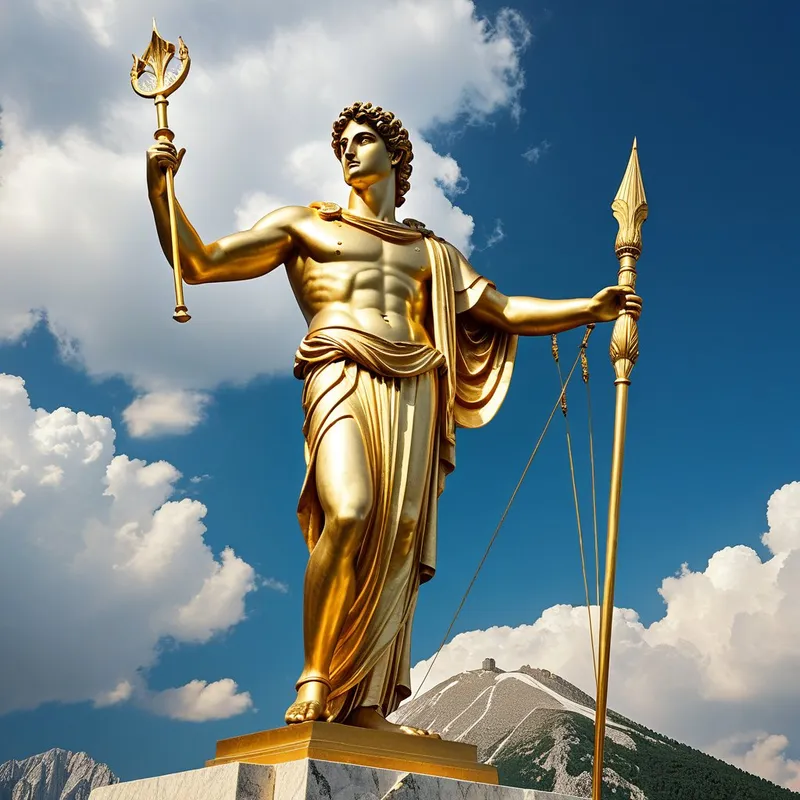
Apollo's Kithara Myth Meaning & Symbolism
The god Apollo wins the golden kithara from Hermes, transforming a trickster's theft into the divine instrument of cosmic order and prophetic truth.
The Tale of Apollo's Kithara
Hear now, a tale not of brute force, but of stolen cattle and stolen sleep, of a trickster’s laugh and a god’s wrath, resolved not by thunderbolt, but by a song.
In the first grey light of his birth, the infant Hermes did not cry for milk. His eyes, old as the roads between worlds, saw opportunity. He slipped from his cradle and found, at the cave’s mouth, a tortoise. With a flash of cunning and a whisper of thanks to the creature’s spirit, he hollowed its shell, strung it with gut, and invented the first lyre. Its sound was sweet, a curious hum that seemed to hold the secret of laughter itself. But the newborn god was restless. He craved action, and his gaze fell upon the sun-drenched pastures of Apollo.
Under the cloak of night, the babe became a thief. He stole fifty of Apollo’s sacred cattle, driving them backwards so their tracks deceived, weaving sandals of brushwood to disguise his own. He hid them in a grove, sacrificing two to the twelve great gods—a precocious piety—and then returned to his cradle, innocent as dawn.
Apollo’s rage was a solar flare. The god of truth, whose eye misses nothing, had been blinded by guile. He traced the mischief back to Cyllene and confronted the babe, who feigned sleep, then wide-eyed ignorance. “I, a newborn? Steal your cattle? Look at my size!” But Apollo, seer of Delphi, was not fooled. He seized the infant, and the argument rose to the throne of Zeus himself.
On Olympus, before the amused and stern father, Hermes did not deny. Instead, he played his defense. From the folds of his blanket, he produced the tortoise-shell lyre. His small hands, touched with a grace not of this world, plucked the strings.
A sound filled the hall that stilled the nectar in its cups. It was a music never before heard: playful yet profound, containing the rustle of the reeds, the lowing of the cattle, the whisper of the night wind, and the sly joy of invention itself. The melody wound around Apollo’s wrath like a vine, softening its edges, cooling its heat. The god of light stood transfixed. His anger melted, replaced by a deep, resonant longing. In that sound, he heard a potential—a raw, chaotic creativity that yearned for form, for scale, for divine purpose.
The trial was over. Hermes, in a gesture of reconciliation both shrewd and genuine, offered the lyre to Apollo. In exchange, Apollo gave the cattle to the trickster and bestowed upon him the caduceus, the herald’s staff. But the true prize was the instrument. Apollo, master of measure and harmony, took the simple lyre and transformed it. He crafted a kithara of gold and ivory, an instrument worthy of the cosmos’s song. When he played it, the music was no longer just clever or sweet. It was the very voice of cosmic order—the music of the spheres, the rhythm of the seasons, the clear, prophetic tone that could heal souls and reveal fate. The theft was forgiven, for from the chaos of a prank was born the instrument of cosmic harmony.

Cultural Origins & Context
This myth, primarily told in the Homeric Hymn to Hermes, was not merely a children’s story. It was a foundational narrative explaining the divine provenance and social power of music in ancient Greece. The kithara was not a casual instrument; it was the sophisticated, large-format lyre used by professional musicians (kitharodes) in public competitions, religious festivals, and the recitation of epic poetry. By claiming its origin in a divine pact between two of the most important Olympians, the myth sacralized the musician’s art.
The story was performed, likely with kithara accompaniment, at festivals for both gods. It served multiple societal functions: it explained the domains of Apollo (music, prophecy, order) and Hermes (trade, cunning, boundaries); it modeled conflict resolution through artistic exchange rather than violence; and it established music as a civilizing force, a medium through which raw, amoral cleverness (Hermes) is elevated into a principle of world-ordering beauty (Apollo). The myth was a charter for the Greek belief that true culture—mousikē—emerges from the tension and reconciliation between wild inspiration and disciplined form.
Symbolic Architecture
At its core, the myth maps the psyche’s journey from unconscious, instinctual action to conscious, creative expression. Hermes represents the shadow and the puer aeternus—the quick, mercurial spark of new ideas that operates outside the law, stealing energy (the cattle) from the established, conscious order (Apollo).
The shadow’s theft is not mere destruction; it is the unconscious demanding recognition, offering its raw material to the light of consciousness.
Apollo symbolizes the conscious ego and the logos principle. He is structure, clarity, and identity. His initial rage is the ego’s outrage at being undermined by the unconscious. The conflict before Zeus is the internal crisis where the conscious mind must confront what it has repressed or ignored.
The resolution is alchemical. The lyre/kithara is the transcendent function—the symbol that emerges from the tension of opposites to create a new, higher reality. Hermes’s lyre is the nascent, unintegrated talent or complex. Apollo’s kithara is that same potential, mastered, amplified, and directed toward a cosmic purpose. The exchange—lyre for cattle, trickery for the caduceus—represents a psychic bargain: the conscious ego (Apollo) gains creative mastery and depth by acknowledging and integrating the shadow’s energy, while the shadow (Hermes) gains a legitimate place in the psychic economy, its chaotic energy channeled into a defined role (as messenger, guide).
The Dreamer's Resonance
When this myth pattern stirs in the modern dreamer, it often signals a struggle between a nascent, rebellious creativity and the established structures of one’s life. Dreaming of a stolen or hidden treasure (the cattle) points to psychic energy that has been taken from the “solar” conscious life—perhaps ambition, passion, or a wild idea—and sequestered in the shadow.
Dreaming of a musical instrument, especially one that is broken, being tuned, or miraculously played, signifies the emerging transcendent function. A dream of making a deal or exchange with a mischievous figure or an authoritative one can reflect the internal negotiation between the Hermesian and Apollonian aspects of the self. Somatically, this process may feel like restless energy (Hermes’s insomnia), followed by tension or anger (Apollo’s rage), culminating in a moment of profound release or insight when the “music” is finally heard—a physical sensation of harmony, alignment, or a “click” into place.

Alchemical Translation
The individuation process modeled here is the transmutation of theft into gift, and chaos into cosmos. We all have inner Hermes moments: impulsive acts, “stolen” time for a hobby, a subversive thought that challenges our self-image. The Apollonian response is often to suppress this as disruptive. The myth instructs us not to crush the trickster, but to listen to its offering.
The first step in psychic alchemy is to court the shadow, not with judgment, but with a curious ear for the strange music it carries.
The “cattle”—our vital, instinctual energy—must be driven into the open and acknowledged. The ensuing conflict before our inner “Zeus” (the observing Self, the higher conscience) is necessary. It is in this court that the shadow reveals its creative potential. Our task is to take the raw, perhaps crude, “lyre” of our hidden talents or repressed complexes and, with Apollonian discipline and care, craft it into our personal “kithara”—a unique instrument of expression that brings order and beauty to our inner world and contributes our unique note to the world’s harmony.
The final stage is mastery. Apollo does not just own the kithara; he becomes its supreme virtuoso. The alchemical translation is complete when the integrated content no longer feels like a stolen or foreign part, but the very source of our authority, healing, and prophetic understanding of our own path. We become the player of our own reconciled nature, creating harmony from what was once conflict.
Associated Symbols
Explore related symbols from the CaleaDream lexicon: