Apollo and the Muses Myth Meaning & Symbolism
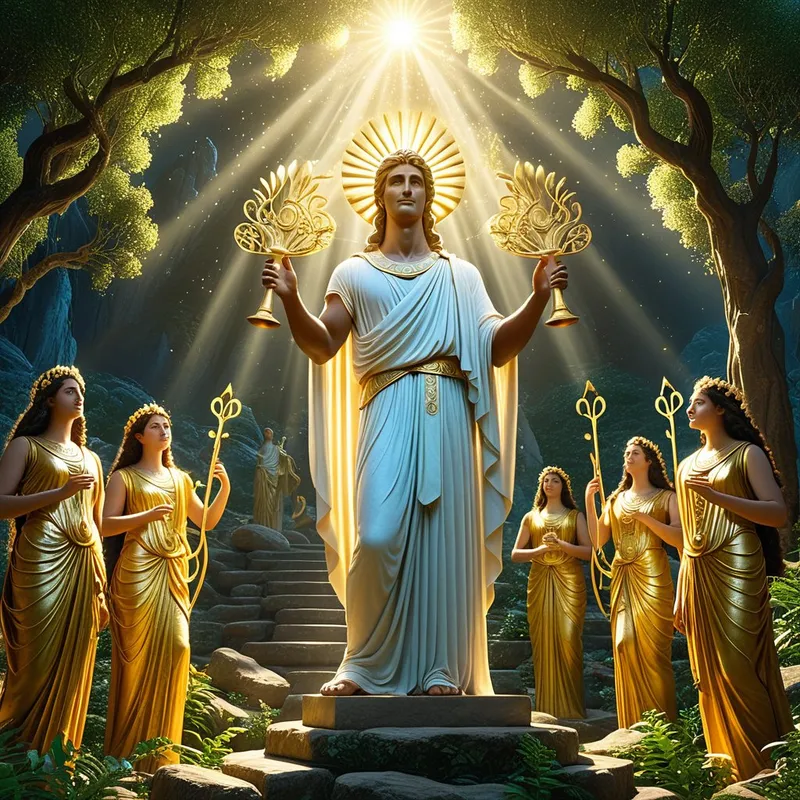
The sun god Apollo leads the nine Muses, transforming raw chaos into the ordered, sacred arts that give meaning to human life.
The Tale of Apollo and the Muses
Before history, there was chaos—a formless, soundless world. Then, from the deep, misty valleys of Mount Helicon and the clear, cold slopes of Mount Olympus, a murmur arose. It was not yet music, not yet word, but a potential, a whispering in the wind. This was the province of the nine sisters, the Muses. They were wild, their powers untamed, their songs echoing the raw, unshaped beauty of the world—the crash of the sea, the sigh of the forest, the silent dance of the stars. Inspiration was a torrent, beautiful and terrifying.
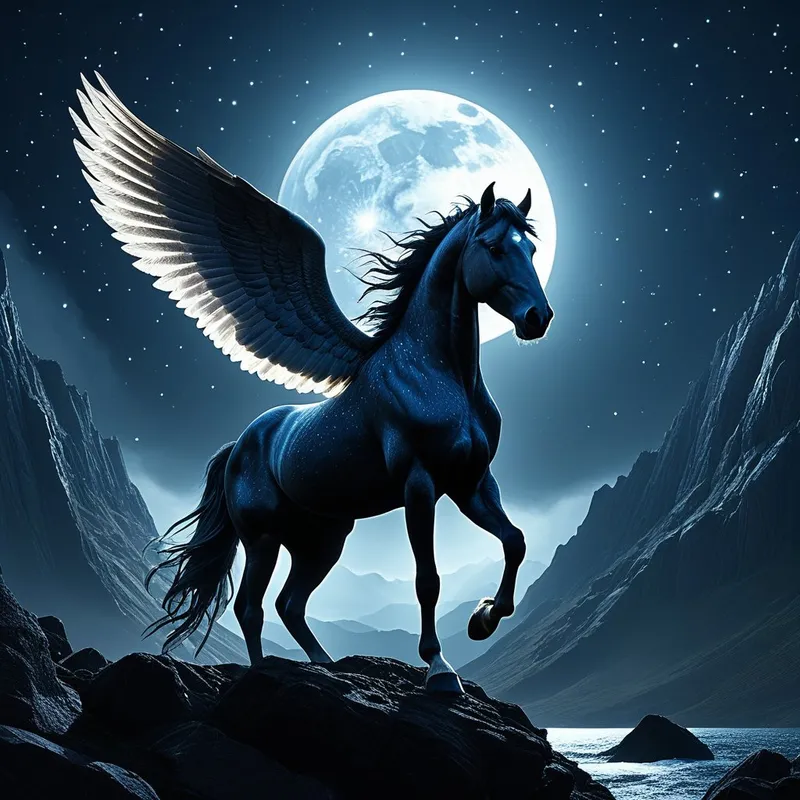
Into this realm of primal creativity came Apollo. He did not come as a conqueror, but as a principle. The light of his presence did not burn away the mist, but revealed its contours. He carried the kithara, its frame carved from sacred tortoise shell, its strings awaiting the touch of divine order. He found the sisters by the springs—first at Aganippe, and later, where the winged steed Pegasus struck the earth and brought forth the sparkling Hippocrene.
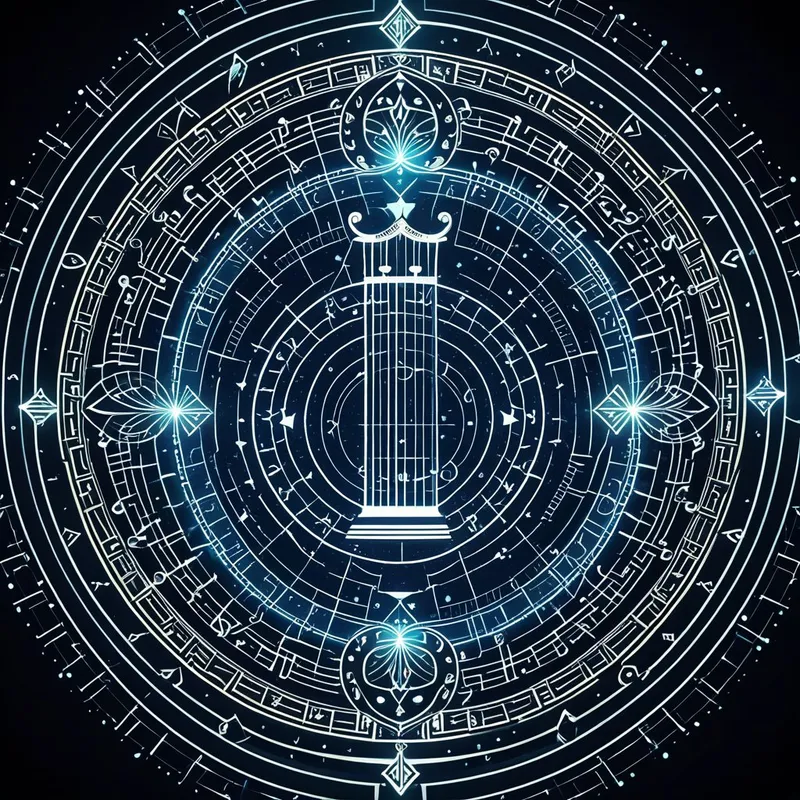
He did not command. He listened. He heard Calliope’s fragments of heroic sagas, Erato’s unformed sighs of passion, Melpomene’s deep notes of impending sorrow. Then, he placed his fingers upon the strings. The first chord he struck was not a melody, but a law—a harmonic ratio, the music of the spheres made audible. It was a tone of pure relation, of number and balance. The chaotic murmurs of the Muses stilled, not in obedience, but in recognition. They heard in his music the hidden architecture of their own power.
One by one, their wild energies found focus, name, and domain. Clio understood her whispers were the memory of things that were. Euterpe found the flute’s voice. Terpsichore felt the rhythm in her limbs. Thalia discovered the shape of laughter. Polyhymnia learned the posture of reverence. Urania saw the stars not as random lights, but as a celestial score. Apollo, the Musagetes, had become their conductor. Together, they transformed the whispering chaos into a symphony of the civilized arts—a sacred order that humans could approach, but never fully possess, a wellspring of meaning for all who dared to listen.
Cultural Origins & Context
This myth was not a single story penned by one author, but a living, breathing concept woven into the fabric of Hellenic life from the 8th century BCE onward. It was passed down through the oral tradition of bards and rhapsodes, the very performers who invoked the Muses and Apollo at the start of every epic recitation, as Homer does in the Iliad and Odyssey. The myth’s primary function was etiological—it explained the origin and nature of artistic and intellectual inspiration.
The cult centers of the Muses, the Mouseia, were often associated with springs, like those on Helicon, linking creativity to the life-giving and mysterious underworld. Apollo’s role as their leader was cemented in the Sanctuary of Delphi, where he was the god of prophecy, and prophecy was a form of inspired speech. In society, the myth served to sacralize the arts and sciences. It taught that creativity was not a purely human, personal talent, but a divine gift (kharis) channeled through discipline and form (Apollo’s domain). The poet, historian, or musician was a vessel, and their work was an act of pious service to these ordering deities.
Symbolic Architecture
At its heart, this myth is a profound allegory for the birth of consciousness from the unconscious, and of culture from nature. The nine Muses represent the undifferentiated, chaotic wellspring of the creative unconscious—the raw, fertile, and potentially overwhelming matrix of images, impulses, and possibilities.
Apollo represents the principle of logos: the differentiating, ordering, and structuring force of consciousness. He is the light that allows us to see form, the ratio that turns noise into music.
Each Muse, given her specific domain by Apollo, symbolizes a fundamental category of human cultural expression, a way the formless psyche is shaped into something communicable and meaningful. The pairing is essential: without the Muses’ raw material, Apollo’s order is empty intellectualism; without Apollo’s structuring light, the Muses’ inspiration remains inarticulate, even maddening, chaos. The myth depicts the ideal creative process as a sacred marriage (hieros gamos) between these two poles: inspired frenzy and disciplined craft, Dionysian flow and Apollonian form.
The Dreamer’s Resonance
When this mythic pattern stirs in the modern dreamer, it often signals a critical juncture in one’s relationship with their own creativity or inner voice. Dreaming of chaotic, beautiful, but frightening sounds or figures (the pre-Apollonian Muses) may reflect a psyche flooded with unprocessed emotion, intuitive hits, or creative ideas that feel overwhelming and unmanageable. There is energy, but no direction.
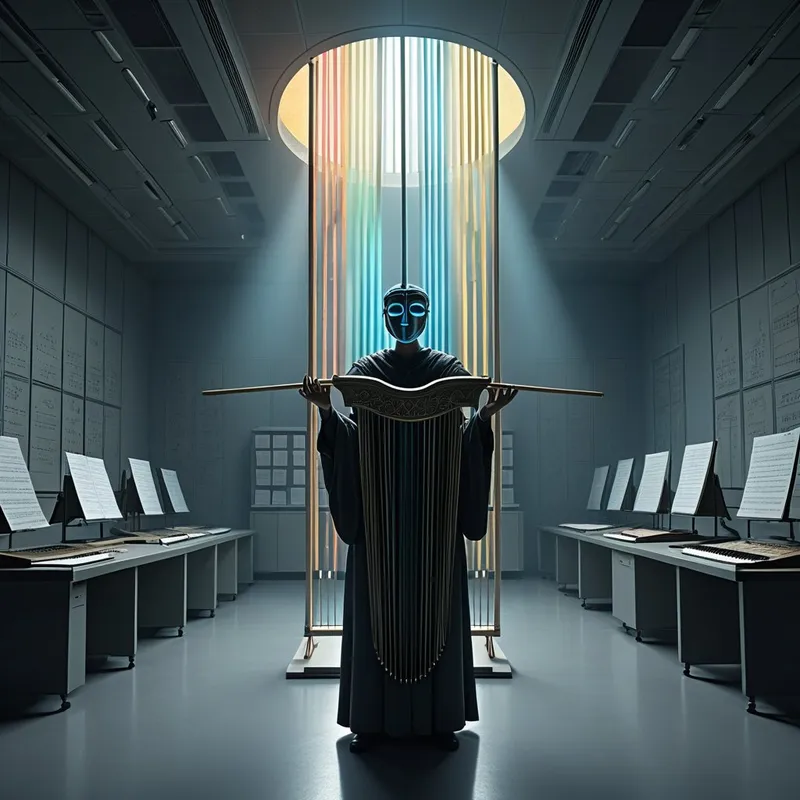
Conversely, dreaming of a brilliant but cold, sterile light or a rigid, mathematical structure (an Apollo without Muses) may indicate an over-reliance on rational control, analysis, or order at the expense of one’s intuitive, emotional, or imaginative life. The dreamer may feel creatively barren or spiritually dry.
The healing dream, the resolution, often involves an image of synthesis: finding a sacred spring or source; being given a musical instrument one knows how to play; or witnessing chaotic elements gently organizing themselves into a beautiful, coherent pattern. Somaticly, this can feel like a release of tension in the chest or throat—the place of breath, song, and speech—as the blocked creative current finds its proper channel and form.
Alchemical Translation
The journey from the wild Muses to the chorus led by Apollo is a perfect map for the alchemical process of individuation—the forging of a coherent, conscious Self from the prima materia of the unconscious. The initial state is the nigredo, the chaotic, dark mass of unrefined potential within us. This is the raw, often troubling, content of our inner world: our complexes, our wounds, our latent talents.
The appearance of Apollo as Musagetes is the act of bringing the light of conscious attention and disciplined practice to this inner chaos. It is the albedo, the whitening, where things are separated and clarified.
The modern individual undergoes this transmutation when they dare to confront their inner chaos not with fear, but with the intent to give it form. This is the artist who commits to a daily practice. The analyst who journals to understand their dreams. The seeker who uses ritual or meditation to structure their spiritual inquiry. We each must become our own Apollo to our inner Muses—not to suppress their wildness, but to provide the lyre upon which their song can be played. The triumph is not control, but collaboration. The resulting “art” is the individuated life itself: a unique, harmonious expression where every aspect of the psyche—the tragic and the comic, the historical and the astronomical, the erotic and the sacred—has its appointed place and voice in the greater symphony of the Self.
Associated Symbols
Explore related symbols from the CaleaDream lexicon: