
Aphrodite/Venus Myth Meaning & Symbolism
Born from sea foam and severed divinity, Aphrodite is the cosmic force of irresistible attraction, binding chaos into creation through beauty and desire.
The Tale of Aphrodite/Venus
Listen. Before the world was ordered, when the raw stuff of creation still churned in the dark, a crime of cosmic scale was committed. Ouranos, the starry sky, was cast down and cut apart by his own son, Kronos. From the terrible wound where flesh met void, from the divine blood and seed that fell into the waiting, salt-thick embrace of the Sea, a miracle began to stir.
The ocean, which had known only the whispers of deep currents, began to foam. Not the gentle froth of waves, but a churning, iridescent effervescence, a luminous broth born of severed god-stuff and primordial water. The sea itself was in labor. And from this sacred foam, this aphros, she emerged. Not as an infant, but in the full, breathtaking power of her nature. She was Aphrodite, and her first breath was a sigh that became the west wind, Zephyrus. Her first steps were upon a great scallop shell, which carried her like a cradle to the shores of Kypros.
Where her feet touched sand, flowers sprang forth. Where her gaze fell, the very air softened with longing. The Graces came to clothe her. Eros, with his bittersweet arrows, attended her from the first. She walked inland, and the world, which had been a collection of separate things—rock, tree, beast—suddenly felt a pull, a magnetic yearning. She was the force that binds, the irresistible attraction that turns chaos into pair, void into creation.
Yet, for a force so fundamental, her place among the gods of Olympos was never simple. She was given in marriage to Hephaistos, the steadfast, limping craftsman—a union of breathtaking beauty and steadfast utility, of surface and structure. But her nature was not to be contained. Her heart, and her myths, were drawn to the thrill of the hunt with Ares, to the mortal beauty of Anchises, to the youthful tragedy of Adonis.
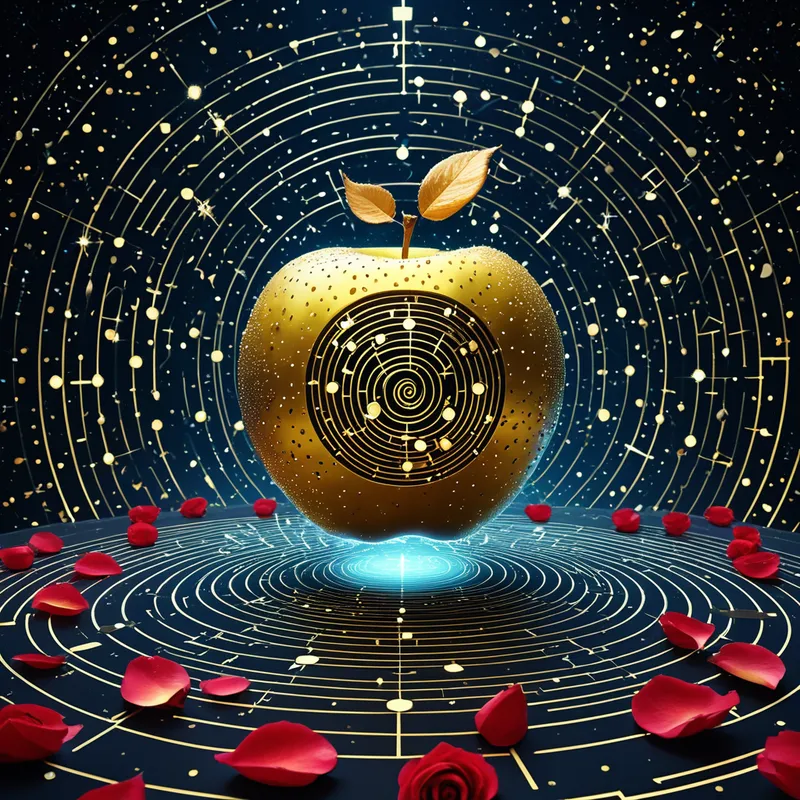
Her power sparked the greatest of wars. When Eris tossed a golden apple inscribed “for the fairest” among the goddesses, it was Aphrodite who offered the shepherd Paris the love of the world’s most beautiful woman, Helen. She won the apple, and in doing so, lit the fuse that would burn Troy to the ground. For her power is not gentle. It is the tectonic force of desire, which builds civilizations in its name and reduces them to ashes for its sake.

Cultural Origins & Context
The worship of Aphrodite is ancient, complex, and layered with cultural exchange. Her origins likely weave together pre-Greek, possibly Minoan, goddesses of fertility with the powerful influence of the Near Eastern love and war goddess, Ishtar (Inanna). Her arrival via the sea from the East, from Kypros (Cyprus) and Kythera, mirrors the Phoenician trade routes, suggesting her myth encoded the arrival of a potent foreign cult into the Greek world.
Homer, in the Iliad, presents her as a daughter of Zeus, a safely integrated Olympian. But the older, more primal tradition, preserved by Hesiod in his Theogony, tells the story of her birth from the sea foam and the severed genitals of Ouranos. This version places her among the primordial forces, older than Zeus himself, a power that emerges from violent separation and cosmic wounding. She was worshipped not just as a goddess of romantic love (Aphrodite Pandemos, “of all the people”) but as a goddess of civic harmony, seafaring, and, in her aspect as Aphrodite Ourania (“the heavenly”), of a more philosophical, transcendent union. Her festivals, like the Aphrodisia, involved rituals that celebrated sexual power as a fundamental, creative, and socially cohesive force.
Symbolic Architecture
Aphrodite is not merely a personification of romantic feeling. She is the archetypal principle of Eros in its broadest, most profound sense: the force of attraction that creates relationship, spark, and ultimately, new life. She is the psychic energy that moves us toward—toward another person, toward beauty, toward creation.
She is the answer to the primordial separation. Where there is a cut, a void, a distance, Aphrodite is the magnetic pull that seeks to bridge it, to create a new whole from disparate parts.
Her birth from the castration of Ouranos is deeply symbolic. The violent separation of Sky (Ouranos) from Earth (Gaia) creates a painful, fertile void. From this wound, Aphrodite is born. Thus, she is the beautiful, life-giving result of a necessary, if traumatic, differentiation. She represents the gorgeous, compelling force that emerges after a painful separation, inviting new unions on a higher, more conscious level. Her marriage to Hephaistos symbolizes the necessary union of inspiration (beauty, desire) with craft and manifestation (the forge). Without her, his creations lack soul and allure. Without him, her power remains unanchored, a fleeting dream.
The Dreamer's Resonance
To dream of Aphrodite’s symbols—the rose, the scallop shell, the ocean foam, the golden apple—is to feel the stirring of this archetypal force within one’s own psyche. It signals a time when the deep, often unconscious, energy of Eros is seeking conscious expression.
A dream of rising from the sea may not be about literal birth, but about the emergence of a new capacity for relationship, creativity, or appreciation of beauty from the depths of the unconscious. A dream of judging a golden apple speaks to a critical inner choice about what one truly values most—what “the fairest” means for the dreamer’s life. Is it power (Hera), wisdom (Athena), or love (Aphrodite)? Conversely, dreams of being wounded by a rose’s thorn or caught in a turbulent, foamy sea may reflect the shadow side of this force: the chaos, obsession, jealousy, or painful longing that unintegrated desire can bring. The archetype demands recognition; to refuse it is to risk being ruled by it unconsciously.

Alchemical Translation
The individuation process, the journey toward psychic wholeness, requires a conscious relationship with the Aphrodite principle. It is not enough to have a functioning persona (the Hephaistos-like structure of our daily life) or a disciplined mind (the Athena principle). The soul craves connection, beauty, and the creative spark.
The alchemical work is to take the raw, often chaotic, foam-born energy of primal attraction and, like the craftsman-god, give it a conscious form—to build a sacred marriage within between the driving force of desire and the vessel of the self.
This means moving from being a passive victim of attractions and infatuations (the “spell” of Aphrodite) to becoming a conscious participant in the force of Eros. It involves recognizing beauty as a path to the numinous, seeing relationship as a crucible for growth, and understanding desire as the engine of all creation—whether of art, of community, or of a more authentic life. To integrate Aphrodite is to honor the body as a temple, to see the world with eyes that can perceive the inherent beauty in things, and to allow the heart’s magnetic pull to guide one toward what truly makes one feel alive and connected. It is to accept that this force, born from a cosmic wound, is the very thing that heals our own separations, weaving the fragments of our experience into a whole that is both beautiful and true.
Associated Symbols
Explore related symbols from the CaleaDream lexicon:
- Ocean — The primordial, unconscious womb from which Aphrodite is born, representing the vast, unknown depths of feeling and potential from which creative love emerges.
- Foam — The liminal substance between sea and air, symbolizing the moment of genesis where potential becomes manifest, the effervescent spark of life from chaotic matter.
- Shell — The sacred vessel that carries the goddess to shore, representing the protective, containing form that allows a nascent, vulnerable beauty to travel into the world.
- Rose — The emblem of Aphrodite’s beauty, encapsulating the paradox of her power: breathtaking allure intertwined with the ever-present potential for painful wounding.
- Apple — Specifically the golden apple of discord, representing the object of supreme value and desire, the choice that defines destiny and ignites transformative conflict.
- Mirror — The tool of self-regard and vanity, but also a symbol of reflection, inviting one to see and acknowledge one’s own inherent beauty and desirability.
- Love — The core force she embodies, the magnetic attraction that binds separate entities, creating relationship, harmony, procreation, and ultimately, meaning.
- Bird — Often the dove or sparrow, her sacred creatures, representing the spirit of love as a gentle, cooing presence or a swiftly darting, unpredictable impulse.
- Greek Temple — The structured, human-made sanctuary for her worship, symbolizing the cultural and psychological container built to honor and regulate the wild force of Eros.
- Cup — The vessel of emotion and communion, related to her son Eros, holding the intoxicating wine of desire that can bless or overwhelm.
- Beauty — Her primary domain, not as superficial appearance, but as the radiant quality that draws the soul toward truth, harmony, and the divine.
- Wound — Referencing her origin from the castration wound of Ouranos, symbolizing how profound creativity and attraction can be born from trauma, separation, and sacrifice.
- Seashell