Antar ibn Shaddad Myth Meaning & Symbolism
The epic of a Black slave-poet-warrior who forges his own destiny through valor, eloquence, and an unbreakable will, becoming a legend of pre-Islamic Arabia.
The Tale of Antar ibn Shaddad
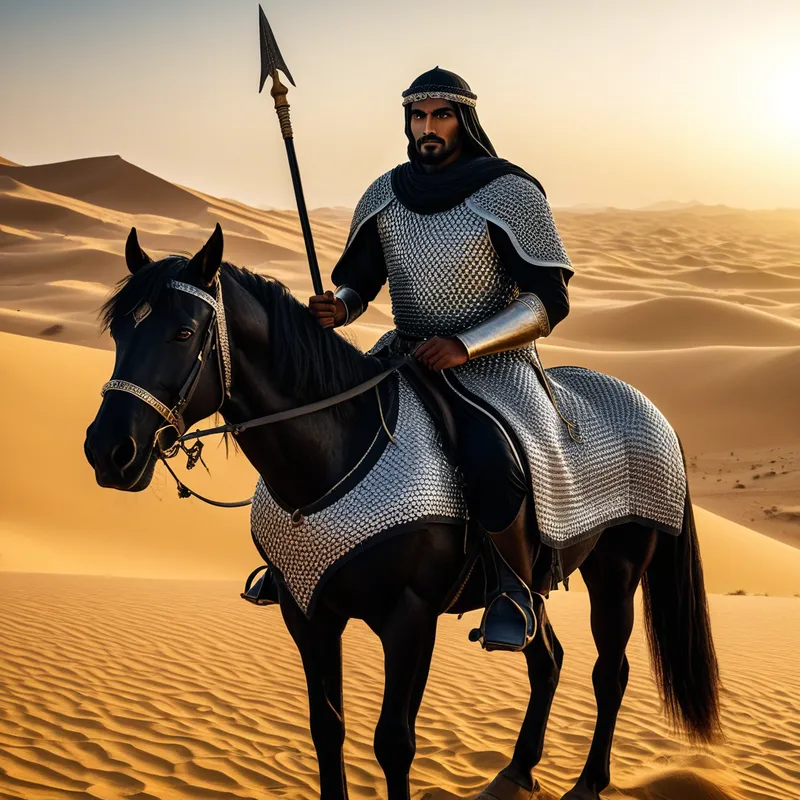
Hear now the tale of the one whose name means “Courageous,” the son of the noble Shaddad and the enslaved Zabiba. In the scorching cradle of the Najd, where honor was a flame and lineage its only fuel, a child was born into shadow. They named him Antar. His skin was the deep hue of fertile earth, a mark of his mother’s origin, and in the eyes of the Bani Abs, it was a brand of servitude. He grew, a sapling of immense strength in stony ground, tending the camels, bearing the lash of his own kin’s contempt.
But within that bound chest beat the heart of a lion and the soul of a poet. His true father was the desert wind, his tutor the clash of swords. He became a giant among men, his strength legendary. Yet his might was a curse, for it served a tribe that saw him only as a beast of burden. His love, a forbidden fire, was kindled for his cousin, Abla, a moon of beauty whose light he was deemed unworthy to reflect.
The turning came not in a grand battle, but in a moment of existential theft. Raiders from a rival tribe swept down upon the Abs, driving off their precious camels—the lifeblood of the people. The warriors hesitated. Then, from the margins, Antar roared. Unbidden, unarmored, he charged alone into the host. His spear became a whirlwind, his voice a thunder that shook the dunes. He routed the enemy single-handedly, returning triumphantly with the herds.
Standing before his father Shaddad and the sheikhs, covered in the dust and glory of his deed, he demanded his price. Not gold, not camels. “Acknowledge me,” he said. “Grant me my freedom. For I have defended the honor you said I could not possess.” And in that moment, the immutable law of blood was challenged by the higher law of action. Grudgingly, they could not deny the evidence of his valor. The slave was freed. The warrior was born.
Yet the path of the Faris is paved with endless trials. To win Abla, her father set impossible bride-prices: a thousand rare camels from the land of King Munzir, the teeth of a monstrous lion, and more. Each quest became an epic unto itself, a saga of battles against kings, magicians, and mythical beasts. Through it all, his sword, Dhami, spoke the language of force, but his tongue spoke the language of the soul. His poems, odes to Abla, to courage, to the stark beauty of the desert, were as sharp and enduring as his blade. Antar ibn Shaddad did not just fight his way to legend; he poetized his way into eternity, forging his identity in the twin fires of conflict and verse, becoming the immortal Black Knight of Arabia.
Cultural Origins & Context
The saga of Antar is not a myth of gods, but a Sira, a heroic romance that crystallized around a potentially historical figure from the 6th century, the so-called Jahiliyyah. Passed down orally for generations by Rawis, it was eventually compiled into a vast, sprawling literary epic. It functions as a foundational narrative of pre-Islamic Arab identity, codifying the Bedouin code of Muruwah.
Its societal function was multifaceted. For listeners, it was supreme entertainment—a desert soap opera of love, war, and supernatural adventure. More deeply, it was a moral compass. Antar, despite his marginalized origin, becomes the ultimate exemplar of Muruwah, proving that true honor is earned through action, not inherited by blood. The epic thus contained a radical, subversive kernel: it challenged the rigid hierarchies of tribal society by showcasing a hero who transcended his birth. It served as a collective dream where the tribe could admire its highest ideals, embodied by an outsider who loved it more fiercely than any native son.
Symbolic Architecture
Antar’s journey is the archetypal drama of the marginalized Self striving for recognition and integration. He represents the aspect of the psyche that is disowned, shamed, and forced into servitude due to its “otherness”—be it a talent, a trauma, a passion, or a heritage that the conscious identity deems unacceptable.
The hero is not born in the palace, but in the stable; his first task is to liberate himself from the inner tribe that enslaves him.
His blackness is not merely a physical trait but a profound symbol of the shadow—all that the tribal consciousness rejects. His incredible strength symbolizes the potent, raw energy locked within that shadow. His love for Abla represents the soul’s yearning for the anima, the beautiful and unattainable inner other that motivates the entire heroic endeavor. The impossible quests set by her father are the trials the ego must undergo to become worthy of uniting with the soul, to transform brute strength into disciplined power and gain self-awareness.

The Dreamer's Resonance
When the pattern of Antar stirs in modern dreams, it signals a profound somatic and psychological process: the uprising of the disenfranchised self. One may dream of being incredibly strong yet bound, of having a vital voice that goes unheard in a familiar crowd, or of performing a feat of salvation for a family or group that then scorns or ignores the contribution.
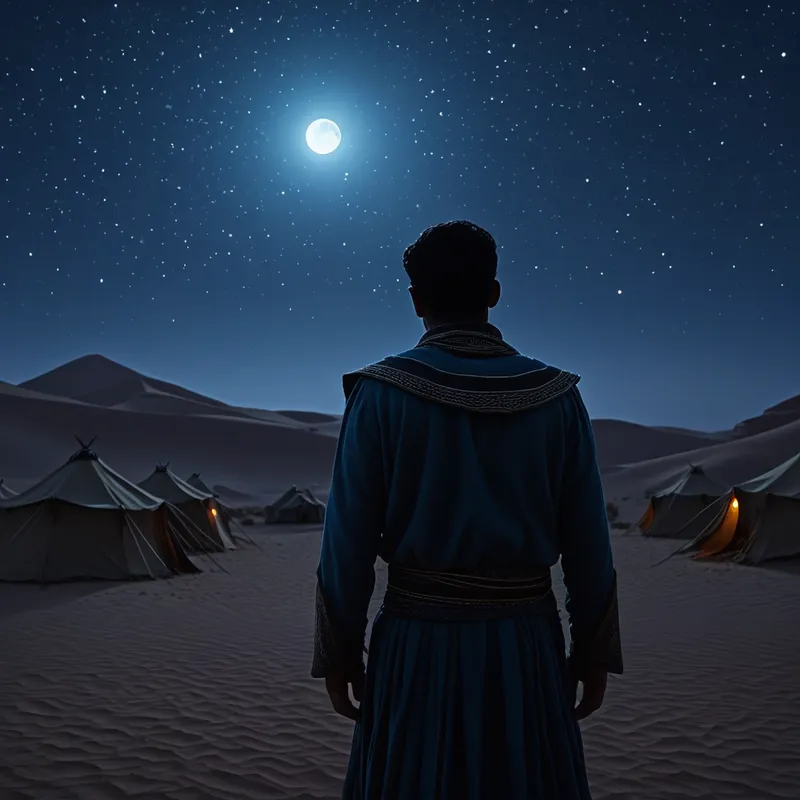
The somatic experience is often one of a fierce, hot energy in the chest—a feeling of righteous rage or stifled pride—coupled with a literal or metaphorical scar on the back (the wound of betrayal or servitude). This is the psyche’s signal that a foundational aspect of one’s identity is demanding manumission. The dreamer is in the “desert encampment” phase, where the innate gifts (the strength, the poetic voice) are fully formed but are being used in service to an internalized system that denies their owner’s worth. The psychological process is one of gathering the courage to claim one’s deeds as one’s own, to stop seeking permission from the inner patriarch and to declare, through action and authentic expression, one’s inherent freedom and value.

Alchemical Translation
The alchemy of Antar models the individuation process of psychic transmutation, where base matter (the enslaved shadow) is turned into gold (the integrated, legendary Self). It begins with Nigredo: the blackness of Antar’s status, the despair of being unseen. The catalyst is the raid—an external crisis that forces the hidden strength into the light (the act).
The spear that slays the external enemy is the same that pierces the internal veil of projection; the hero discovers he was only enslaved because he consented to the chains.
The subsequent quests represent Albedo and Citrinitas—the long, arduous purification through trials. Each monster slain is a complex (pride, shame, inferiority) confronted. Each poem composed is the conscious articulation of the soul’s longing, refining raw emotion into enduring meaning. The final union, the goal of the quest, is not merely marriage to Abla, but the achievement of Rubedo: the fully realized Self. This is Antar the freedman, the knight, the poet, the legend—the once-divided individual now forged into a sovereign, cohesive being whose authority comes from within, ratified by his own deeds and his own authentic voice. He becomes the ruler of his own internal kingdom, having alchemized the lead of rejection into the gold of unassailable honor.
Associated Symbols
Explore related symbols from the CaleaDream lexicon:
- Horse — Antar's steed Abjar represents the tamed instinctual power and noble spirit that carries the hero through his trials, a symbol of the mastered life force.
- Spear — The weapon of direct action and penetrating truth; it is the tool with which Antar fights for his freedom, symbolizing focused will and the ability to confront.
- Poetry — Represents the transformative power of authentic self-expression, the alchemy that turns raw experience and emotion into lasting meaning and legacy.
- Shadow — Antar himself embodies the personal and collective shadow—the disowned, powerful, and dark aspect that must be integrated for wholeness.
- Honor — The central psychic value being forged; not given but earned through consistent action in alignment with one's deepest code, representing self-respect.
- Love — The anima force, represented by Abla, which motivates the entire heroic journey and calls the individual toward relationship, beauty, and soulful connection.
- Journey — The endless series of quests signifies the lifelong process of individuation, where each trial refines the character and purpose of the seeker.
- Desert — The arid, testing landscape of the soul where all illusions are stripped away, and only the essential, resilient self can survive and be revealed.
- Chain — The literal and metaphorical bonds of servitude and social constraint that must be broken by an act of courageous self-assertion.
- Father — Represents the internalized patriarchal law, the tribal authority that must be confronted and whose acknowledgment must ultimately become irrelevant to one's self-worth.
- Heart — The inner furnace where the fires of passion, courage, and grief are felt; in Antar, it is a heart tested by fire and proven true.
- Destiny — The fate that is not written by stars or lineage, but forged by the individual through relentless will, choice, and action against all odds.