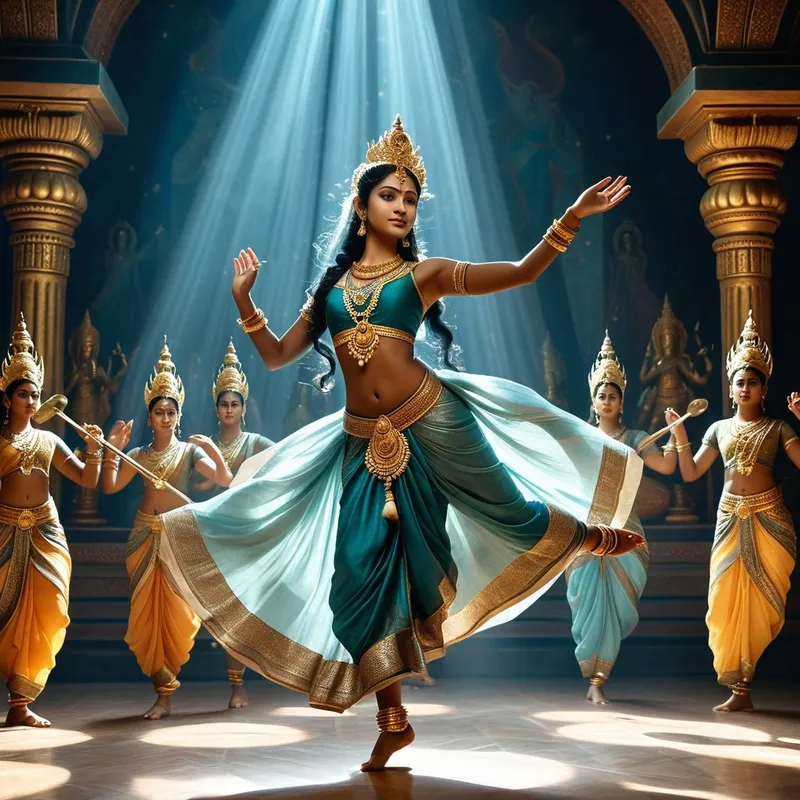
Anklets of the Apsaras Myth Meaning & Symbolism
A celestial dancer's anklet falls to earth, igniting a divine conflict between ascetic power and the irresistible allure of beauty and creative life-force.
The Tale of Anklets of the Apsaras
Listen. In the time before time, when the air itself was nectar and the mountains were young gods sleeping, there existed a realm of perfected delight: Svarga. Here, in gardens where every scent was a memory of creation, the Apsaras danced. They were not merely performers; they were the visible breath of beauty, the rhythm to which the cosmos swayed. Their dance was the binding of chaos into grace, and the music of their ghungroos was the very pulse of life’s joyous potential.
Among them was one whose name is whispered on the wind that passes through temple towers—Rambha, or perhaps Urvashi. As she spun, a vortex of silk and starlight, one of her silver anklets, worked by Vishvakarma himself, came loose. It tumbled from her slender ankle, a circle of captured moonlight, and fell. It did not simply drop; it descended through the layered heavens, past the chariots of the sun and moon, through the realm of clouds and storms, and finally came to rest on the sacred, silent earth of Bharata.
It landed in a hermitage. Not just any hermitage, but that of a great Rishi, a man whose power was built from decades of silence, of breath controlled, of senses subdued. His tapas was a fortress, and within it, he was invincible. The anklet, this artifact of celestial frivolity, lay on the bare ground before his meditation seat. Its faint, tantalizing chime, a sound utterly alien to the monotone of asceticism, seeped into his consciousness.
The conflict was instant and cosmic. In Svarga, the loss was discovered. The dance was broken. The Devaraja Indra, upon his throne Airavata, felt a tremor in the order of his court. An Apsara’s ornament in the world of men? It was a spark in tinder. For Indra knew a truth all kings fear: the unchecked tapas of a sage could shake the very pillars of heaven. A sage who had conquered desire was a threat. But a sage who had just been touched by desire? That was a crisis.
Indra’s gaze turned to his most potent weapon: the Apsaras themselves. He commanded the one who had lost the anklet to descend. Her mission was not war, but a subtler unraveling. She was to reclaim her property, yes, but in doing so, she was to test the fortress of the sage’s will. She descended, a ripple of perfume and grace entering the austere grove. She approached, not as a thief, but as the very embodiment of what the anklet represented. She asked for its return. But the act of asking, her presence, her voice like rain on parched earth, was the true test. The myth holds its breath here, at the moment where divine discipline meets divine allure. The resolution is not a battle, but a transformation. The sage returns the anklet. But in that exchange, something is transferred. The fortress is not breached, but a window has been opened. The rigid equilibrium of pure asceticism is, forever after, in conversation with the flowing, creative, desiring pulse of life.

Cultural Origins & Context
This myth, woven into the vast tapestry of Puranic and epic literature, served a vital societal function. It was not merely a celestial anecdote but a pedagogical tool, passed down by storytellers, sutas, and elders. In a culture that deeply valued both Dharma, Artha, Kama, and Moksha, this story dramatized the eternal tension between them.
The Apsaras, often sent by Indra to distract sages accumulating dangerous amounts of tapas, represent the necessary check on absolute withdrawal from life. The myth acknowledges the awesome power of asceticism but warns against its potential sterility and arrogance. It was a reminder that the cosmos is a balance—the unwavering focus of the sage and the enchanting movement of the dancer are both divine, both necessary. The hermitage and the court of Indra are not enemies, but complementary poles in the ecology of existence, and the fallen anklet is the agent that forces a dialogue between them.
Symbolic Architecture
At its core, the myth is a profound map of the human psyche. The sage represents the conscious ego, building a fortress of discipline, order, and control—the principle of Purusha. The Apsara and her anklet symbolize the irresistible allure of the unconscious—the anima, creativity, eros, and the chaotic, life-giving waters of Prakriti.
The anklet is not a temptation to sin, but a call to wholeness. Its chime is the sound of the part of the soul that the ego has tried to silence.
The falling of the anklet from heaven to earth is the inevitable descent of unconscious content into conscious life. It cannot be forever kept at bay. The sage’s initial encounter with the object is passive; it simply appears. This is how the unconscious often first announces itself—through slips, moods, accidents, or inexplicable fascinations. The Apsara’s subsequent arrival is the active, personified force of that content demanding recognition and integration. The return of the anklet is not a defeat for the sage, but a sacred transaction. He acknowledges the power and rightful place of what she represents, without being destroyed by it.

The Dreamer's Resonance
When this myth pattern stirs in the modern dreamer, it often manifests as an encounter with mesmerizing beauty or captivating artistry that feels disruptive. One might dream of finding a piece of exquisite jewelry in a stark, minimalist room, or hearing enchanting music in a place of silence and work.
Somatically, this can feel like a quickening—a flutter in the chest, a sense of breath caught. Psychologically, it signals a moment where a long-held, rigid stance (a "hermitage" of career focus, intellectualism, or emotional control) is being infiltrated by a repressed life-force. The conflict in the dream mirrors the internal struggle: a part of the self wants to clutch the discovered beauty and keep it secret, while another feels compelled to answer the call of its source. This is the psyche initiating its own "test," pushing the dreamer toward a more authentic, balanced state where discipline and desire can converse.

Alchemical Translation
The alchemical journey modeled here is the transmutation of rigid, perfected prima materia into a living, flexible gold. The sage’s pure asceticism is the lead—valuable in its density, but inert. The anklet is the catalytic mercurius, the quickening agent.
Individuation is not the victory of the sage over the dancer, nor the dancer over the sage. It is the creation of a sacred space where both can perform their essential roles.
The process begins with the fall—the involuntary introduction of the missing element into a closed system. This is the crisis that initiates all transformation. The dreamer’s task is to play both roles: to be the sage who must acknowledge the power of the arriving symbol without being annihilated, and to be the Apsara who must respectfully claim what belongs to the totality of the self. The "return of the anklet" is the conscious act of integration. It is the moment the intellectual acknowledges the needs of the body, the workaholic makes space for beauty, the cynic allows for enchantment. The fortress of the ego becomes a temple with open gates, where the dance of life can be witnessed, appreciated, and ultimately, joined. The final gold is a consciousness that is both disciplined and fluid, capable of deep focus and profound appreciation, where the chime of the anklet is no longer a distraction, but a part of its own sacred rhythm.
Associated Symbols
Explore related symbols from the CaleaDream lexicon: