Anito Ancestor Spirits Myth Meaning & Symbolism
A myth where the living and the dead are woven together, and ancestral spirits guide, warn, and demand remembrance from the world they left behind.
The Tale of Anito Ancestor Spirits
Listen. The world is not as thin as you believe. Between the breath of the living and the silence of the dead, there is only a veil, woven from memory and smoke.
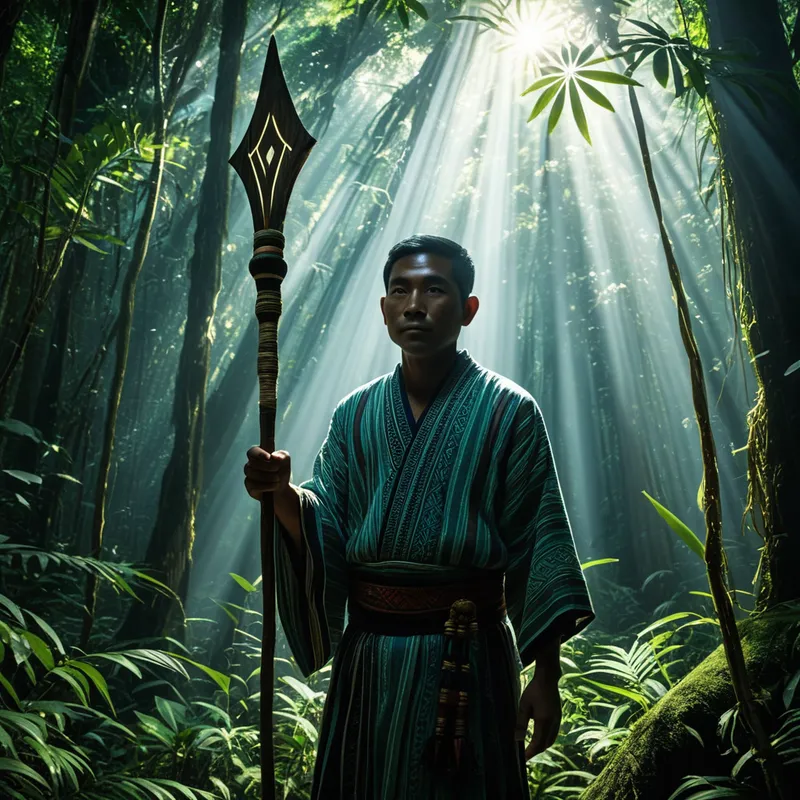
In the time when the mountains were young and the rivers first learned their songs, the people of the islands lived not just beneath the sun and moon, but within a great, whispering web. They knew the names of the trees, the moods of the wind, and the secret language of the waves. But most of all, they knew that when a person’s body grew still and was returned to the Earth, their story did not end. It changed. Their anito was born—a spirit, a presence, a watchful essence born from the love, strength, and even the flaws of the life they had lived.
These Anito</abestors did not depart for some distant, unreachable heaven. They lingered. They dwelled in the towering narra trees, in the cool darkness of caves where water dripped like time, and in the carved wooden figures the people kept in their homes. They were in the scent of rain on dry soil, a scent that was the very breath of those who had farmed that land.
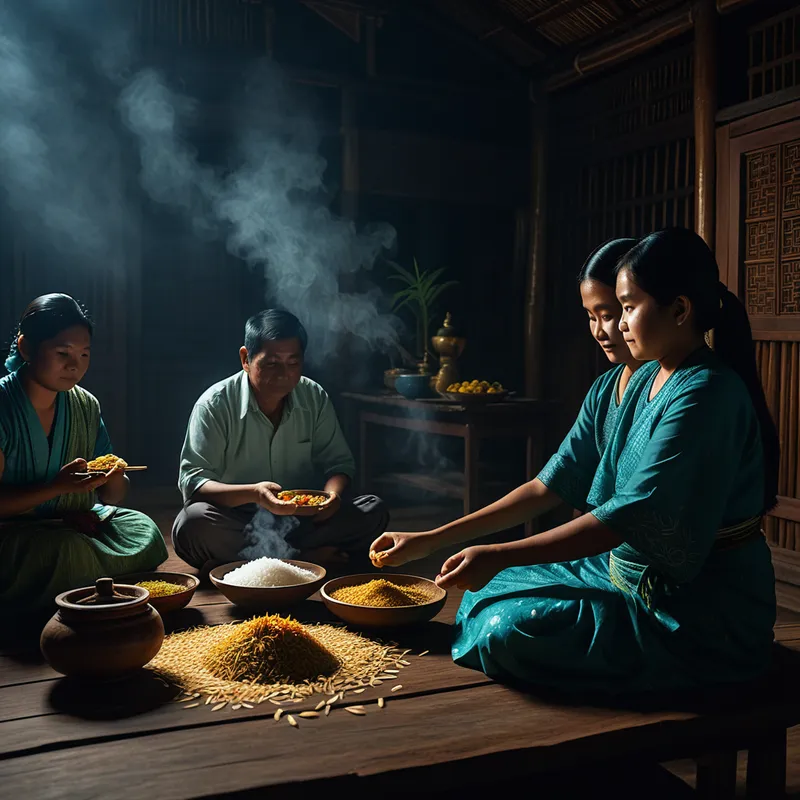
The people spoke to them. Not with shouts, but with the quiet rustle of offerings: a perfect piece of golden rice, a sip of pungent rice wine, the vibrant red of betel nut. The smoke from cooking fires and burning incense carried these messages into the subtle realm. In return, the Anito guided. A hunter would feel a sudden, certain pull toward a part of the forest, and find game. A farmer, dreaming of his grandfather, would be shown where to plant. They offered protection, turning away malevolent forces with their vigilant presence.
But this covenant was woven from respect. The great conflict was not one of clashing armies, but of fading memory. If the living grew loud, arrogant, and forgetful—if they let the stories of their lineage turn to dust on their tongues, if they neglected the simple offerings—the Anito did not rage with fire and storm. Instead, a profound silence would descend. Guidance would vanish, leaving the people feeling spiritually orphaned, their instincts dull. The forest would become merely trees, the river merely water. A subtle sickness of the soul, a feeling of being unrooted and alone, would creep into the village.
The resolution was always a return. Not out of fear, but out of longing. A child would ask about the carved figure in the corner. A mother would sing an old lullaby whose words she did not fully understand, yet whose melody carried the weight of generations. They would gather again, clean the ancestral stones, share the names and tales of those who came before. And as memory was rekindled, the presence would return. The world would thicken once more with meaning. The Anito were not gods to be worshipped from afar, but family to be remembered. In that act of remembrance, the living and the dead breathed together, and the world was whole.
Cultural Origins & Context
The belief in Anito is not a single, codified myth from one book, but the living breath of pre-colonial Philippine spiritualities, persisting through centuries of foreign influence. It is the bedrock of indigenous Anitism, a worldview that sees the cosmos as profoundly animated and interconnected. This myth was not "told" in a linear narrative by a single bard; it was lived and enacted by the community—the barangay—through daily ritual, seasonal celebration, and oral tradition.
The babaylan or catalonan (often women) served as the primary custodians of this relationship. They were the interpreters of the will of the ancestors and the spirits, conducting rituals to heal illness (often seen as a displeased anito), ensure bountiful harvests, or guide the soul of the newly deceased. The myth functioned as the operating system of society: it enforced ethical behavior (as one would answer to one’s forebears), provided psychological comfort in the face of mortality, and rooted collective identity in a specific landscape inhabited by specific ancestral guardians. It was a system of ecology, psychology, and social order, all woven into one.
Symbolic Architecture
At its core, the myth of the Anito presents a radical model of identity and consciousness. The individual is not an isolated ego, but a nexus in a vast network of relations that extends backward through time.
The past is not a foreign country we visit; it is the very soil from which our present consciousness grows. To forget our roots is to experience ourselves as cut flowers, beautiful but doomed to wilt.
The Anito symbolizes the psychic presence of the past. They are the accumulated wisdom, trauma, talents, and unresolved conflicts of our lineage, existing as autonomous complexes within the family or tribal soul. The babaylan represents the developed capacity for introspection and dialogue with these inner figures. The offerings are not bribes, but acts of symbolic attention—the psychic energy required to engage with these deep parts of the self.
The forest, caves, and rivers where they dwell are metaphors for the unconscious itself—teeming with life and intelligence that is not our personal, daytime mind. Neglect of the Anito is the modern condition of historical and psychological amnesia, where we are tyrannized by the present moment, disconnected from the instincts and patterns that shaped us. Their return upon remembrance is the healing that occurs when we integrate our personal story into the larger, older story of our becoming.
The Dreamer's Resonance
When this myth pattern stirs in the modern psyche, it often manifests in dreams of forgotten houses, unknown yet familiar relatives, or discovering hidden rooms in one’s own home. One may dream of being given an object—a key, a book, a piece of jewelry—by a silent, elderly figure. There is a somatic quality of being watched in the dream, not with malice, but with a patient, expectant gravity.
Psychologically, this indicates a process where contents of the collective unconscious—specifically the familial and cultural layers—are seeking recognition. The dreamer may be at a life threshold (a birth, death, career change, or identity crisis) where the old, autonomous patterns of the lineage are activated. The “sickness” described in the myth translates as a feeling of existential emptiness, a lack of direction, or a repetitive, frustrating life pattern whose origin feels mysteriously external. The dream is the psyche’s own babaylan, initiating a ritual of remembrance. It asks: What from your past are you failing to honor? What story are you refusing to tell?

Alchemical Translation
The alchemical work modeled by the Anito myth is the transmutation of ghost into guide. It is the heart of the individuation process where we confront and integrate our psychic inheritance.
Individuation does not mean becoming someone entirely new; it means becoming responsibly related to the ancient someone you already carry within.
The first stage is nigredo: the “neglect” phase, a descent into the feeling of being lost, unrooted, and haunted by vague anxieties or compulsions. This is the necessary darkening, the acknowledgment that something is missing. The second stage is albedo: the “remembrance.” This is the careful, respectful work of genealogy—both literal and psychological. It is researching family history, but also examining the unspoken rules, the inherited fears (the “family Shadow”), and the dormant strengths. Making an “offering” is the act of giving focused, non-judgmental attention to these patterns.
The final stage is rubedo: the return of the Anito as integrated wisdom. The ancestral complex, once a haunting ghost, becomes an inner resource. A inherited tendency toward rage might be alchemized into righteous passion for justice. A legacy of grief might transform into profound empathy. The individual no longer blindly repeats the past nor rebelliously flees from it, but consciously carries it forward, transformed. They become a living altar, where the ancestors are honored not by stagnation, but by the conscious, creative life of their descendant. In this, the circle of lineage is not a chain, but a sacred, unbroken circle.
Associated Symbols
Explore related symbols from the CaleaDream lexicon:
- Ancestral Spirits — The core symbol of the myth, representing the enduring psychic and spiritual presence of those who came before, who offer guidance and demand remembrance.
- Forest — Symbolizes the dense, mysterious realm of the unconscious and the ancestral past, where the Anito dwell and where wisdom can be found if one knows how to listen.
- Altar — Represents the dedicated psychic space, both literal and metaphorical, where conscious attention (offerings) is given to the unconscious or ancestral contents, facilitating dialogue and integration.
- Key — Signifies the access to hidden ancestral wisdom, family secrets, or locked-away parts of the self that are passed down through the lineage, awaiting discovery.
- Shadow — Embodies the unacknowledged, often difficult, aspects of the ancestral inheritance—the traumas, shames, and repressed energies that must be faced and integrated during the remembrance.
- Earth — Represents the grounding force of ancestry, the literal soil where ancestors are buried, and the source of rooted identity, stability, and nourishment from the past.
- Circle — Symbolizes the cyclical nature of life, death, and remembrance, the unbroken chain of lineage, and the wholeness achieved when the living and the dead are in right relationship.
- Door — Represents the threshold between the conscious world and the ancestral realm, the moment of ritual invocation or dream visitation where communication becomes possible.
- Ritual — The structured, symbolic action—like making offerings—that bridges the gap between the individual ego and the vast, timeless world of the ancestral spirits.
- Root — Signifies the deep, often hidden connections to one’s origin, family tree, and cultural heritage that provide sustenance and identity.
- Dream — The primary modern mode of encounter with the Anito, where the ancestral spirits communicate in the symbolic language of the unconscious psyche.
- Memory — The essential faculty and act that sustains the Anito; without active remembrance, the connection to the guiding ancestral presence fades and is lost.