Animal Guides Myth Meaning & Symbolism
A journey into the sacred bond between human and spirit, where animals are not merely creatures but profound teachers and guardians of the soul's path.
The Tale of Animal Guides
In the time before time, when the world was soft and the stories were still being sung into the clay, the People walked. They walked, but they were lonely. They had hands to build and minds to wonder, but their hearts beat a solitary rhythm against the vast breast of the world. They knew how to hunt, but not why. They knew how to speak, but not to whom.
One night, a young seeker, heavy with this loneliness, climbed to a high place where the wind scraped the sky clean of clouds. The cold bit his skin, but the emptiness inside bit deeper. He built no fire, seeking only the raw truth of the dark. For four nights and four days, he cried out—not with his voice, which was too small, but with the whole silent yearning of his spirit. He fasted. He thirsted. He offered his human comfort back to the earth.
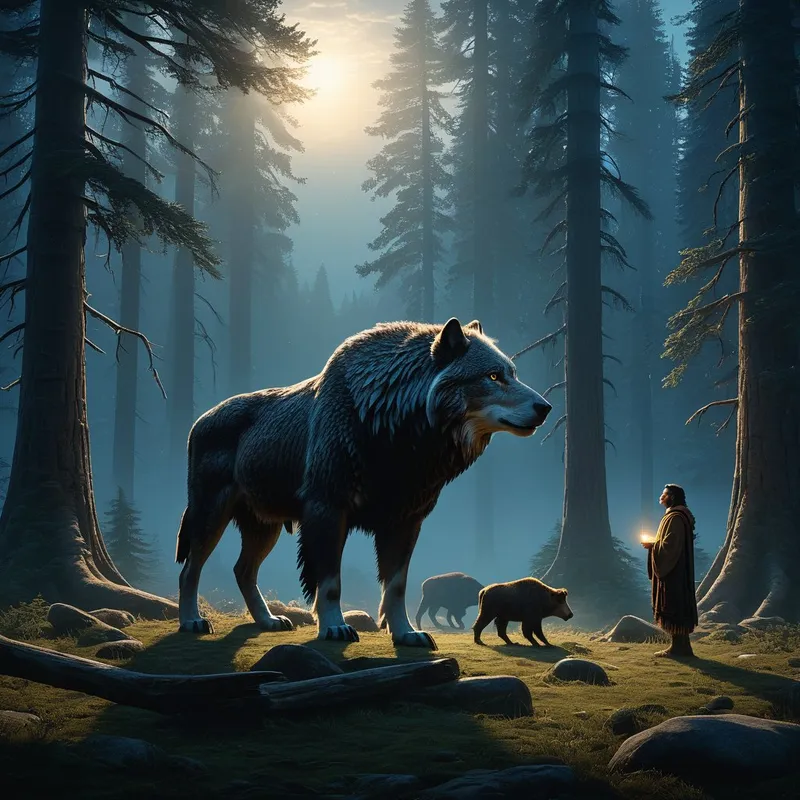
On the fourth night, as the moon hung like a sliver of bone, the world changed. The wind did not blow; it spoke. It carried a scent of pine and deep earth, and from the treeline, a shadow larger than any wolf stepped into the starlight. Its eyes were pools of molten amber. It was Ma’iitsoh, the Wolf. It did not approach as predator to prey, but as elder to child. It sat, and its gaze was a weight and a warmth.
“You call from your solitude,” the wind seemed to whisper with the Wolf’s breath. “But you are never alone. You have forgotten how to listen.”
Then, from the dizzying heights where the stars seem nailed to the sky, a piercing cry split the silence. A great shadow blotted the moon. Igmu Tanka, the Eagle, landed on a lightning-split pine, its feathers rustling like dry prayers. “You look, but you do not see,” a thought echoed in the seeker’s mind, sharp and clear. “You see only the ground at your feet. I will show you the pattern of the valleys, the serpentine path of the river, the approach of the storm from beyond the horizon.”
The earth itself then trembled. From the thicket emerged Mato, the Bear, a mountain of fur and quiet power. It moved with a deliberate, grounding slowness. “You think with the frantic energy of the hummingbird,” a low rumble communicated, felt in the bones more than heard. “You must learn to go inward, to sleep in the dark cave of your own spirit, and to emerge with the strength of knowing.”
One by one, they came—the cunning Coyote, the persistent Beaver, the graceful Deer. They formed a circle around the shivering human, not a cage, but a council. They did not speak in human words, but in the language of presence, of gesture, of essence. They offered him their gifts: the Wolf’s loyalty and strategy, the Eagle’s vision, the Bear’s healing solitude, the Coyote’s transformative laughter. They were not giving him something new, but awakening something ancient that slept within his own blood and bone—the memory of kinship. The great loneliness shattered. He was not a lone creature in a vast world, but a relative in a vast family. The myth was born in that moment, not as a story to be told, but as a truth to be remembered: the animals are our guides, and in remembering them, we remember ourselves.

Cultural Origins & Context
The concept of the Animal Guide or spirit helper is not a single, monolithic myth from a single tribe, but a foundational thread woven through the diverse tapestry of many Indigenous cultures across the Americas. From the Lakota Hembleciya to the Anishinaabe practices, and within the complex spiritual systems of the Pueblo and Northwest Coast peoples, the principle remains a constant: the natural world is ensouled, communicative, and intimately related to humanity.
These narratives were not mere folklore for entertainment; they were the living curriculum of a people. They were transmitted orally by elders, storytellers, and medicine people, often within specific ritual contexts or during rites of passage. Their societal function was multifaceted: they were maps of the ecosystem, teaching the behaviors and properties of animals; ethical frameworks, illustrating values like courage, patience, and community; and sacred technology for navigating life’s challenges. To have a vision or dream of an animal guide was to receive a personal charter, a source of power and identity that connected the individual to the greater web of life. It grounded human life in a network of reciprocal responsibility, where respect for the guide necessitated respect for all its physical kind.
Symbolic Architecture
At its core, the myth of the Animal Guide dismantles the modern illusion of human separateness. The animal is not an “other” to be dominated, but an aspect of the self’s own primordial inheritance. Psychologically, each guide represents a cluster of innate potentials, instincts, and wisdom that the conscious ego has forgotten or suppressed in the process of “civilization.”
The Wolf symbolizes the social instinct, the power of the pack (community), and strategic intuition. The Eagle embodies transcendent consciousness, the ability to rise above the petty details of life to see the grand pattern—the function of the Self in Jungian terms. The Bear is the deep, introspective power of the unconscious, the capacity for hibernation (withdrawal for healing) and formidable, grounded strength upon return.
The Animal Guide is the psyche’s attempt to re-wild the domesticated soul, to reintroduce the lost instincts that are necessary for a whole and grounded life.
They are not servants, but teachers. Their appearance in myth or vision often coincides with a life crisis, a point where the individual’s learned, cultural knowledge is insufficient. The guide offers the older, deeper intelligence of the body, the instincts, and the ancestral mind. To accept a guide is to accept a part of oneself that has been waiting in the forests of the unconscious.
The Dreamer's Resonance
When this mythic pattern erupts in the modern dreamscape, it signals a profound somatic and psychological process: the call of the instinctual self. A person dreaming powerfully of a specific animal—especially in a recurring, vivid, or numinous context—is often experiencing a rupture in their adapted persona. The conscious attitude, built for navigating the modern world of schedules and abstractions, is failing to meet a deeper need.
The somatic process is one of re-membering. The body, which carries the genetic memory of millennia lived in close dialogue with nature, begins to speak. The dream animal may appear during times of illness (the Bear calling for restorative solitude), career confusion (the Eagle demanding a higher perspective), or relational strife (the Wolf teaching about loyalty and social navigation). The psychological process is one of recognition and dialogue. The dreamer is not inventing the guide; they are encountering an autonomous psychic content that holds the key to balance. The emotion in the dream—be it fear, awe, or profound comfort—is the compass. Fear often indicates a powerful but unfamiliar energy; comfort suggests the return of a long-lost strength.
Alchemical Translation
The journey of the seeker on the cliff is the archetypal model for the modern journey of individuation. The initial state is one of alienation—from nature, from the instincts, from the Self. The fasting and crying out represent the necessary nigredo, the dark night of the soul, where the ego’s resources are exhausted and its arrogance stripped away. This creates the vacuum—the sacred emptiness—into which the guiding spirits can flow.
The arrival of the Animal Council is the albedo, the illuminating whitening. These are the lost parts of the psyche presenting themselves for reintegration. The modern individual must perform this same alchemy. We do not climb a physical mountain, but we must create the interior silence—through meditation, through crisis, through intentional withdrawal from the noise of the world—to hear the call.
Individuation is not about becoming more human, in the civilized sense, but about becoming more whole, which requires becoming animal again in spirit.
The “gifts” of the guides are the latent functions of our own being. To integrate the Eagle is to cultivate vision and connect to a transpersonal purpose. To integrate the Bear is to honor the rhythms of rest and active introspection. To integrate the Wolf is to build true community and trust one’s gut instincts. This is the rubedo, the reddening, the creation of the Philosopher’s Stone: a personality that is both fully cultured and fully instinctual, capable of navigating the digital world without losing the ancient song in its blood. The myth teaches that our wholeness depends not on rising above nature, but on sinking our roots back into its symbolic soil, and recognizing the guiding spirits that have been with us all along.
Associated Symbols
Explore related symbols from the CaleaDream lexicon: