
Ancestral Bridge Myth Meaning & Symbolism
A monk journeys to the underworld to save his mother, building a bridge of devotion that spans the realms of life, death, and enlightenment.
The Tale of the Ancestral Bridge
Listen, and hear a tale not of gods on high, but of a heart’s cry that echoed through the three worlds. In a time when the veil between the seen and unseen was as thin as a monk’s robe, there lived a son named Maudgalyayana. His devotion was a quiet flame, burning brightest for the mother who had nourished his body and spirit.
But fate, that weaver of sorrow, took her. Not to the peaceful fields of the blessed, but into the hungry, shadowed depths of the lower realms. In his meditative visions, Maudgalyayana saw her—a wraith of suffering, gaunt and pleading, trapped in a realm where sustenance turned to ash and rivers ran with fire. Her past actions, born of ignorance and clinging, had forged her chains. His filial love, once a comfort, became a torment. How could he abide his own peace while she suffered?
Thus began a journey not measured in leagues, but in realms. With a mind honed by meditation and a heart shattered by compassion, he stepped beyond the world of form. He descended through the mists of the Bardo, where whispers of past lives brushed against him like cobwebs. He traversed the courts of the Yama Kings, their stern faces illuminated by the cold light of karmic ledgers. He pleaded, but the law was immutable: the weight of her own deeds could not be lifted by his hand alone.
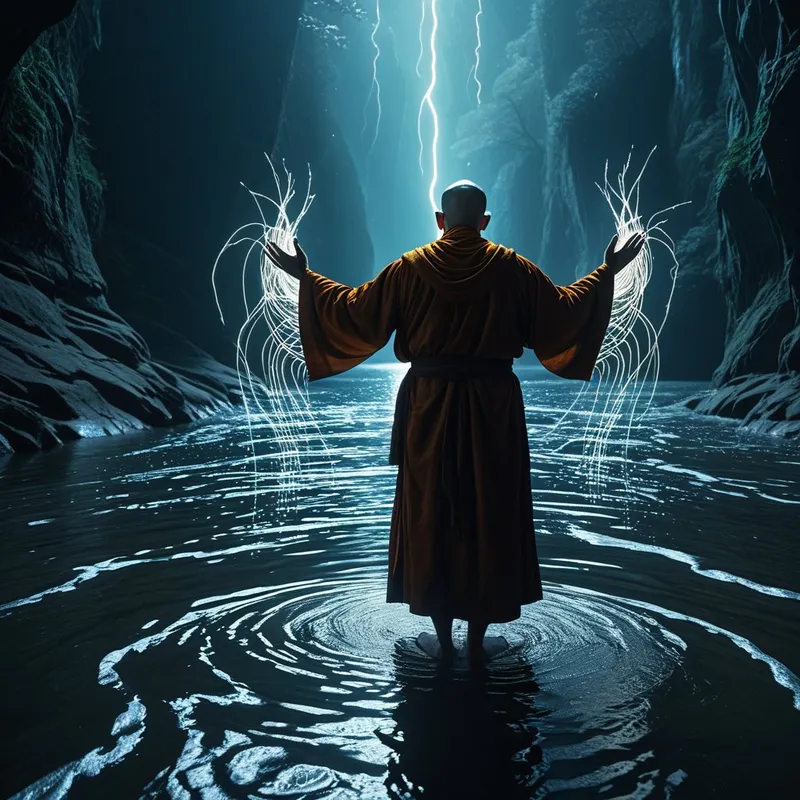
Yet, a truth deeper than law stirred within him. The bond between parent and child is itself a kind of karma, a thread in the vast net of Dependent Origination. He could not take her suffering, but he could build a path out of it. Standing on the spectral shore of the river that divides the suffering from the liberated, he began his great work. Not with stone and mortar, but with the substance of the spirit.
He offered the pure merit of his own practice, a luminous currency in the realms of effect. He made offerings in her name, dedicating every good deed, every moment of mindfulness, as a brick in an unseen causeway. He called upon the compassionate gaze of the Bodhisattvas, whose vows are bridges for all beings. His devotion became the architect, his tears the mortar, and his unwavering intention the blueprint.
And then, on a day when the boundaries of the Samsaric worlds grew thin, it appeared. A bridge, shimmering like moonlight on water, arced over the churning river of suffering. It was woven from prayers, paved with merits, and guarded by blessings. It was the Ancestral Bridge. His mother, guided by the light of his devotion, took her first trembling steps upon it. With each step, the shadows clinging to her fell away like shed scales. She crossed from the realm of hunger into a field of peace, where she could hear the dharma and plant the seeds of her own liberation. The son did not carry her; he built the way. And in doing so, he discovered that the bridge he built for one, stands open for all.
Cultural Origins & Context
This story, most famously embodied in the tale of Moggallana and his mother, is a cornerstone of East Asian Buddhist tradition, particularly celebrated during the Ullambana festival. It is far more than a folktale; it is a social and soteriological script. In cultures where ancestral veneration was already deeply ingrained, Buddhism provided a metaphysical framework for this practice. The myth gave a vivid, emotional narrative to the doctrine of karma and merit-transfer.
It was told by monks to lay congregations, not merely to inspire awe, but to prescribe action. It explained the purpose of monastic practice—to generate the "merit" that could act as spiritual aid—and empowered the laity, showing how their offerings to the Sangha could directly assist their loved ones in the afterlife. The myth thus functioned as a psychic and social glue, linking the living and the dead, the monastic and the householder, in a shared project of liberation. It transformed filial piety from a social obligation into a path of profound spiritual engineering.
Symbolic Architecture
The Ancestral Bridge is not a physical location but a dynamic symbol of the permeable boundary between the personal and the transpersonal, the karmic and the liberated.
The bridge is not found, but forged in the heart's furnace where personal love meets impersonal compassion.
The Mother represents our inherited karma—the psychological, emotional, and even genetic legacy passed down through our lineage. She is the "hungry ghost" within us all: the insatiable patterns of desire, attachment, and unresolved trauma we inherit. The Son (or devoted child) symbolizes the awakened aspect of consciousness—the part of us that can witness this inheritance with clarity and is compelled to act, not from guilt, but from transformative compassion.
The River is the flow of Samsara itself, the relentless current of conditioned existence and suffering. The Bridge is the constructed path of practice. Every mindful breath, every ethical choice, every act of dedicated generosity becomes a plank in this structure. It signifies that liberation is not a sudden escape, but a careful, intentional building of a new way of being across the chasm of old patterns.
The Dreamer's Resonance
When this myth stirs in the modern dreamscape, it often manifests as dreams of dilapidated bridges, impossible crossings over dark waters, or encounters with frail, needy parental figures in labyrinthine spaces. The dreamer may feel an urgent, somatic pressure to "build" or "fix" something with their bare hands.
Psychologically, this indicates a profound process of psychic digestion. The ego is grappling with the weight of ancestral burden—be it family trauma, inherited beliefs, or cultural conditioning. The "hungry ghost" of the mother is the undigested pain of the lineage now demanding attention. The dreamer is in the phase Maudgalyayana endured: the visceral witnessing of this suffering within their own psychic ecosystem. The dream is the soul's imperative to stop ignoring this inner underworld and to begin the active, arduous work of constructing a means of transformation. The somatic feeling of urgency or pressure is the psyche's energy mobilizing for this great work.
Alchemical Translation
The alchemy of the Ancestral Bridge myth models the individuation process—the journey toward psychological wholeness. It reframes our relationship with our "inherited karma."
The ultimate ancestor we must liberate is the one within; the final bridge we build is the integrated Self.
First comes the Descent: acknowledging the shadowy, "hungry" parts of ourselves that feel foreign yet intimately familiar—our irrational fears, compulsive behaviors, and deep-seated wounds that seem to predate our own experiences. This is the painful vision of the suffering mother.
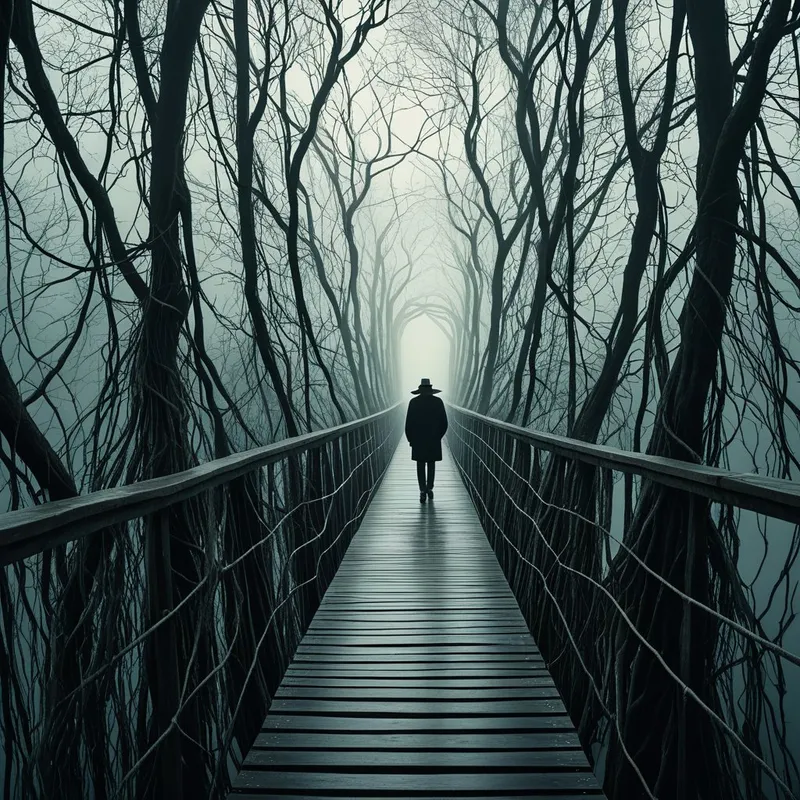
Then, the Construction: We cannot simply "fight" these inherited complexes. That is war on ourselves. Instead, we must build a structure of consciousness that can hold and transform them. This is the daily practice of mindfulness, therapy, creative expression, and ethical living. Each insight is a stone; each moment of self-compassion is a railing. We build a bridge of awareness between our unconscious inheritance and our conscious life.
Finally, the Crossing: As the bridge is built, the energy trapped in the "hungry ghost" complex is not destroyed, but liberated and integrated. The mother crosses over. Psychologically, this is the moment when a former trauma or pattern loses its compulsive power and becomes a source of wisdom and empathy. The inherited burden transforms into ancestral blessing. We realize that in working to liberate the ghosts of our past, we are, in truth, liberating our own future. The bridge, once built, becomes a permanent part of our inner landscape—a testament that the way from suffering to wholeness is built by the courageous, loving labor of the awakened heart.
Associated Symbols
Explore related symbols from the CaleaDream lexicon: