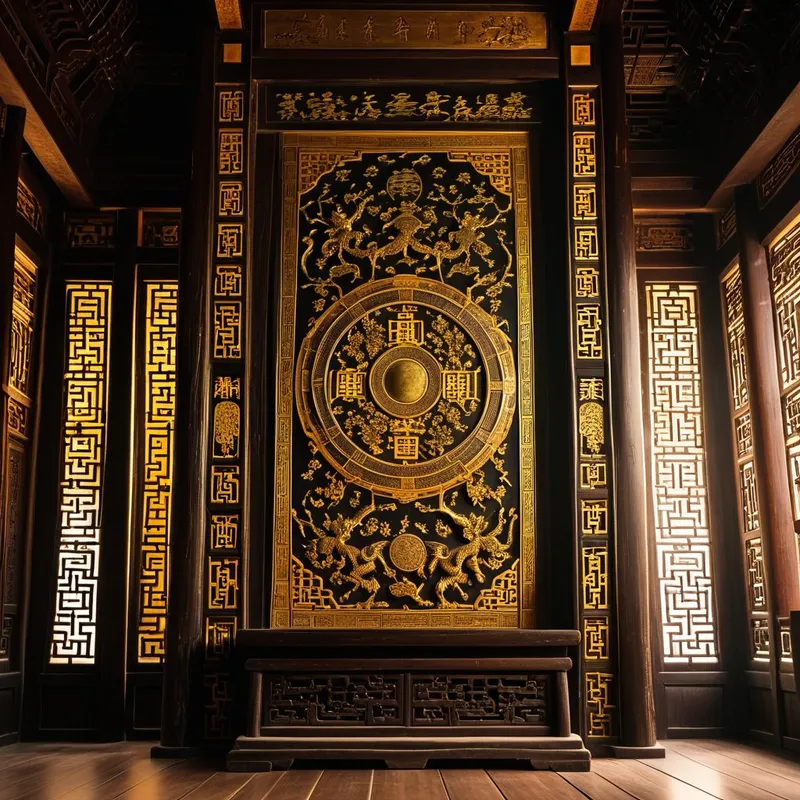
Ancestor Veneration Tablets Myth Meaning & Symbolism
A myth of the first ancestral tablet, born from a son's grief, forging a bridge between the living and the dead to preserve memory and lineage.
The Tale of Ancestor Veneration Tablets
Listen, and hear the story not of gods on high, but of a human heart, heavy as stone, and the bridge it built across the unthinkable chasm.
In a time when the world was raw and memory was carried on the wind, there lived a man named Xiao. His father, a wise farmer who knew the language of the soil and the song of the seasons, had passed into the great silence. The funeral rites were done, the earth was mounded, but for Xiao, a colder, deeper grave opened within his own chest. He would sit in his father’s empty chair by the hearth, and the silence there was not peaceful, but hungry. It ate the sound of his father’s laughter. It blurred the lines of his face. The world moved on, the rice grew, but in Xiao’s home, a vital thread had been severed, and the tapestry of his life was beginning to unravel.
One evening, in the deepening blue twilight, the loss became a physical ache. He stumbled to his father’s workbench, where the scent of cedar and honest sweat still lingered. His hands, moving with a will of their own, found a piece of wood his father had planed smooth. He took a chisel. Not to shape a bowl or a beam, but to make a wound in the silence. With each tap of the mallet, he did not carve wood; he carved absence. He formed the characters of his father’s name—not the public name, but the intimate name only a son would use. The shavings curled like fallen leaves, like shed tears.
When he was done, he placed the simple plaque on the shelf above the hearth, the heart of the home. He lit a stick of incense. The smoke did not rise in a straight column; it curled and danced, weaving a visible breath in the still air. And in that moment, Xiao did not feel alone. The chair was still empty, but the silence was no longer hollow. It was inhabited. He spoke then, not to the air, but to the plaque. “Father,” he whispered, “the south field is ready. I remembered what you taught me.” And in the settling of the smoke, in the warmth of the flickering hearth-light on the wood, he felt a reply—not a voice, but a presence. A continuity.
Word traveled, carried on the river of shared grief. Others came, their own hearts holding similar voids. They saw the plaque, the incense, the quiet communion. They asked Xiao to teach them. And so, the practice spread—not as a law from an emperor, but as a medicine from a broken heart. The tablets became more ornate, the rituals more refined, but the essence remained: a hand-carved bridge, a name made substance, a point of contact where love could flow backwards and forwards, defying the finality of the grave.

Cultural Origins & Context
This foundational myth, while not attributed to a single textual source like the Shan Hai Jing, is the cultural bedrock of a practice millennia old. It emerges from the core of Ruist (Confucian) philosophy, where xiao is the root of all virtue. The story was passed down not by bards in courts, but by mothers and fathers at family altars, by village elders during the Qingming festival. Its societal function was profound: it was the glue of the clan, the engine of cultural continuity. In a civilization that venerated history and lineage, the tablet was a tangible archive. It transformed the terrifying anonymity of death into a named, honored, and integrated part of the family organism. The state endorsed it, the philosophers systematized it, but its power sprang from the universal, human need to say, “You are still here with me.”
Symbolic Architecture
The Ancestor Veneration Tablet is far more than a ritual object; it is a profound symbol of the psyche’s architecture.
The tablet is the axis mundi of the family soul, the fixed point where time becomes vertical and the horizontal march of generations can be perceived as a single, enduring entity.
Psychologically, it represents the internalized other. When a primary figure—a parent, a mentor—passes on, a part of our own psyche, which was co-created in relationship with them, risks disintegration. The tablet is a symbolic container for that internal object. The act of inscribing the name is the act of defining and preserving that psychic complex within oneself. The incense is the libido—the psychic energy—directed toward that complex, keeping it “alive” and interactive within the internal world. The tablet thus prevents the deceased from becoming a haunting, fragmented ghost (a repressed complex) and instead facilitates their transformation into a guiding ancestor (an integrated complex).
The altar itself becomes a temenos, a sacred space where the dialogue between the conscious ego and the vast, timeless psyche (the ancestors) can safely occur. It acknowledges that we are not self-created, but are living in a stream of consciousness that began long before us.

The Dreamer's Resonance
When this mythic pattern stirs in modern dreams, it often surfaces not as a literal wooden tablet, but through its symbolic equivalents. To dream of a forgotten name you struggle to inscribe, a blank plaque, or a dusty, neglected shrine in the corner of a familiar house is to dream of a rupture in psychic lineage.
The somatic process is one of aching absence—a feeling of being ungrounded, of missing a foundational piece of one’s identity. Psychologically, the dreamer is navigating the complex work of internalization. Perhaps they have experienced a literal bereavement and their psyche is attempting to build the inner structure to hold that relationship in a new form. Or, more broadly, they may be confronting the “ancestors” of their own personality: the inherited traumas, gifts, and patterns passed down through family dynamics. The dream asks: What from your past are you failing to properly “name,” honor, and integrate? What part of your history is threatening to become a ghost because it has no altar in your conscious life?

Alchemical Translation
The myth models the alchemical process of psychic transmutation, central to individuation. The raw, leaden prima materia is the crushing weight of grief, loss, and the fear of oblivion.
The first, crucial operation is mortificatio—the acknowledgment of death and the dissolution of the old, purely physical connection. This is the funeral, the raw pain Xiao endures.
The carving of the tablet is the separatio and coagulatio. The son separates his memory and love from the decaying physical form and coagulates it into a new, enduring symbol (the tablet). This is the creation of a symbolic body for the relationship. The regular offerings of incense and communication are the sublimatio—the repeated lifting of mundane, daily life into connection with this eternal, symbolic layer. The final stage is not a conclusion, but a state: coniunctio. The union is not with the literal deceased, but with the wholeness of the Self that includes the past as a living, guiding force.
For the modern individual, the “alchemical tablet” is any practice that consciously transforms a loss or an inherited pattern into an integrated part of the self. It could be writing a letter to a departed loved one, consciously examining and “naming” a family trauma in therapy, or creating a ritual that honors the end of a life chapter. The myth teaches that to become whole, we must build altars within. We must learn the sacred craft of turning ghosts into ancestors, and in doing so, discover that we are not alone in our present, but are the living point of a conversation that spans the ages.
Associated Symbols
Explore related symbols from the CaleaDream lexicon: