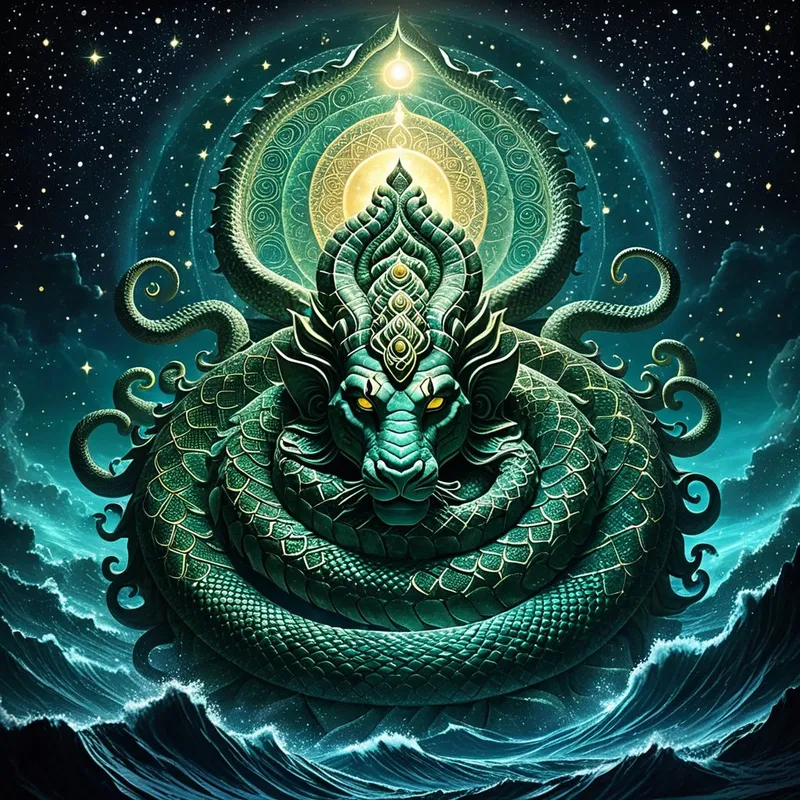
Ananta Shesha Myth Meaning & Symbolism
The endless serpent who supports the universe, embodies time, and offers a throne of stability from which creation unfolds.
The Tale of Ananta Shesha
Before the first breath, before the first thought, there was the ocean. Not an ocean of water, but of cause—dark, silent, and without shore. In that absolute stillness, a presence stirred. Not a waking, for there was nothing to wake from, but a turning of attention inward.
He was Ananta, and his form was Shesha. A thousand heads rose from the endless coils of his body, each crowned with a hood like a celestial lotus, each mouth whispering the true names of all things that were, are, and ever shall be. His scales were not mere armor but firmaments, holding within them the light of unborn suns. He was the first foundation, the only ground in that groundless deep.
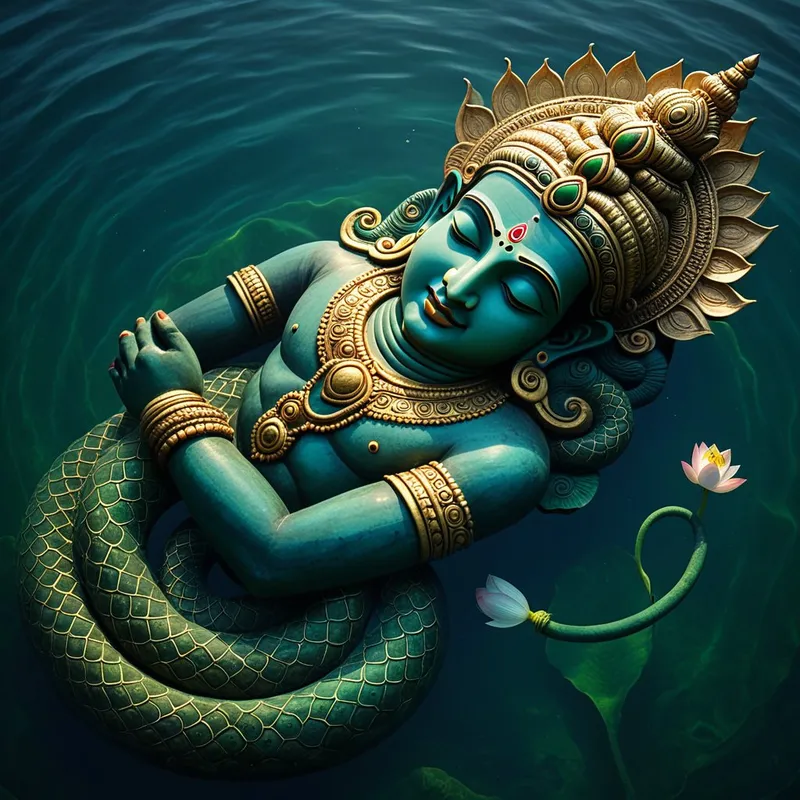
Upon his vast, unwavering coils, a blue-skinned figure came to rest. This was Vishnu, the divine consciousness. Weary not from labor, but from the completion of a world-age, he entered a state of profound, creative sleep—Yoga Nidra. Shesha became his bed, his couch, his eternal support. The serpent’s hoods arched overhead, a living pavilion shielding the sleeper from the utter void.
And from the navel of the sleeping Vishnu, a stem emerged. It grew, piercing the darkness, until it blossomed into a resplendent lotus. Upon that lotus sat Brahma, the demiurge, who opened his eyes and beheld the infinite expanse with terror and wonder. “What is this? Where am I?” he cried into the silence. He looked down the long stem, seeking its root, and saw the sleeping god upon the serpent in the boundless deep. In that moment, Brahma understood his task: to fashion the worlds from the substance of his own mind, supported by the serpent below and emanating from the god above.
Thus began the great cycle. The lotus of creation bloomed, the universes whirled into being, danced their cosmic dance for an acon, and then dissolved back into the essence of the sleeping god. Through it all, Ananta Shesha remained. He was the unwavering constant. When the fire of dissolution would come, it was Shesha who would breathe out the flames to consume the exhausted cosmos. And when the time for a new dawn arrived, it was upon his coils that the Preserver would again recline, and the whisper of his thousand heads would become the seed-syllable from which all sound, all form, all story, would once more unfold.
Cultural Origins & Context
The myth of Ananta Shesha finds its early roots in the Puranas, particularly the Vishnu Purana and the Bhagavata Purana. These texts, composed and compiled over centuries beginning around the early centuries of the Common Era, served as narrative encyclopedias of cosmology, theology, and philosophy, designed to be accessible and instructive.
The story was not confined to priestly classes but was disseminated through the oral tradition of kathakas and temple sculptors. Its societal function was multifaceted. Cosmologically, it answered the profound human question: “What does the universe rest upon?” It provided a mythic model that avoided an infinite regress—the world rests on Vishnu, who rests on Shesha, who rests upon himself, a perfect symbol of self-sustaining reality. Theologically, it established the supremacy of Vishnu as the sustaining principle and positioned Shesha as both his ultimate devotee and the very ground of his being. Philosophically, it visualized the concept of cyclical time (Kalpas and Manvantaras), making the abstract tangible through the image of the sleeping god and the enduring serpent.
Symbolic Architecture
Ananta Shesha is not a monster to be slain, but a fundament to be recognized. He represents the primordial, unconscious ground of being from which conscious reality (Vishnu) arises and upon which it depends.
- The Endless Coil: This is the symbol of eternity itself—time not as a linear arrow, but as a cyclical, self-sustaining process. Shesha is time as a container, not time as a force.
- The Supportive Bed: He embodies the principle of support, foundation, and stability. Before any action, any creation, any preservation can occur, there must be a stable base. Psychologically, this is the often-unconscious structure of the psyche—the instincts, the inherited patterns, the deep somatic knowing that allows the ego (Brahma) to operate and the conscious personality (Vishnu) to exist.
- The Thousand-Headed Witness: Each head reciting the names of the divine signifies omniscience and the totality of potential forms. Shesha holds the blueprint, the “code,” for all manifestation. He is the archetypal realm in its pure, unmanifest state.
- The Serpent of the Depths: Unlike the threatening serpent of other myths, Shesha is the benevolent ruler of the Kshira Sagara. He is the master of the deepest unconscious, not as a chaotic abyss, but as an ordered, intelligent, and supportive matrix.
The foundation does not seek glory; its triumph is in remaining unmoved, so that everything glorious may be built upon it.
The Dreamer's Resonance
When the archetype of Ananta Shesha stirs in the modern psyche, it often manifests in dreams not of drama, but of profound grounding. One might dream of discovering an immense, ancient, and utterly peaceful serpent coiled in the basement of a familiar house. Or of feeling an unshakeable support beneath during a dream of freefall, as if landing on a living, resilient mattress of scales.
These dreams signal a somatic and psychological process of receiving support from the depths. The dreamer may be undergoing a period of extreme transition, creative endeavor, or necessary withdrawal (Yoga Nidra). The psyche is asserting that one is not building on sand. The dream serpent is the embodied feeling that there is a core stability within, an inherited strength or a deep, instinctual wisdom that can bear the weight of one’s life, one’s responsibilities, or one’s healing. It is the antithesis of anxiety; it is the dream of the bedrock self.
Alchemical Translation
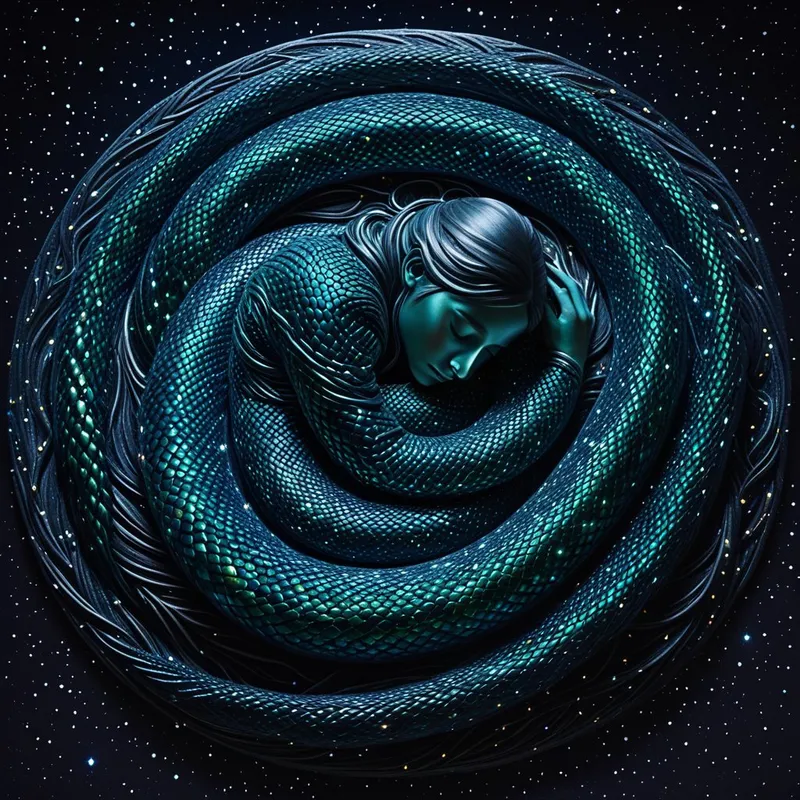
The individuation process, the journey toward psychic wholeness, is not only about slaying dragons and integrating the shadow. A crucial, often overlooked phase is the construction of the inner vessel—the creation of a stable, resilient psyche capable of containing the tensions and transformations of the work. This is the alchemy of Ananta Shesha.
First, one must descend into the “primordial ocean” of the unconscious, not to fight, but to find the base. This is the work of discovering what is truly foundational to the self—beyond family, society, or persona. What are the coils of your own enduring nature? What ancient, instinctual patterns actually support you?
Second, one learns to “recline” upon this foundation. This is the practice of trust in the deeper Self. It is allowing the conscious ego to rest, to enter a state of receptive Yoga Nidra, so that new creation can emerge organically from the navel of the psyche (the symbolic center). The struggle here is against the modern imperative of constant, frantic doing (Brahma’s creation) without first establishing a mode of serene, supported being.
Finally, Shesha’s role as the agent of dissolution teaches that this foundational self is also the agent of necessary endings. To create anew, old structures, worn-out identities, and exhausted worlds within must be allowed to burn away. The supportive ground is also the transformative fire.
Individuation requires not just a hero to venture forth, but a serpent to curl beneath, offering the throne from which one can truly rule one’s inner universe.
Thus, to integrate Ananta Shesha is to build your psyche upon the recognition of your own endlessness. It is to know that you are supported by the timeless, cyclical processes of life and death within you, and from that unshakeable throne, your unique creation can safely unfold.
Associated Symbols
Explore related symbols from the CaleaDream lexicon: