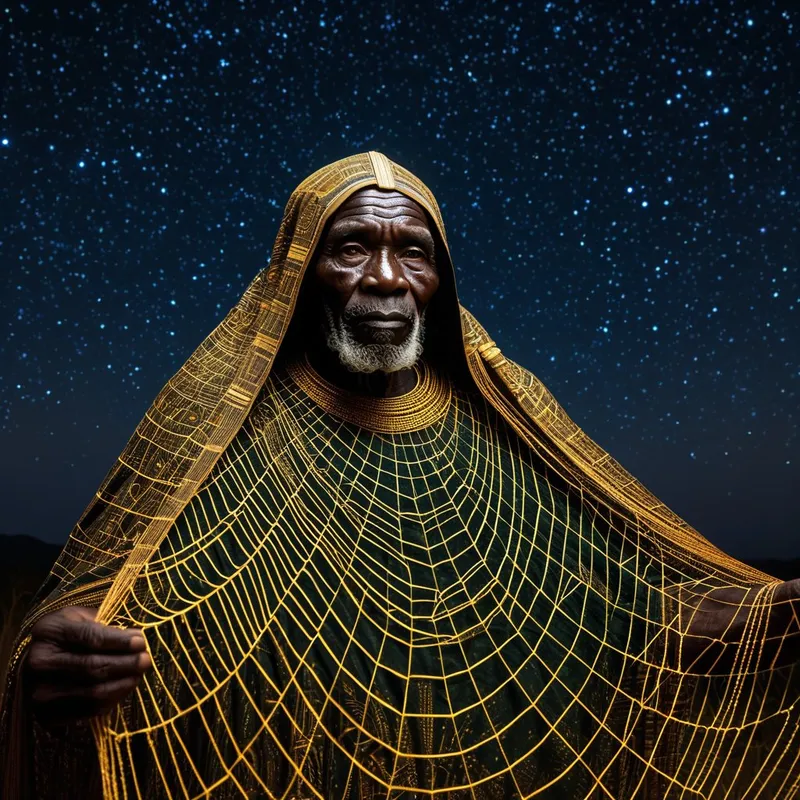
Anansi Myth Meaning & Symbolism
The myth of Anansi, the spider trickster, is a West African tale of wit overcoming brute strength, embodying the power of intellect and cultural survival.
The Tale of Anansi
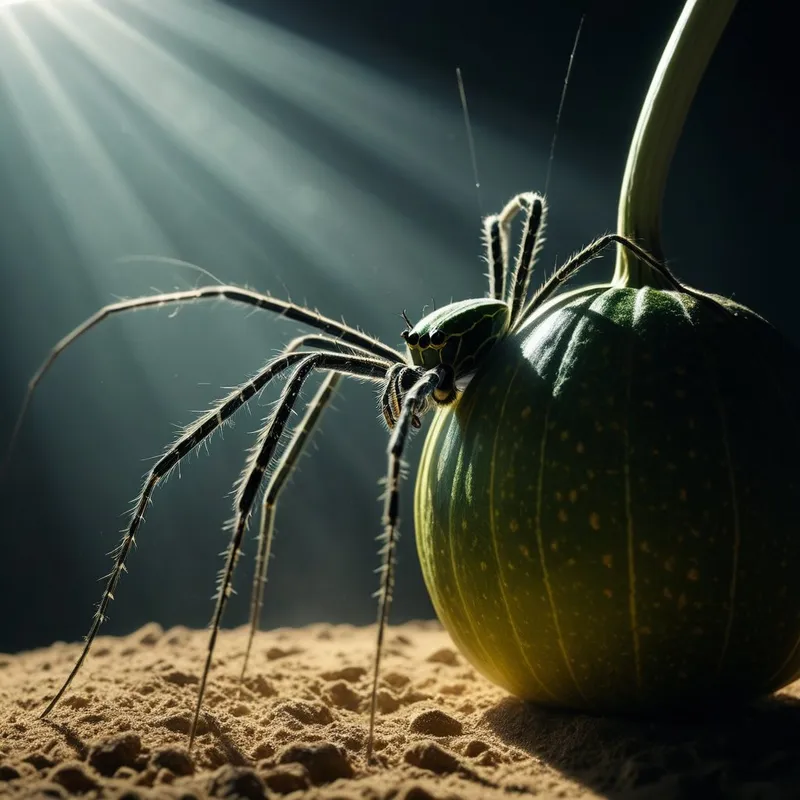
Listen, child, and let the firelight dance. In the time before time, when the world was still soft and stories slept in the belly of the sky, there lived Anansi. He was not large like the elephant, nor strong like the leopard. He was a spider, small and many-limbed, but within his cephalothorax whirred a mind sharper than any thorn.
In those days, all the stories in the world belonged to Nyame, the Sky Father, who kept them locked away in a beautiful wooden box high above the clouds. The world below was quiet, its wisdom unshared. Anansi looked up at the distant, glittering firmament and felt a hunger—not for meat or fruit, but for the nectar of narrative. He desired the stories for his people, for all people, so that wisdom and folly, laughter and warning, could walk among them.
He climbed the silken thread of his ambition all the way to Nyame’s court. “Great Sky God,” Anansi said, his voice a soft click. “I wish to buy all the stories from you.”
Nyame’s laughter rumbled like gathering thunder. “You? Little spinner in the dust? The price is too high. Bring me Onini the Python, who is longer than the longest river and can crush a palm tree. Bring me Osebo the Leopard, whose teeth are lightning and whose hide is the night sky pierced with stars. Bring me the Mmoboro Hornets, whose wrath is a thousand burning needles, and Mmoatia the Fairy, who is never seen and whose name is whispered only on the wind. Do this, and the stories are yours.”
The creatures of the forest heard this and shook with laughter. Anansi merely nodded, his eight eyes gleaming.
He went first to the python. Not with a spear, but with a whispered debate. “Onini,” he said, “there is a argument between my wife and I. She says you are shorter than the palm branch I carry. I say you are longer. Will you let us measure you against it, to settle our peace?” Flattered and curious, the great snake stretched out beside the branch. As he did, Anansi quickly tied him to it with vines, singing, “I am tying you to the branch for a true measure!” Until the python was bound fast.
For the leopard, he dug a deep pit and covered it with brush. When Osebo fell in, Anansi offered a slender web-rope to help. As the leopard climbed, the “rope” cut deep into his paws, weakening him until he too could be bound.
For the hornets, he filled a calabash with water and poured some over himself and a leaf, crying to the sky, “Is this not rain? Should you not seek shelter?” He held the empty gourd aloft. The hornets, believing a storm was coming, flew into the dry calabash for refuge. Anansi sealed the opening.
For the fairy, he carved a wooden doll and smeared it with sticky sap. He set it by a stream with a bowl of pounded yam. Mmoatia came, asked to eat, and when the doll did not answer, struck it. Her hand stuck. She struck with the other, and her feet, until she was fully caught in the trap of her own temper.
One by one, Anansi presented his impossible captives to Nyame. The Sky God was silent, his vast gaze upon the small, determined spider. Then, he nodded. He handed Anansi the box of stories. And from that day, the stories belonged not to the sky alone, but to the earth. They flowed down Anansi’s thread to every village, every hearth, becoming the property of all who could tell them and listen.
Cultural Origins & Context
The tales of Anansi are rooted deeply in the wisdom traditions of the Akan peoples, primarily in what is now Ghana and the Ivory Coast. He is a central figure in the Ashanti pantheon, more than a mere character; he is a Nyame, a divine expression of creativity, intelligence, and survival. These stories were never written but breathed. They were the domain of the griot and the elder, told in the twilight hours as communal pedagogy. The rhythm of the telling, the call and response, the dramatic pauses—these were the tools of transmission.
His primary societal function was multifaceted: to teach moral lessons about the dangers of greed, pride, and foolishness (often through Anansi’s own failures), to explain natural phenomena, and, most crucially, to model the survival of the intellect. For a people who endured displacement, including the transatlantic slave trade, Anansi traveled too. He transformed into “Aunt Nancy” or “Anancy” in the Caribbean, and his essence infused the Br’er Rabbit tales of the American South. In this diaspora, the myth performed its ultimate cultural work: it became a narrative of psychic survival, a coded testament that the weak could outwit the strong, that mind could triumph over matter, and that culture itself could be carried, like precious stories, in the vessel of a clever mind.
Symbolic Architecture
Anansi is the archetypal Trickster in its most potent form. He is not evil, but amoral—a force of chaotic intelligence that tests the rigidity of systems and the arrogance of power. His form, the spider, is profoundly symbolic. The spider is the weaver, the connector, the creator of intricate, non-hierarchical networks from its own substance.
The web is not a trap for others alone; it is first the architecture of the self, spun from the inner world to catch meaning from the chaos of the outer.
Anansi’s quest for the stories represents the human hunger for consciousness—for bringing the latent, divine knowledge (Nyame’s box) into the realm of human experience. The four impossible creatures symbolize the overwhelming, raw, and often terrifying powers of the unconscious: the crushing weight of primal instinct (Python), the predatory shadow of fierce emotion (Leopard), the stinging swarm of anxious thoughts (Hornets), and the elusive, magical but temperamental spirit of inspiration (Fairy). Anansi does not conquer them through force; he engages them. He uses language, debate, illusion, and understanding of their own nature to integrate them. His tools are not weapons, but the mind’s faculties: reason, persuasion, strategy, and craft.

The Dreamer's Resonance
When the pattern of Anansi weaves itself into modern dreams, it signals a profound somatic and psychological process: the negotiation of limitation. The dreamer may feel small, outmatched, or bound by an impossible task (Nyame’s price). The Anansi energy emerges as a creative, cunning, and often uncomfortable inner voice proposing a lateral solution.
Dreaming of intricate webs suggests the psyche is actively making connections, synthesizing disparate experiences into a new understanding. Dreaming of being trapped like Onini the Python may point to a feeling of being constrained by a rigid belief or “measurement” imposed from outside. The appearance of a trickster figure—perhaps a clever but unreliable friend, or even oneself acting in uncharacteristically sly ways—indicates that the conscious, rule-bound ego is being challenged to employ more imaginative, resourceful, and self-derived strategies. It is the psyche’s insistence that the way through a problem is not by meeting its brute force head-on, but by out-thinking it, by using the very threads of the dilemma to weave a solution.

Alchemical Translation
The individuation process, the journey toward psychic wholeness, is mirrored perfectly in Anansi’s myth. It is the alchemical work of acquiring the “stories”—the full narrative of one’s Self—from the distant, ruling “god” of our internalized authorities and collective norms (the super-ego, or Nyame). The price is always the confrontation with our own inner beasts.
The treasure of the Self is guarded not by dragons, but by aspects of our own nature we have deemed monstrous, fearsome, or too wild to approach.
The conscious ego, like Anansi, often feels inadequate for this task. The alchemical translation lies in the method. We are not to bludgeon our rage (the Leopard) or crush our obsessive thoughts (the Hornets). We are to engage them with cunning respect. We must talk to our depression, measure our anxieties, offer shelter to our swarming fears, and patiently wait for our elusive creativity to stick itself to the work. This is the trickster’s art: the transmutation of raw, autonomous complexes into bound, presented, and integrated energies.
By successfully “presenting” these captured aspects to our higher Self, we pay the price. The box of stories opens. We gain not just one story, but the capacity for narrative itself—the ability to author our own meaning, to weave the disparate threads of our experiences, failures, and talents into a coherent, resilient, and self-owned life-web. Anansi’s final gift is not just the content, but the copyright: the authority to tell, retell, and reshape our own myth, spinning a world of meaning from the very center of our being.
Associated Symbols
Explore related symbols from the CaleaDream lexicon:
- Hornet Sting
- Mosquito Bite
- Mosquito Buzz
- Venomous Spider
- Spooky Spider
- Mosquito
- Pygmy Chameleon
- Spotted Chameleon
- Spiritual Anansi
- Wooden Marimba
- Rhythmic Cajón
- Vibrating Djembe
- Metaphysical Kalimba
- Leather Cajon
- Harlem Renaissance Jazz Club
- Lush Folktale
- Kazoo
- Savannah Grass
- Bark Cloth
- Spider's Web
- Satire