Amaterasu's Robe Myth Meaning & Symbolism
A myth of sacred weaving where the Sun Goddess's rage is calmed by a robe of divine cloth, symbolizing the restoration of cosmic and inner order.
The Tale of Amaterasu's Robe
Listen, and hear the tale of when the world fell into shadow.
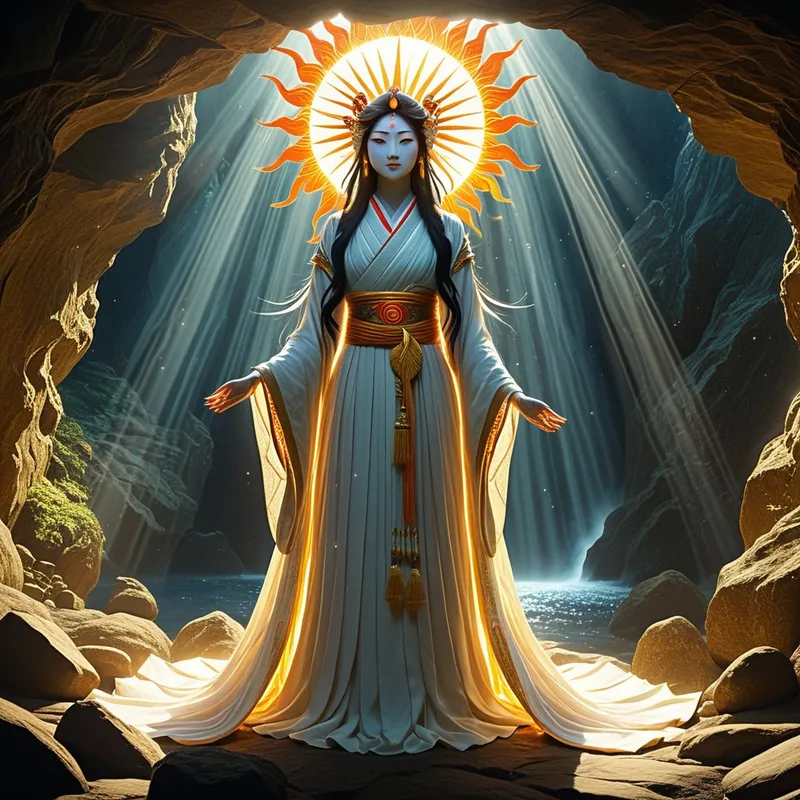
In the High Plain of Heaven, a terrible silence had fallen. The laughter of the eight million kami was gone, replaced by a chilling stillness. For the Sun herself, Amaterasu Ōmikami, had withdrawn. Grieving and enraged by the violent defilement of her sacred weaving hall by her brother, the storm god Susanoo, she had sealed herself within the Ama-no-Iwato. With her light imprisoned, the Three Realms—Heaven, Earth, and the Yomi—were plunged into an endless, chaotic night. Crops withered, spirits wailed, and disorder reigned.
The kami gathered before the cave, their faces pale in the gloom. Desperation hung thick in the air. Then, the wise deity Omoikane spoke. A plan was woven, not of force, but of sacred spectacle and craft. Before the cave's stony mouth, they performed a divine pantomime. The mighty Ame-no-Tajikarao stood ready, hidden beside the door. The goddess Ame-no-Uzume mounted an upturned tub, and with a wild, ecstatic dance, she stamped her feet, loosening her garments, sending the assembled kami into roars of laughter that shook the very roots of heaven.
Inside her dark solitude, Amaterasu heard the inexplicable joy. A flicker of curiosity, the first ember in the long night, sparked within her. She edged the great rock door open a sliver. “Why do you laugh while the world is dark?” her voice, like distant sunlight, filtered out.
“We rejoice because there is a deity greater and more radiant than you!” Uzume declared.
Intrigued and unable to resist, Amaterasu opened the door wider. At that moment, Ishikoridome and Tamanoya held aloft the Yata-no-Kagami, its polished surface catching the faintest glow from within the cave. Amaterasu, seeing her own radiant reflection—a brilliance she had forgotten—leaned further out, captivated by this “greater deity.”
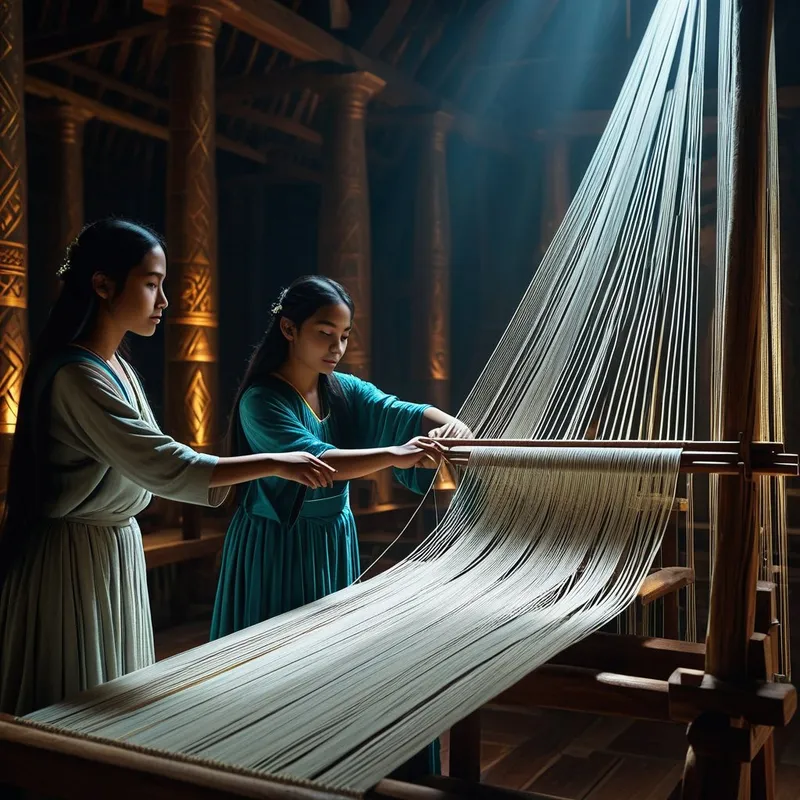
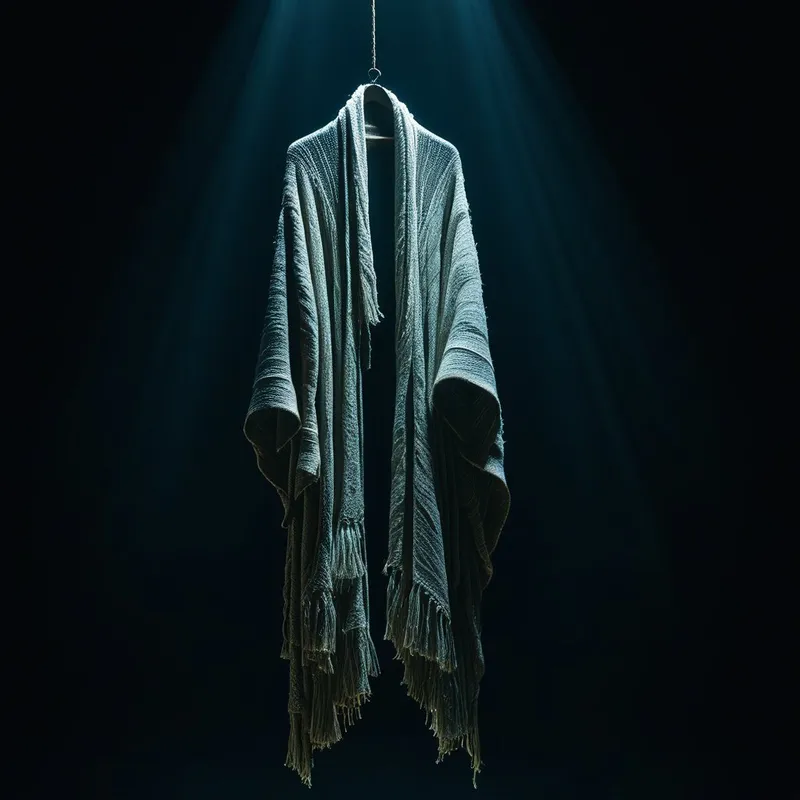
This was the moment. But the final, crucial act was not the mirror, nor the laughter, nor the strong arm that would pull the door wide. It was an act of restoration. For as Amaterasu emerged, the celestial weavers presented their sacred work: a robe. This was no ordinary garment. It was the Nigite, the “Soft Robe,” woven on the very loom Susanoo had desecrated, but now reconsecrated. It was crafted from the bark of the kōzo and the hemp plant, materials of purity and offering. As they draped this holy cloth over a sacred rack before her, it was an act of profound apology and restitution. It was the tangible mending of the violated sanctuary, the restoration of order to her most sacred craft.
Seeing this—the laughter, the mirror, and finally, the robe that honored her domain—Amaterasu’s heart softened. The light that had been coiled tight within her grief began to unfurl. Tajikarao seized the moment and flung the rock door wide. The Sun Goddess, her radiance now mingling with the light reflected in the mirror and consecrated by the robe, stepped fully back into the world. Light flooded the heavens, spilling over the plains and into the lands below, banishing the shadows. Life, order, and time itself began anew.
Cultural Origins & Context
This myth is the heart of the “Ama-no-Iwato” narrative, recorded in Japan’s oldest chronicles, the Kojiki (712 CE) and the Nihon Shoki (720 CE). These texts were commissioned by the imperial court to codify a national mythology, legitimizing the ruling line as descendants of Amaterasu herself. The story was not mere entertainment; it was a foundational political and cosmological document.
Its transmission was likely both ritual and oral before being inscribed. The myth served multiple societal functions: it explained the solar cycle, validated the imperial institution’s divine right, and underscored core Shinto values. Central to these is the concept of harae and kegare. Susanoo’s actions introduced violent kegare into the sacred space of weaving. The entire ritual before the cave—the laughter, the mirror, the robe—constitutes a grand ceremony of purification and restoration of harmony, or musubi. The robe, in particular, ties the myth to the ancient and vital tradition of ritual cloth-making (nusa), connecting the divine narrative to the everyday sacred practices of the people.
Symbolic Architecture
The myth is a masterful allegory for the dynamics of consciousness, trauma, and healing. Amaterasu is not merely the sun; she is the light of the conscious self, the ruling principle of order, clarity, and life. Her retreat into the cave represents a profound psychological withdrawal—a depression, a creative block, or a trauma response where the ego-consciousness, overwhelmed by chaotic or violent impulses (Susanoo), hides its light to survive.
The cave is not a prison of stone, but the necessary womb of darkness where a wounded light retreats to preserve its core.
The other kami represent the resources of the psyche. Uzume is the liberating power of embodied ecstasy and humor, which can shake loose rigid despair. The mirror (Yata-no-Kagami) symbolizes self-reflection—not narcissism, but the objective recognition of one’s own essence, often needing to be “held up” by another (the community, the therapist, the art).
But the Robe is the most profound symbol. It represents sacred restitution. The violence was against her domain of weaving—her creative, ordering function. The gift of a new robe, woven specifically for her, is the psyche’s ability to reconstitute its violated boundaries and creative spirit. It is the act of remaking what was broken, not by ignoring the break, but by honoring the craft that was attacked. The robe signifies that healing is not just about emerging from darkness, but about being met with something that acknowledges and repairs the specific nature of the wound.
The Dreamer's Resonance
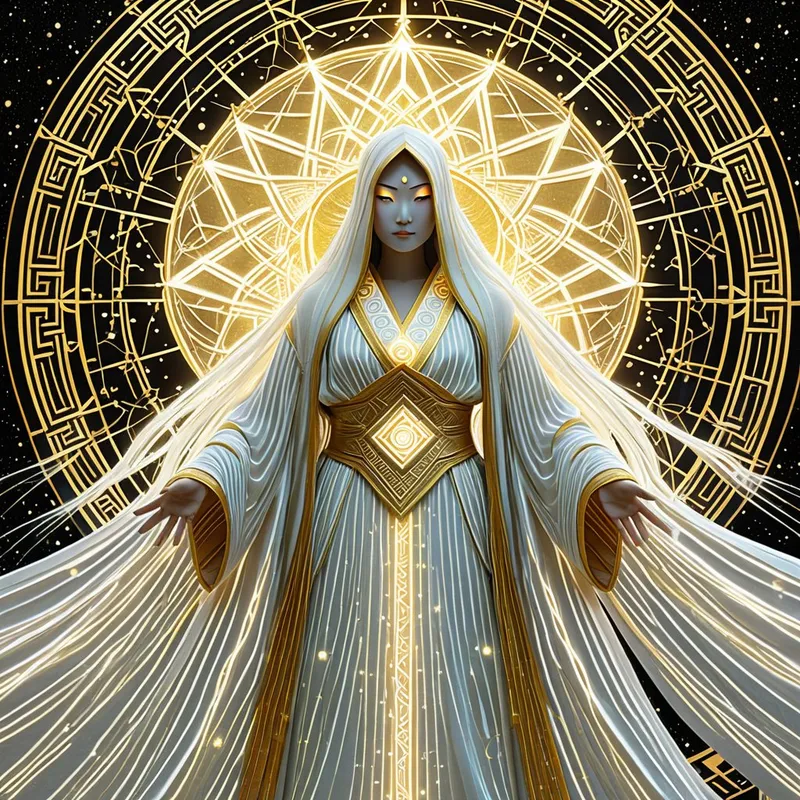
When this myth patterns a modern dream, the dreamer is navigating a profound cycle of withdrawal and hoped-for return. Dreaming of being in a dark, enclosed space (the cave) often coincides with feelings of depression, burnout, or a sense that one’s vital energy or creativity is inaccessible. The dreamer feels “in the dark.”
Dreaming of a robe, especially one being woven, offered, or torn, points directly to the theme of personal integrity and sacred vocation. Is the dreamer’s “robe”—their identity, their work, their creative output—feeling defiled, neglected, or incomplete? The appearance of chaotic figures (Susanoo) or joyful, dancing figures (Uzume) indicates the internal forces at play: the chaotic emotions that triggered the retreat and the playful, instinctual energies that might lure the light back out.
Somatically, this dream complex may arise with a feeling of heaviness, of being “walled in,” or conversely, with the nervous energy of a loom—a sense of threads pulling tight. The dream is the psyche’s enactment of the alchemical nigredo, the blackening, with an innate pointer toward the albedo, the whitening, represented by the pure, offered robe.
Alchemical Translation
For the individual on the path of individuation, Amaterasu’s retreat is a non-negotiable stage. It is the confrontation with the shadow in its most disruptive form (Susanoo), which forces the conscious attitude to collapse. One cannot “positive-think” their way past it. The cave becomes the vas hermeticum, the sealed vessel where the transformation occurs.
The alchemical operation here is Solve et Coagula—to dissolve and to coagulate. The old, rigid solar consciousness is dissolved in the waters of grief and rage. But the myth provides the blueprint for coagulation. It teaches that the return of the light is a communal, ritualized process. The individual must allow for the “Uzume” within—the body’s wisdom, laughter, and irreverence. They must engage with the “mirror” of honest self-reflection, often mediated through others (therapist, mentor, community).
The final and most crucial step is to weave the new robe. This is the act of conscious creation from the ruins of the old order.
The “Alchemical Translation” is the active, patient crafting of a new identity from the raw materials of the experience itself. The violated loom of one’s old life is not abandoned; it is reconsecrated. The dreamer must become their own celestial weaver, taking the threads of their pain, insight, and broken expectations, and deliberately, sacredly, weave them into a new “garment”—a renewed sense of purpose, a healed relationship to one’s creativity, a more resilient and compassionate consciousness. One does not simply leave the cave. One emerges wearing a robe woven in the dark, a garment that now contains and transforms the very story of the darkness itself. The light that returns is the same, yet fundamentally changed—softer, deeper, and clothed in the wisdom of its own restoration.
Associated Symbols
Explore related symbols from the CaleaDream lexicon: