Amarok the Wolf Spirit Myth Meaning & Symbolism
A myth of a lonely boy who seeks the giant wolf Amarok to gain strength, learning that true power comes from confronting the wild within.
The Tale of Amarok the Wolf Spirit
Listen, and let the wind carry you to a time when the ice sang and the snow held memories. In a village nestled against the endless white, there lived a boy. He was not like the others. While they laughed and wrestled, growing strong from seal meat and their fathers’ teachings, he remained small, his limbs thin as willow switches. The village children mocked his weakness, their words sharper than the winter wind. “You are nothing,” they would chant. “You will be carried away by the first blizzard.” A deep loneliness, colder than the deepest ice, settled in his bones. He was an orphan in spirit, adrift in a world that demanded strength.
One evening, as the sun bled into the horizon, staining the snow crimson, an elder saw his sorrow. The old one’s face was a map of wrinkles, each line a story of survival. He did not offer comfort. Instead, he spoke a name into the gathering dark: “Amarok.”
“The great wolf does not run with the pack,” the elder whispered, his voice like gravel underfoot. “He walks alone, hunting the giant caribou that would break a man’s spear. He is the spirit of the solitary land, the strength that is not given, but taken from the very heart of fear. If you wish to be strong, child, you must find him. You must go into the lonely places where the world is raw, and ask.”
Terror seized the boy’s heart, but beneath it, a spark ignited—a desperate, defiant hope. With no weapon but a sliver of courage, he left the circle of firelight and walked into the embracing darkness of the tundra. For days he wandered, a speck against the immensity. The cold gnawed at him. The silence roared in his ears, a deafening presence. He felt the eyes of unseen things upon him. He was peeling away, his old self crumbling in the vast, indifferent beauty.
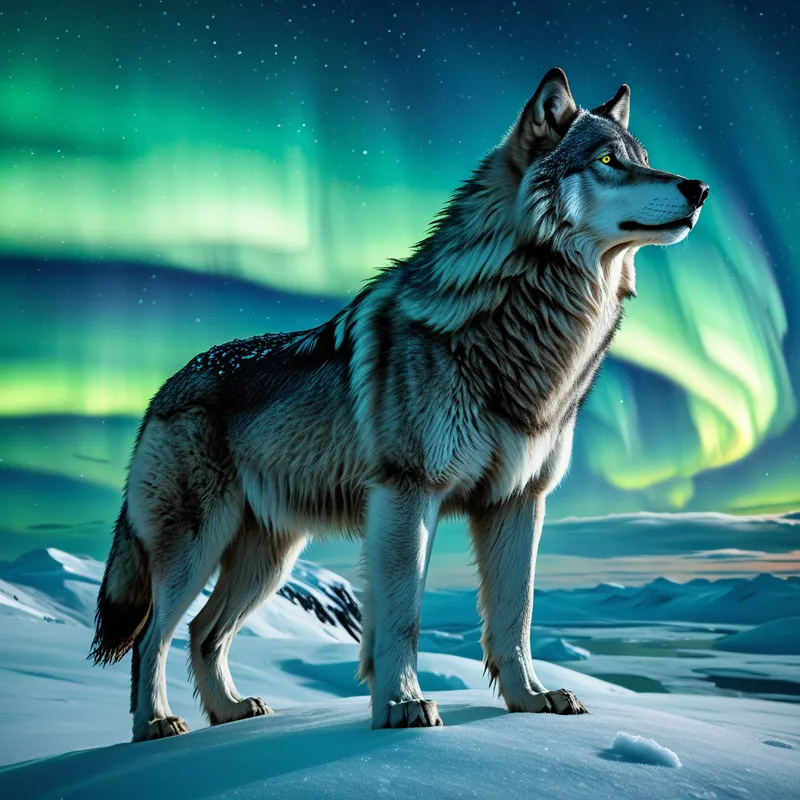
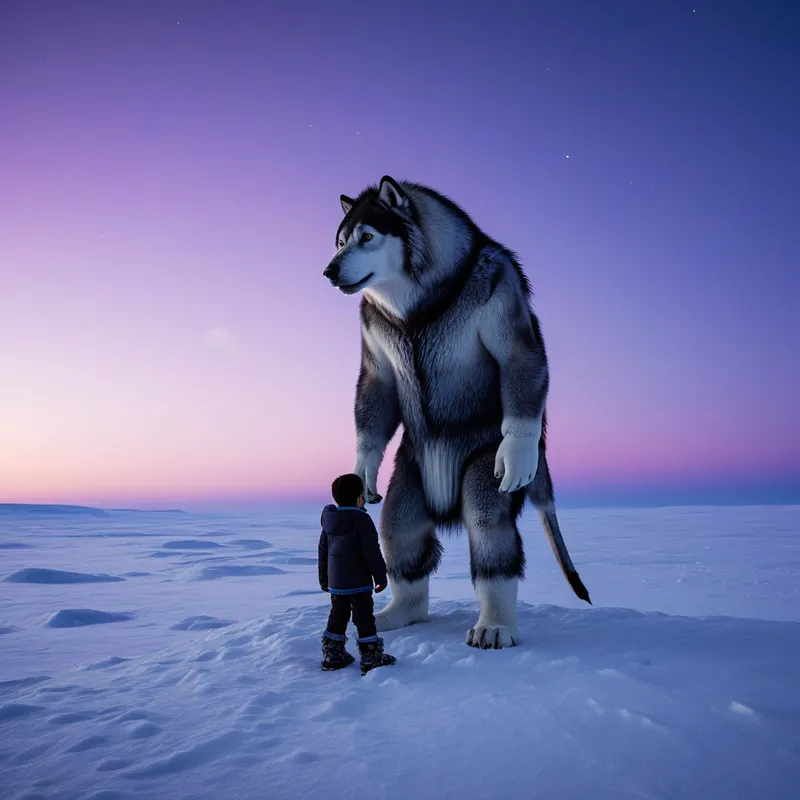
Then, on a night when the Aurora danced like silent ghosts, he felt it. A presence, immense and ancient, thrumming through the frozen ground. The air grew heavy. From the gloom of a rocky pass, it emerged. Amarok. He was not simply a large wolf; he was a force of the land made flesh. His shoulders were as high as a man’s, his fur a cascade of shadows and frost, his eyes two pools of liquid amber holding the patience of the ice ages. The boy’s breath caught. Every instinct screamed to flee.
But he remembered his loneliness. He remembered the mocking laughter. He stood his ground, his small body trembling not just from cold, but from the sheer magnitude of the spirit before him. He did not speak with words, but with his whole being—a plea cast from his soul into the wolf’s timeless gaze.
Amarok regarded him. Then, with a motion smoother than flowing water, the great wolf turned and vanished into the night. The boy, heart hammering, followed the path of crushed snow. He found Amarok waiting beside the carcass of a massive caribou. The wolf looked at him, then at the beast. Understanding dawned. This was not a gift of meat, but a test of will.
Summoning every shred of his spirit, the boy fell upon the caribou. He wrestled with the frozen hide, fought to tear the tough flesh. He strained until his muscles burned and his vision blurred, drinking the rich, hot blood, consuming the raw strength of the wild thing. As he ate, a fire kindled in his belly—a new warmth, a new solidity. He felt his sinews knit with power, his bones dense with purpose. When he looked up, sated and transformed, Amarok was gone. Only a single, perfect paw print in the snow remained.
The boy returned to his village, not as a child, but as a young man forged in solitude. He said nothing of the wolf. He simply picked up the heaviest harpoon, lifted it with ease, and met the eyes of those who had mocked him. They saw not just strength in his arms, but a deep, quiet knowledge in his eyes—the knowledge of one who has faced the lonely heart of the world and returned, whole.
Cultural Origins & Context
The myth of Amarok springs from the Inuit relationship with a world that is both breathtakingly beautiful and lethally austere. Survival in the Arctic demanded immense physical resilience, self-reliance, and a profound understanding of the non-human persons—the animals and spirits—with whom the Inuit shared the land. This story was not mere entertainment; it was a pedagogical tool, a psychological blueprint passed down by elders, often around the communal hearth during the long winter nights.
Its primary function was initiatory. For a culture where individual weakness could endanger the entire group, the tale provided a symbolic pathway from helplessness to capability. It externalized the internal process of growing up, of transforming childish vulnerability into adult strength. The storyteller, often a grandparent or respected hunter, was not just recounting a fable but imparting a core survival truth: true strength cannot be given by the community; it must be claimed by the individual through a direct, terrifying, and ultimately transformative encounter with the wild—both outside and within. Amarok represents that ultimate teacher: the indifferent, majestic, and ruthless reality of Nature itself, which confers power only on those who dare to approach it with respect and courage.
Symbolic Architecture
At its core, the myth of Amarok is a masterful depiction of the encounter with the Shadow and the retrieval of vital power from it. The lonely boy embodies the conscious ego—weak, isolated, and alienated from its own latent potential. His village represents the collective, which can mock or pity but cannot enact the fundamental change he requires.
The wilderness is not a place of mere danger, but the psychic landscape of the unconscious, where the untamed and rejected aspects of the self reside.
Amarok is the quintessential symbol of this wild self. He is not a monster of malice, but a spirit of sublime solitude and immense, focused power. He does not hunt in packs, symbolizing that the deepest work of individuation is a solitary journey. His prey is the "giant caribou"—the large, daunting challenges or blocks that ordinary means cannot overcome. The boy’s act of consuming the caribou is the critical symbolic act: he must ingest, integrate, and metabolize the raw, primal energy of the wild. He does not receive cooked meat (pre-digested wisdom); he must tear it himself, undergoing the struggle that makes the strength his own. This is the alchemy of the psyche: transforming raw, instinctual fear and longing into disciplined personal power.
The Dreamer's Resonance
When the pattern of the Amarok myth stirs in modern dreams, it signals a profound somatic and psychological initiation is underway. The dreamer may find themselves in vast, empty landscapes—symbolic of a feeling of existential loneliness or a life that has become psychologically barren. They may feel "too small" for their challenges, haunted by a sense of inadequacy.
The appearance of a giant wolf, a powerful solitary animal, or even just the palpable presence of something immense and watching in the dream points directly to the awakening of the instinctual self. This is not a socialized instinct, but the raw, archetypal force of survival, assertion, and autonomy. The somatic process is one of gathering—of feeling a latent power coiling in the belly, a readiness to fight for one’s place, a deep, growling "no" to further diminishment. The dream is the psyche’s way of staging the confrontation the conscious mind avoids: the meeting with the magnificent, frightening source of one’s own unused strength. The fear felt in the dream is the threshold; crossing it is the requirement.
Alchemical Translation
The myth models the complete arc of psychic transmutation, or Individuation. It begins with the nigredo, the blackening: the boy’s state of shame, weakness, and isolation. His journey into the wilderness is the separatio, the necessary withdrawal from the collective values that have defined (and limited) him.
The encounter with Amarok is the coniunctio—not a union of opposites in harmony, but a fierce and terrifying marriage of the conscious ego with the instinctual Shadow.
This sacred confrontation is the crucible. The wolf’s indifference is key; the transformative power does not come from parental love or social approval, but from engaging with a reality that is utterly unconcerned with one’s egoic suffering. The task given—to devour the caribou—is the albedo, the whitening, where the raw material of the unconscious (the animal) is laboriously worked upon and integrated. The boy’s struggle is the active participation of consciousness in its own transformation.
His return, silent and strong, represents the rubedo, the reddening or culmination. The integrated power is now a quiet, unshakeable fact of his being. He does not need to boast or seek validation; his transformed presence is its own testament. For the modern individual, this myth instructs us that healing from shame, weakness, or alienation does not come from reassurance alone, but from a willing descent into our own inner tundra to face the majestic, solitary power we have feared—and to claim its fierce nourishment as our own.
Associated Symbols
Explore related symbols from the CaleaDream lexicon:
- Wolf — The central archetype of instinct, solitude, and fierce intelligence. Amarok is not a pack wolf but the ultimate embodiment of the wild, self-sufficient spirit that teaches through formidable presence.
- Journey — The essential movement from the known world of the village into the unknown wilderness, representing the necessary psychological voyage away from collective safety toward individual discovery.
- Shadow — Amarok perfectly personifies the Jungian Shadow: the immense, often feared repository of latent power, instincts, and strengths that the conscious ego has rejected or ignored.
- Strength — Not as brute force, but as integrated power earned through direct confrontation with one's deepest fears and the raw materials of the unconscious self.
- Solitude — The critical condition for the transformation. True strength, in this myth, can only be forged in the alchemical vessel of being alone with the vast, untamed aspects of existence.
- Fear — The primary obstacle and the essential gateway. The boy's trembling before Amarok is not a failure but the necessary somatic experience that precedes integration and empowerment.
- Initiation — The entire narrative structure is a classic initiation rite: separation (leaving the village), ordeal (facing the wolf), and return (transformed).
- Wilderness — The symbolic landscape of the unconscious mind—vast, indifferent, beautiful, dangerous, and filled with both peril and the precise nourishment needed for growth.
- Blood — The vital, life-giving essence of the wild (the caribou) that the boy must consume, symbolizing the direct ingestion and integration of primal, instinctual energy.
- Spirit Guide — Amarok serves in this capacity, though not as a gentle helper. He is a fierce, demanding guide who leads by presenting a terrifying truth and an opportunity, not by offering comfort.
- Transformation — The core process of the myth, depicted not as a sudden magic but as a grueling, somatic act of wrestling with and internalizing raw power.
- Hero — The boy embodies the hero archetype not through slaying a monster, but through having the courage to face the majestic source of his own fear and lack, and to be changed by it.