Alyosha Popovich Myth Meaning & Symbolism
The tale of the youngest and cleverest of the three great Bogatyrs, whose wit and cunning triumph over brute strength, embodying the trickster's path to wisdom.
The Tale of Alyosha Popovich
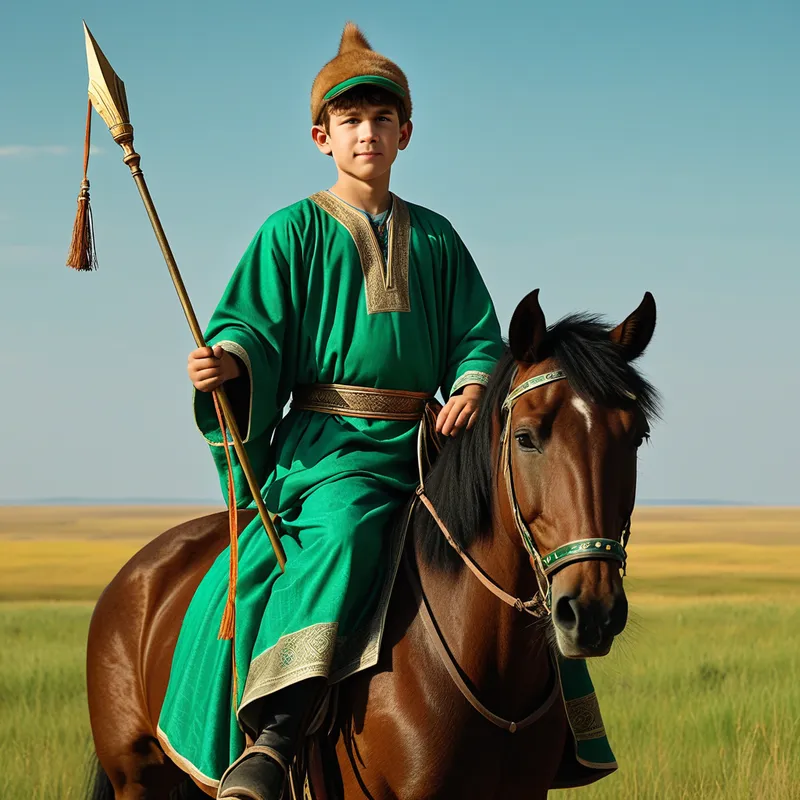
Listen, and let the wind from the wide steppe carry the tale. It was a time when the earth was young with heroes, and the sun baked the grasslands into a sea of gold. From the holy city of Kiev, ruled by the wise Prince Vladimir, three pillars of strength held up the sky: the mighty Bogatyr Ilya Muromets, the steadfast Dobrynya Nikitich, and the youngest, Alyosha Popovich, son of the priest.
But do not mistake youth for weakness. Alyosha’s strength was not in the girth of his arms, but in the lightning of his mind and the sharpness of his tongue. His horse was swift, his spear was light, and his eyes missed nothing.
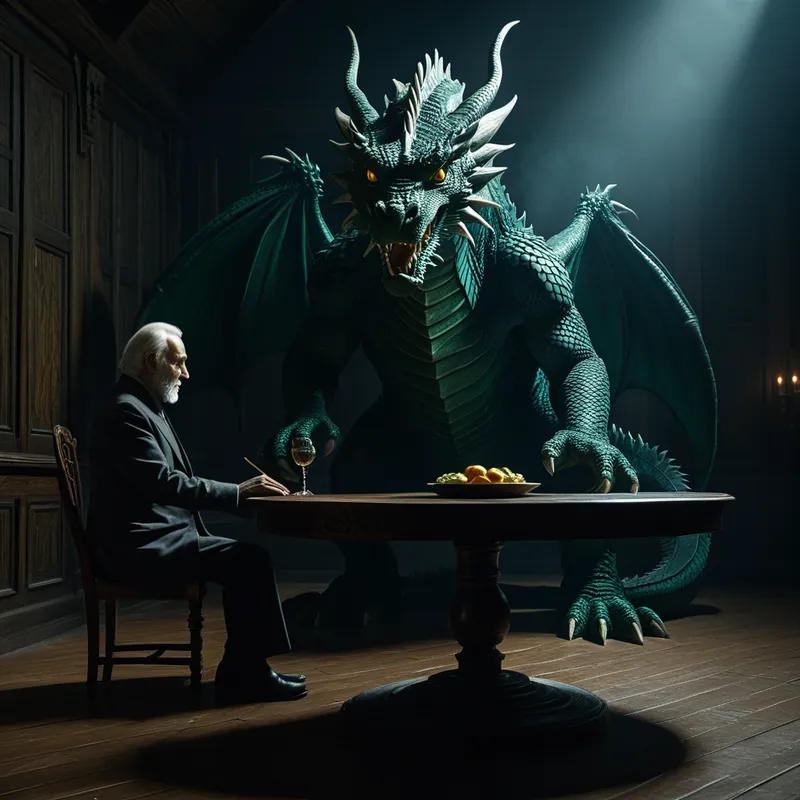
The shadow fell from the east. Tugarin Zmeevich, a foe whose name hissed with serpent’s breath, came to Kiev. He was a mountain of a man, they said, who devoured whole swans in a single bite, who drank wine by the barrel, and whose shadow on the wall was not the shadow of a man, but of a great, coiling Zmei. He demanded tribute, he mocked the Prince, and his presence choked the hall with a cold, arrogant fear.
The elder Bogatyrs were away. The duty fell to the youngest. Alyosha did not strap on extra armor. He did not practice his swing. He knelt in the chapel, then rode out to meet the monster—not on the open field, but in the hall of the Prince itself, where wit could be a sharper sword than steel.
The feast was a tense pantomime. Tugarin gorged, throwing bones over his shoulder with contempt. Alyosha sat, seemingly meek. When the monster boasted he would swallow Alyosha whole with his wine, the young Bogatyr spoke, his voice clear as a bell in the smoky hall. “You are a wonder, Tugarin,” he said. “But I saw a greater wonder on my ride. A peasant was ploughing a field, and his mare gave birth to a foal. That foal ran around the cart, stood up on its hind legs, and kicked its own mother in the belly!”
The hall fell silent. Tugarin scowled. “A lie! No foal can do such a thing at birth!” Alyosha smiled, a thin, sharp smile. “If a newborn foal cannot kick its mother, then how can a newborn man—for you sit at our table as a guest—threaten to swallow a Bogatyr of Holy Kiev?”
The insult hung in the air, a gauntlet thrown not with force, but with flawless logic. Enraged, Tugarin lunged. What followed was not a clash of titans, but a dance of the clever against the brutal. Alyosha dodged, weaved, and led the blundering giant outside. He did not meet the charge head-on. He invoked the heavens, calling upon a sudden, drenching rain to soak the paper-like wings Tugarin used to fly. Grounded and sodden, the monster was vulnerable. Then, and only then, did Alyosha strike with his spear, not with overwhelming power, but with perfect, precise timing. The Zmei-shadow dissolved. The steppe wind carried away the last of the serpent’s breath, and the youngest had defended the hearth not with the strongest arm, but with the keenest mind.
Cultural Origins & Context
Alyosha Popovich belongs to the revered cycle of byliny, the narrative poems of Kievan Rus’ that were sung or recited by itinerant storytellers for centuries. Unlike written scripture, these tales lived in the breath and memory of the people, performed in village squares and princely halls alike. As the son of a priest ( pop ), Alyosha represents a distinct social layer—the literate, the cunning, the spiritually adjacent yet fiercely independent. His stories served a vital societal function: they championed intellect and adaptability as heroic virtues equal to pure physical might. In a culture often romanticizing brute strength, Alyosha’s tales reassured that the quick mind of the younger brother, the savvy of the seemingly weaker, could safeguard the community. He is the folk embodiment of a crucial truth—that the preservation of the Mir often depends on the trickster’s art as much as the warrior’s oath.
Symbolic Architecture
Alyosha Popovich is the archetypal Trickster operating within the Hero’s realm. His victory is not an overthrow of order, but its preservation through unorthodox means. He represents the psychic function of cunning intelligence ( Metis in Greek tradition) that must be integrated for wholeness.
The true adversary is never the monster at the gate, but the collective hypnosis that believes only the monster’s own language of force can be used to defeat it.
His enemy, Tugarin Zmeevich, is not just a foreign invader but a manifestation of unassimilated gluttony and inflated arrogance—the shadow of raw, instinctual power that consumes without respect. Tugarin’s serpentine association marks him as a creature of the chthonic, earthy realm, all appetite and no wisdom. Alyosha’s strategy is alchemical: he first engages the monster on its own terms (the feast), then reframes the reality through a parable, exposing the illogic of the threat. The subsequent rain is a profound symbol; it is divine aid invoked, the heavens themselves intervening to neutralize the unnatural (the paper wings) and level the field. His final strike is not an act of rage, but of necessary release, cutting through the inflated complex to restore balance.

The Dreamer's Resonance
To dream in the pattern of Alyosha is to encounter a situation where you feel outmatched by a looming, seemingly overpowering force—a domineering figure, an insurmountable debt, a consuming anxiety (the Tugarin). The dream ego may feel small, youthful, or ill-equipped. The Alyosha dream does not summon a fantasy of sudden, brute strength. Instead, it presents oblique solutions: a clever retort that deflates a bully, finding a hidden rule in a confusing contract, or discovering that the monster’s power source is absurdly fragile (like paper wings). The somatic sensation is not of clenched fists, but of a sudden, clear click in the mind, a lateral insight. This is the psyche rehearsing the integration of the Trickster function. It signals a movement away from a childlike identification with the “orphan” or “innocent” who is powerless before larger forces, and towards a nascent confidence in one’s own innate wit and contextual intelligence to navigate oppressive systems.
Alchemical Translation
The individuation process modeled by Alyosha is the transmutation of perceived weakness into operative strength. For the modern individual, the “monster” is often an internalized complex: the overbearing inner critic, the weight of familial expectation, or the sheer scale of a life challenge. The instinct may be to meet it with a forced, inauthentic show of “heroic” willpower, which often leads to exhaustion and defeat.
Individuation is not about becoming a giant, but about discovering that the giant is made of paper and fear, and you hold the needle of conscious insight.
The Alyosha path instructs us to first sit at the table with the monster. Do not avoid the anxiety, the shame, the grief. Observe its habits, its logic, its boasts. Then, engage it not on its terms of sheer emotional volume, but by reframing the narrative. This is the “parable” moment—the therapeutic insight, the journal entry that exposes the flaw in the complex’s story. The “rain” that soaks the paper wings is the compassionate, humbling truth we allow in, which grounds the inflated emotion. Finally, the “strike” is the decisive, conscious action taken from this new, balanced perspective—setting a boundary, changing a habit, speaking a truth—which is now effective because it is precise, not merely forceful. We become whole not by destroying our inner Tugarin, but by outgrowing our belief in its omnipotence, using our unique, perhaps unorthodox, intelligence to integrate its energy.
Associated Symbols
Explore related symbols from the CaleaDream lexicon:
- Hero — In Alyosha, the Hero archetype is redefined; his heroism lies in cunning and intellectual victory, proving that the mantle can be worn by the clever as well as the strong.
- Trickster — Alyosha is the quintessential Trickster-hero, using wit, riddles, and psychological insight to defeat foes, symbolizing the necessary disruption of rigid thinking.
- Dragon — Tugarin Zmeevich, the serpentine foe, embodies the Dragon as a chaotic, gluttonous force of inflation and untamed instinct that must be confronted and integrated.
- Rain — The sudden downpour that grounds Tugarin’s flight represents divine intervention, cleansing, and the humbling force of reality that neutralizes artificial or inflated power.
- Horse — Alyosha’s swift steed symbolizes the agile mind, mobility, and the quickness of thought that is the hero’s true vehicle, superior to brute force.
- Feast — The banquet hall setting represents the arena of social and psychological confrontation, where norms are tested, and true character is revealed under pressure.
- Spear — Alyosha’s light spear signifies focused intention and precise action, the tool that delivers the final, conscious strike only after the enemy has been psychologically disarmed.
- Wind — The ever-present steppe wind carries the story and scatters the serpent’s shadow, representing the breath of spirit, change, and the dissemination of truth.
- Shadow — Tugarin’s serpentine Shadow cast on the wall is the projected form of the community’s fear, which Alyosha must make conscious and defeat.
- Wit — Though not a concrete symbol, Alyosha’s wit is his core weapon, representing the transformative power of intelligence, language, and reframing reality.