Allat the Mother Goddess Myth Meaning & Symbolism
The story of Allat, the powerful Arabian Mother Goddess of fate and sovereignty, whose sacred stone was eclipsed but whose archetypal essence endures in the human soul.
The Tale of Allat the Mother Goddess
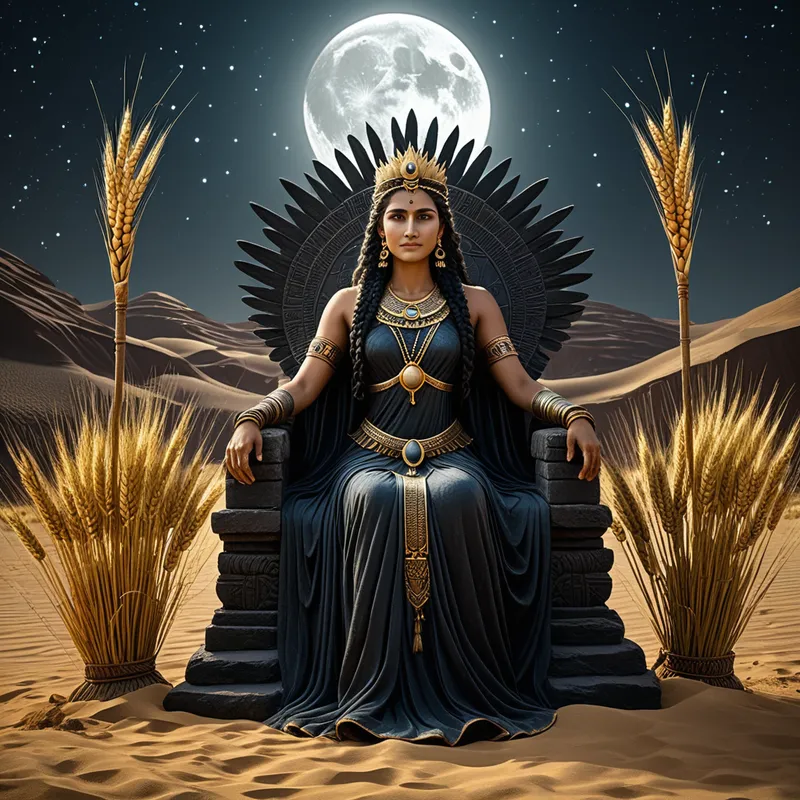
Before the call to prayer echoed over the dunes, before the One God was known in the heart of the peninsula, the desert breathed with older names. In the high place of Ta'if, where the air was cooler and the scent of roses clung to the stone, stood her sanctuary. They called her Allat—"The Goddess." She who was born from the sun itself, a daughter of radiance and terrible power.
Her house was a cube of dark stone, draped in silks the color of blood and night. Within, no idol bore her face, for her presence was the stone itself, smooth and implacable, humming with a vibration that settled in the bones of those who approached. She was the Lady of Fate, the granter of victory, the sovereign who held the threads of life and death in her unseen hands. Her priests moved in hushed reverence, and the people of the Quraysh and beyond brought offerings: fine cloth, precious oils, and the first fruits of the harvest. They whispered prayers for safe passage, for strong sons, for vengeance against enemies. Allat heard. Allat decreed.
Her companion was the lion, a beast of golden fury that lay docile at the conceptual foot of her stone. She was the earth that gives and the earth that consumes, the mountain that shelters and the avalanche that destroys. For centuries, the rhythm held. The pilgrims came, the rites were observed, the world had its order under her ancient, watchful gaze.
But a wind began to blow, scouring and new. A voice rose in the nearby valley of Mecca, speaking of a single, formless God, a God who would suffer no partners. The name of this prophet was Muhammad. His message was a flame that sought to burn away the old ties. To his followers, the Goddess of Ta'if was not a sovereign but a shirk, a blasphemous division of the divine unity.
The conflict was not of armies at first, but of souls. The people of Ta'if clung to their Lady. She was their identity, their protector, the known face of the numinous in a harsh land. Yet the new call was relentless, a tidal force of conviction. The year came when the Prophet’s forces marched on Ta'if. Not for conquest of land, but for the conquest of a world-view.
The sanctuary fell silent. The priests fled or bowed to the inevitable. And the command was given. The great cubic stone of Allat—the focus of a millennium of devotion—was to be shattered. A warrior named al-Mughirah ibn Shu‘bah raised his pickaxe. The air itself seemed to hold its breath. The strike rang out, a sound of finality that echoed across the canyon. The dark stone, which had absorbed countless hopes and fears, cracked. It did not bleed, it did not cry out. It simply yielded to the blow, breaking into fragments that scattered in the dust.
As the pieces settled, the story says something miraculous and terrifying occurred. From the ruins of the stone, a beautiful, dark-skinned woman emerged, wailing and tearing at her hair—a final, ephemeral manifestation of the goddess herself, mourning her own passing. Then, she was gone. The silks were burned. The sanctuary was razed. The name of Allat was to be erased from the lips of the people, forbidden, replaced by the unutterable name of the All-Merciful. The Mother had been eclipsed by the Father. The desert, for a moment, felt utterly empty.
Cultural Origins & Context
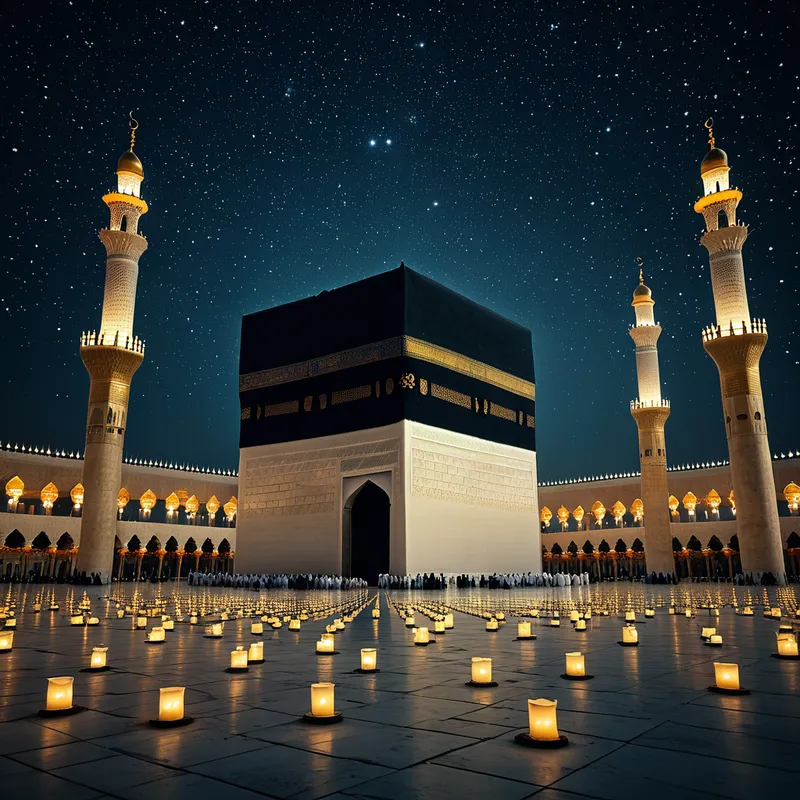
Allat was not a minor local spirit but one of the three supreme goddesses of the pre-Islamic Arabian pantheon, alongside al-Uzza and Manat. Her worship was central, particularly around the city of Ta'if, where she was considered the Rabbah (Lady) of that territory. Her origins are deeply rooted in the Nabatean and wider Semitic religious landscape, connecting her to deities like Athirat.
This myth was not preserved in a single sacred text but in the oral histories, poetry, and later Islamic historiographical works that recorded the "Days of Ignorance" (Jahiliyyah). It was a story told by the victors to explain the profound theological rupture of Islam's rise, and by implication, by the descendants of the defeated to mourn a lost world. Societally, Allat functioned as a divine sovereign, a bestower of legitimacy and protection to tribes and individuals. Her eclipse marked the violent, necessary death of an entire cosmological and social order to make way for the new.
Symbolic Architecture
At its core, the myth of Allat is about the dethronement of a primal archetype. The cubic stone—the betyl—symbolizes the irreducible, foundational aspect of the Feminine as Sovereign Law and Immanent Presence. It is not a nurturing, soft mother, but the Mother as Ruler, the unyielding ground of being from which life springs and to which it returns.
The stone does not love; it simply is. Its shattering is the fragmentation of a once-unquestioned psychic authority.
The emergence of the wailing woman from the rubble is the critical symbolic moment. It represents the transformation of the archetype from a static, externalized object of worship (the stone) into a dynamic, internalized psychic content—a complex of grief, loss, and exiled power now residing in the personal and collective unconscious. The lion, her attribute, signifies the untamed, instinctual power that served this sovereignty, a power that too must go into hiding or be re-directed.
The Dreamer's Resonance
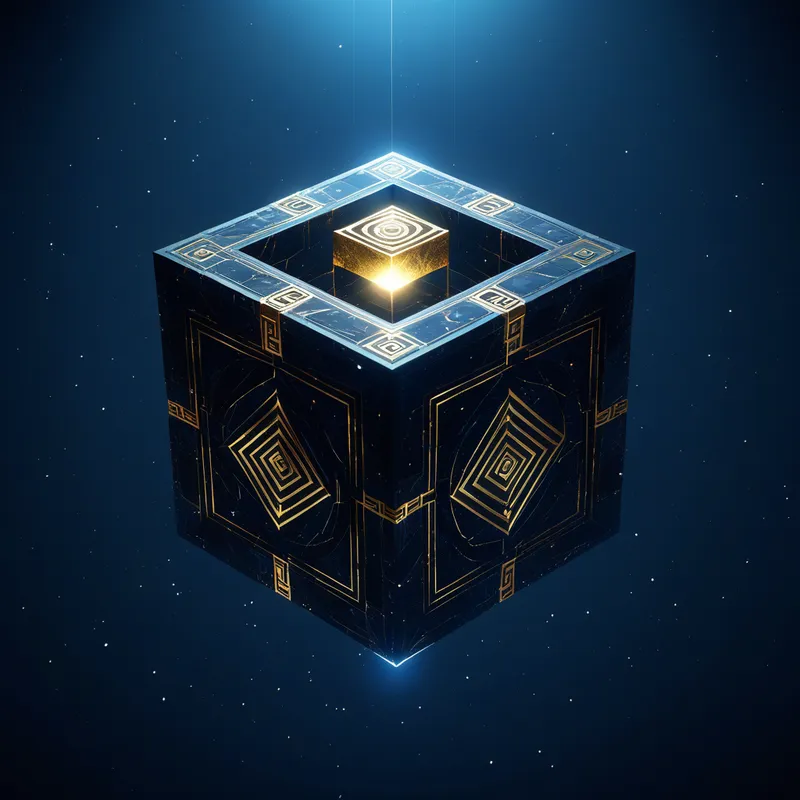
When this myth stirs in the modern psyche, it may manifest in dreams of profound, melancholic loss connected to feminine authority. One might dream of a powerful, ancient female figure who is ignored, imprisoned, or crumbling to dust. There may be dreams of finding a strange, heavy black stone—feeling its significance but not knowing what to do with it. The somatic experience is often a deep, resonant grief in the chest or gut, a feeling of ancestral homesickness for a sacred order one never consciously knew.
Psychologically, this signals an encounter with what has been culturally or personally "shattered"—the inner feminine principle in its aspect of rightful sovereignty, personal fate, and grounded power. The dreamer is not necessarily revisiting a historical event, but touching the pattern of eclipse, where a vital part of the Self (aligned with the Ruler archetype) was suppressed to maintain a newer, more dominant conscious attitude.
Alchemical Translation
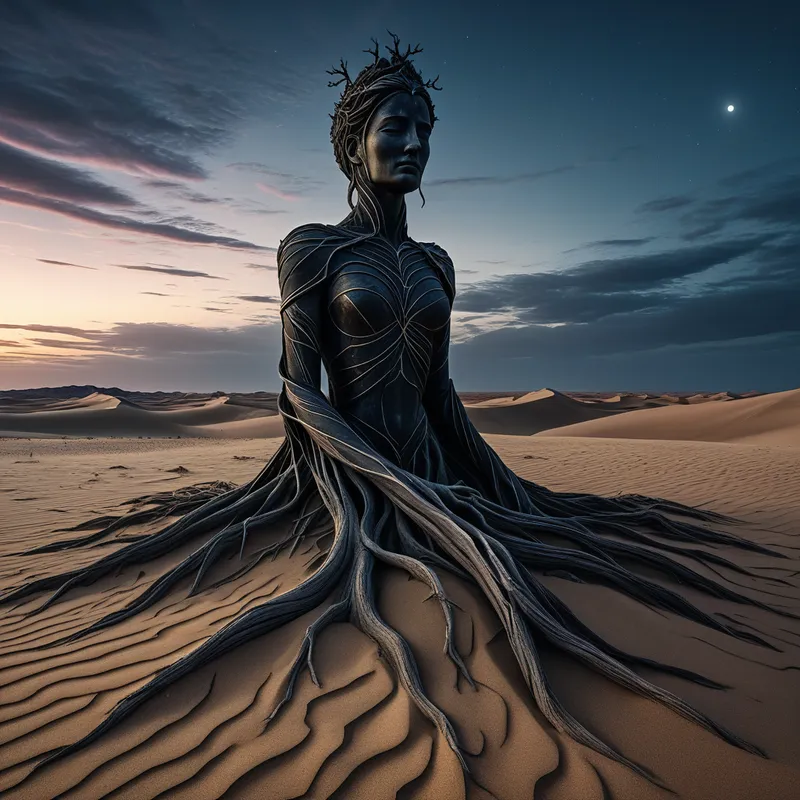
The alchemical process modeled here is the re-integration of the eclipsed sovereign. Individuation is not just about discovering hidden parts, but about rehabilitating dethroned ones. The shattered stone is the prima materia of this work—the fragmented sense of inner authority and self-determination that feels lost or forbidden.
The first step is recognizing the grief—the wailing woman. One must consciously encounter the sorrow of this internal exile, the price paid for aligning with a monolithic conscious worldview (be it religious, cultural, or familial). The next phase is collecting the fragments. This is the painstaking inner work of gathering the pieces of one's own sovereign nature: the right to set boundaries (the lion), the authority over one's own life path (the function of fate), and the capacity to hold a sacred, immovable center (the cubic stone).
The new sanctuary is not rebuilt in the outer world of Ta'if, but reconstructed in the inner temenos of the psyche. The goddess is not worshipped, but embodied.
The final transmutation is moving from a relationship of petitioning an external authority (praying to the stone) to becoming the centered, self-governing entity. The black stone becomes the Lapis Philosophorum within—the unassailable core of individual identity and purpose that can coexist with, but is not subsumed by, any external system. The eclipse ends not with the old goddess restored, but with a more conscious, differentiated form of her essence integrated into a fuller, more resilient Self.
Associated Symbols
Explore related symbols from the CaleaDream lexicon:
- Goddess — The myth centers on the eclipse of the divine feminine in her sovereign, fate-weaving aspect, representing a profound shift in cosmic and psychological order.
- Stone — The cubic betyl of Allat symbolizes the irreducible, foundational presence of the archetype, an immovable center of gravity and sacred authority that is both sanctuary and prison.
- Mother — Allat embodies the Mother archetype not as nurturer, but as the primordial, lawful ground of being from which all life emerges and is governed.
- Lion — As Allat's sacred animal, the lion represents the untamed instinctual power, ferocity, and majestic authority that serves and protects her sovereign domain.
- Fate — Allat was a granter of victory and decree, intimately connected to the concept of destiny and the cutting of life's threads, symbolizing the archetype's role in governing personal fortune.
- Eclipse — The central event of the myth is an archetypal eclipse, the obscuring of one luminous psychic authority by another, forcing its essence into the shadow.
- Grief — Manifest in the wailing woman, this symbolizes the profound, necessary mourning for what is lost when a major archetypal structure is dismantled or suppressed.
- Temple — The sanctuary at Ta'if represents the constructed space where the archetype was consciously honored, a psychic structure that housed and localized the numinous.
- Shadow — After her eclipse, Allat's power and essence did not vanish but descended into the cultural and personal shadow, becoming a source of unconscious fascination and unresolved grief.
- Ruler — This is the core archetype of the myth, depicting the struggle for sovereignty, legitimacy, and the right to govern one's own inner and outer kingdom.
- Death — The shattering of the stone is a symbolic death, not an annihilation, but a necessary dissolution of form so the archetypal energy can be reborn in a new relationship to consciousness.
- Rebirth — The emergence of the wailing woman from the rubble signifies the first, raw movement toward rebirth—the archetype returning not as an idol, but as a living, suffering psychic reality demanding integration.