Alhambra Myth Meaning & Symbolism
A mythic fortress of memory, where paradise is a fleeting reflection and the soul's duty is to remember the divine pattern amidst earthly ruin.
The Tale of Alhambra
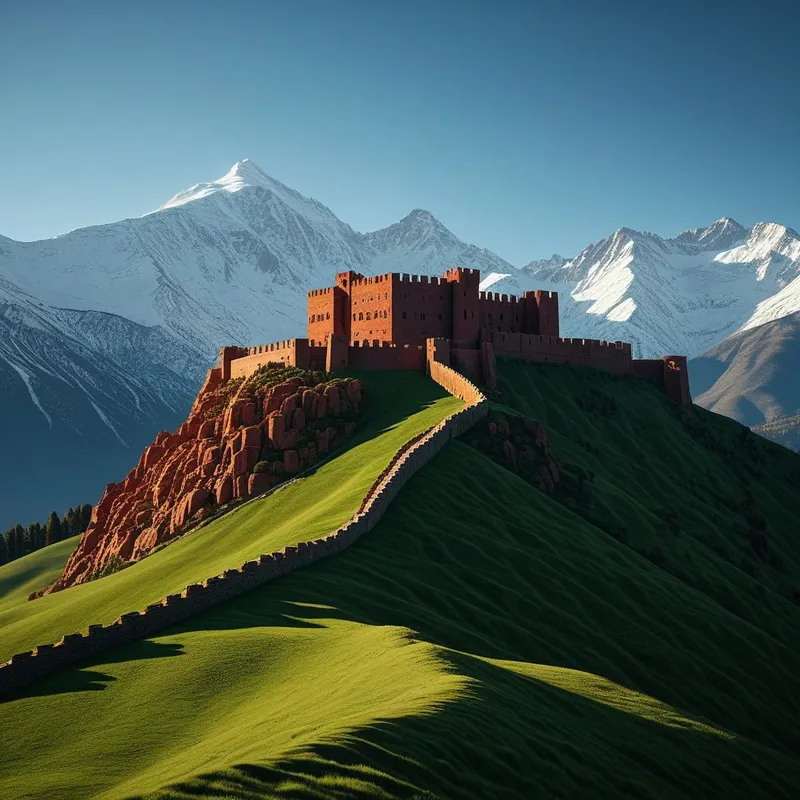
Listen, and let the wind from the Sierra Nevada carry you back. It does not speak of one king, but of kings; not of one battle, but of a long, slow sigh. Upon a hill of red earth—al-Hamra—they built a dream in stone. They called it a fortress, but its walls were woven with poems, and its gates opened not to armies, but to gardens.
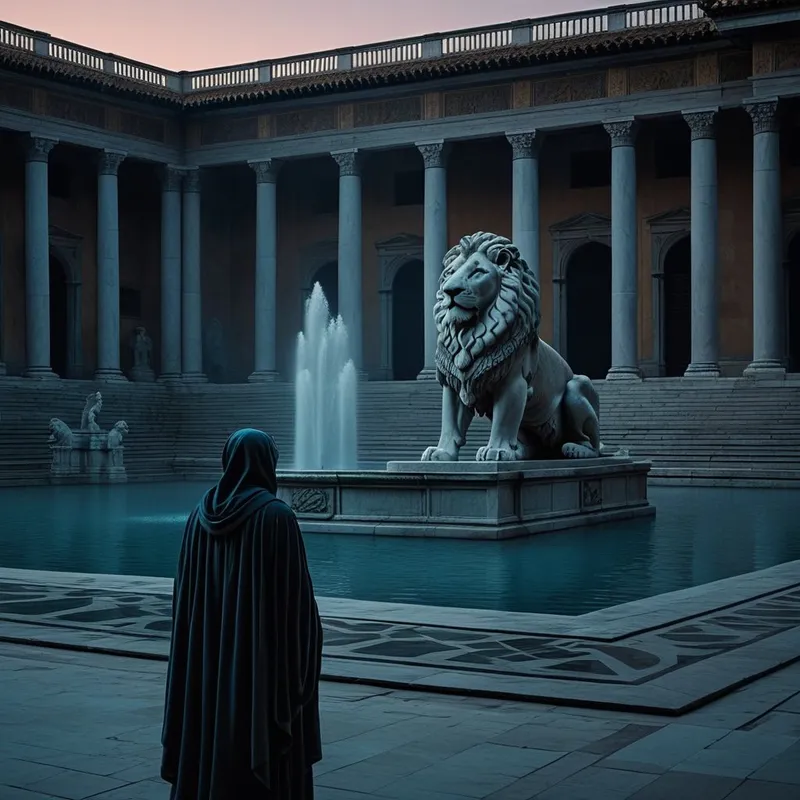
The first breath of this place was a whisper of water. Engineers, who were also poets, captured the sigh of the mountain snows and taught it to sing through narrow channels. It murmured in the Court of the Myrtles, a sheet of liquid green holding the sky captive. It danced in the Court of the Lions, where twelve marble beasts, frozen in a silent roar, supported a fountain—the very axis of the world. The water was the lifeblood, and its sound was the constant, gentle reminder: As above, so below.
The builders were servants of an idea. They covered every surface with a silent scripture. Not of words, but of shapes—interlocking stars, blooming arabesques, infinite geometries that repeated without beginning or end. To walk the halls was to walk through the mind of the divine, a cosmos in miniature. In the Salón de los Embajadores, the cedarwood ceiling was a carved night sky, a celestial honeycomb declaring, “There is no conqueror but God.”
But this paradise was built in the shadow of a closing hand. From the north, the rumble grew. The dream became a refuge, then a memory being made in real time. The last to hold the dream, Boabdil, walked its halls knowing each glance might be his last. The final act was not a battle at the gates, but a quiet surrender on a rocky pass. They say he turned for one final look at the red towers gleaming in the morning sun, and wept. His mother’s legendary rebuke was colder than the mountain wind: “You weep like a woman for what you could not defend like a man.”
The conquerors entered, and the dream did not shatter—it was too strong for that. It was covered, adapted, whispered about in new tongues. The water still ran. The lions still held their silent vigil. The palace became a palimpsest, a memory written over but never fully erased. Its final truth was not in its creation or its conquest, but in its enduring whisper to all who walk its empty, beautiful halls: Remember.
Cultural Origins & Context
The tale of the Alhambra is not a single myth from a sacred text, but a living, cultural mythos born from the historical apex and twilight of Al-Andalus. Its narrators were the Nasrid sultans themselves, who used architecture as their primary scripture. The countless inscriptions carved into its walls—poems praising the beauty of the place, quotes from the Quran, and the repeated motto “There is no conqueror but God”—served as a continuous, performative narrative of power, piety, and paradise.
This myth was passed down not only by historians but by the stones themselves. After the Reconquista, the Alhambra entered European Romantic imagination as the ultimate symbol of lost glory, exotic beauty, and melancholy. Writers like Washington Irving, who lived within its decaying halls in the 19th century, revived and romanticized its story for a new world, cementing its status as a myth of paradise lost. Its societal function has thus evolved: from a political and spiritual manifesto of a living kingdom, to a poignant symbol of cultural memory, coexistence, and the inevitable passage of time.
Symbolic Architecture
The Alhambra is not merely a building; it is a three-dimensional mandala of the soul. Its core symbolism is an intricate dance between opposites, held in perfect, fleeting tension.
The garden is not a place of wild nature, but of nature perfected—a reflection of the celestial paradise brought to earth, yet forever reminding us of its otherworldly origin.
The omnipresent water represents the flow of divine grace and the essence of life, but also time itself—always moving, reflecting, and eventually sinking into the earth. The geometric patterns, infinite and non-representational, symbolize the transcendent, unnameable nature of the divine, the underlying mathematical order of a seemingly chaotic universe. The lions in the courtyard are a profound paradox: symbols of raw, solar power and kingship, yet subdued, supporting the communal fountain, representing power in service to life and order.
The entire complex embodies the principle of *Tawhid—*the absolute oneness of God. The repetition, reflection, and interconnection of all elements proclaim that everything emanates from and returns to a single source. Yet, this unity is experienced through duality: light and shadow, interior and exterior, solid and void, water and stone. The Alhambra is the physical manifestation of the soul’s home—a place of perfect order and beauty that we intrinsically recognize, yet can never permanently inhabit in our earthly state.
The Dreamer's Resonance
To dream of the Alhambra is to dream of the Self as an exquisite, abandoned palace. The dreamer often finds themselves wandering vast, beautiful, empty courtyards. There is a profound sense of awe mixed with loneliness. The fountains may be dry, or the water may be still and black as obsidian. The intricate stucco work might be crumbling, or glowing with an unnatural light.
This dream points to a somatic and psychological process of confronting the inner sanctuary—the place of the soul’s own highest order and beauty, which has been neglected, “conquered” by the demands of the ego, or simply forgotten. The feeling of melancholy is not depression, but the soul’s grief for its own displaced majesty. The dream is a summons from the deep psyche to remember, to return, and to begin the work of restoration. It asks: What inner paradise have you abandoned? What exquisite pattern within you lies covered in dust? The body may feel this as a hollow ache in the chest, a longing for a home it cannot name.
Alchemical Translation
The myth of the Alhambra models the alchemical process of Individuation not as a heroic conquest, but as a sacred act of remembrance and integration. The initial state is one of division: the soul is exiled from its own inner paradise (the Nasrid kingdom under siege). The conscious ego (Boabdil) is tasked with ruling this inner kingdom but is ultimately overwhelmed by external pressures and internal conflict.
The alchemical gold is not found in holding the fortress forever, but in carrying its blueprints within. The surrender is not a defeat, but the necessary dissolution of the old ego-structure to preserve the soul’s essence.
The transmutation occurs in the “last look.” The conscious mind, in its moment of surrender, truly sees the beauty and wholeness of what it is losing. This searing moment of consciousness—the tearful acknowledgment—is the beginning of integration. The paradise is not lost; it is internalized. The intricate geometries, the sound of water, the play of light and shadow—these become internal patterns, the archetypal architecture of the Self.
The modern individual’s journey is thus mirrored. We build our inner paradises—structures of meaning, relationship, and identity. They are inevitably assailed by time, change, and loss (the conquistador). The alchemical work is to do as the Alhambra itself did: not to resist dissolution violently, but to allow the form to change while safeguarding the essential pattern. The goal is to become the living Alhambra—a being in whom the memory of paradise informs every corridor of thought, every courtyard of emotion, and where the fountain of the Self, supported by reconciled opposites, flows eternally at the center.
Associated Symbols
Explore related symbols from the CaleaDream lexicon: