Achilles' Shield Myth Meaning & Symbolism
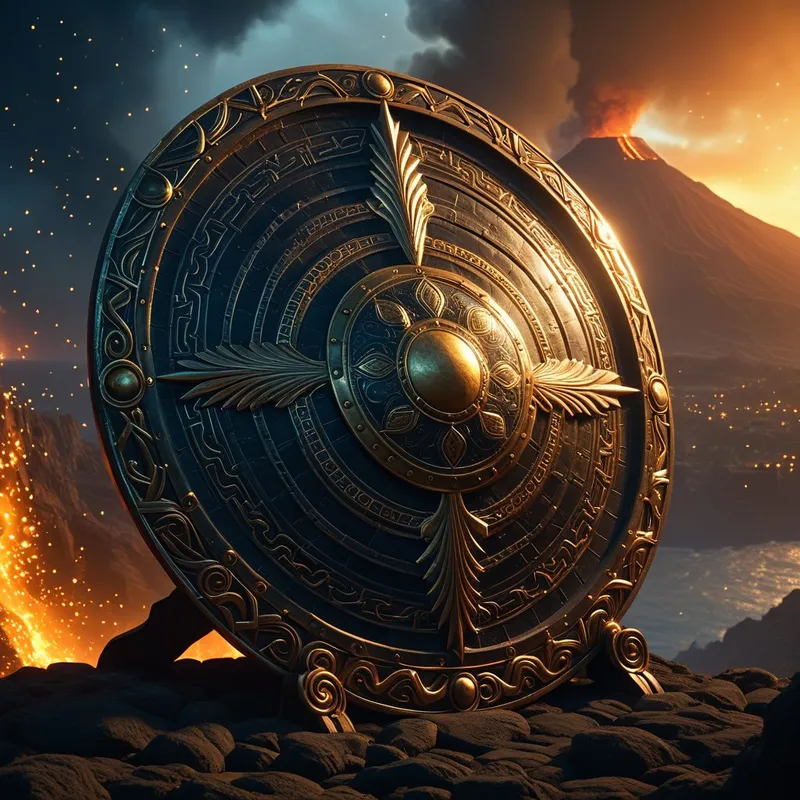
The god Hephaestus forges a shield for Achilles, depicting the entire cosmos, transforming a tool of war into a profound meditation on life itself.
The Tale of Achilles' Shield
Hear now, of a shield born not of mortal hands, but in the heart of a mountain’s fire. The great warrior Achilles rages in his tent, his fury a cold storm because his prize, the woman Briseis, has been taken by Agamemnon. His mother, the silver-footed Thetis, hears his grief. She rises from the wine-dark sea, a shimmer of sorrow, and ascends to Olympus itself.
She does not go to the thunderer Zeus, nor to bright-eyed Athena. She goes to the one who works in darkness and flame: Hephaestus. She finds him in his smithy, a cavern lit by rivers of molten bronze, the air thick with the scent of ozone and hot earth. His mighty shoulders, glistening with sweat, are hunched over an anvil. Thetis, with tears like sea-pearls, clasps his soot-blackened hands. “My son is doomed,” she whispers, her voice the sound of a distant tide. “He will go to his fated end before the walls of Troy. But first, he must have armor. Forge for him a shield, Hephaestus. Forge for him a world to carry into death.”
The lame god nods, his eyes reflecting the forge’s heart. Compassion stirs in him, for he knows the weight of fate. He sets to work. He does not merely hammer metal; he summons cosmos. Into the immortal bronze, he pours the essence of the All.
First, he crafts the very fabric of reality: Earth, Sky, and Sea. The unharvested Ocean, a river of silver, rings the outermost rim. Then, he brings forth two cities. In one, a wedding feast turns to a bloody ambush, a trial beneath the elders’ watchful eyes—a city of Law and Strife. In the other, an army besieges its walls, and on the field between them, Ares and Athena stride among the dying men—a city of War and Fate.
He lifts his hammer, and a field appears, rich and black, plowed by oxen. A king stands silent, staff in hand, watching the labor. Next, a golden harvest, reapers swinging sickles, binders following, and a feast laid under a sacred tree. Then, a vineyard, heavy with clusters like amethyst, where youths and maidens gather grapes in woven baskets, while a boy plays a lyre with a voice of pure longing.
He forges a herd of cattle, straight-horned and gleaming, attacked by lions from a reed-bed by a silver river. Shepherds and their dogs give futile chase. Then, a pasture of white-fleeced sheep. And finally, at the very center, a dancing floor, like the one Daedalus once made for Ariadne. Youths and maidens, garlanded, dance in intricate spirals, their feet a blur of joy, while a divine minstrel sings.
The shield is complete. It is not just a defense; it is a universe. Thetis takes it, along with the gleaming greaves, corselet, and helmet, her heart both grateful and broken. She descends like mist to the Achaean ships and lays the divine arms before her son. The Myrmidons shrink back in terror, unable to look upon the radiance. But Achilles’ eyes ignite. In the shield’s boundless scenes, he sees the life he will never fully live. His rage finds a new companion: a profound, aching clarity. He arms himself with the world, and goes forth to meet his destiny.
Cultural Origins & Context
This masterpiece of poetic imagery is found in Book XVIII of Homer’s Iliad, the foundational epic of ancient Greece. Composed in the 8th century BCE, it was not read, but heard, performed by a rhapsode (a bard) for an audience. The description of the shield—the ekphrasis—is one of the most famous passages in all of Western literature.
Its function was manifold. For the listening audience, it served as a breathtaking pause in the relentless narrative of war, a moment of artistic and philosophical sublimity. It grounded the specific, brutal story of Achilles’ wrath within a universal context. The shield was a microcosm, a symbolic map of the entire Greek understanding of civilized life: agriculture, law, ritual, community, art, and the ever-present shadow of conflict. It reminded the listener that the hero’s personal tragedy unfolded within a vast, beautiful, and tragic order. It was a cultural touchstone, affirming the values and the vision of the world that the epic itself was meant to preserve and transmit.
Symbolic Architecture
Achilles’ Shield is the ultimate symbol of integration. It represents the heroic (or human) consciousness attempting to hold the totality of existence in a single, coherent vision.
The shield is the psyche’s attempt to forge a container strong enough to hold the chaos of life without shattering.
It is a mandala crafted in metal. At its periphery is the primal, unifying Oceanus, the source of all things. Moving inward, we encounter the fundamental polarities: peace and war, justice and violence, labor and festivity, nature’s bounty and its savagery. The two cities are not opposites, but complementary halves of the human condition—the social order and its perpetual threat of dissolution. The dancing floor at the center is the temenos, the sacred, protected space where harmony is momentarily achieved through art and ritual. Achilles, the hero defined by his singular, destructive rage, is given an artifact that embodies the very complexity his nature rejects. The shield symbolizes the whole self he might have been, had fate allowed.

The Dreamer's Resonance
To dream of such a shield, or of a similar encompassing, circular artifact (a mirror, a clock face, a intricate medallion), is to dream of the Self in the Jungian sense. It signals a process of profound psychic reorganization.
The dreamer may be in a period of intense conflict or singular obsession (their own “wrath”). The unconscious responds by presenting an image of breathtaking wholeness. Somatic sensations might include a feeling of immense weight coupled with luminous clarity, or the vertigo of seeing one’s personal struggles mirrored within a vast, impersonal pattern. This dream is an invitation from the deep psyche to step back from identification with a single, consuming emotion or role. It asks the dreamer to behold the full spectrum of their life—their creative labors (the harvest), their conflicts (the besieged city), their moments of community and joy (the dance), and the inevitable cycles of loss and predation (the lions among the cattle). The dream presents the container; the dreamer’s task is to grow strong enough to carry it.

Alchemical Translation
The forging of the shield is the alchemical opus itself. Hephaestus, the wounded creator god, is the archetypal coniunctio oppositorum. In his forge, the base materials of experience—suffering, joy, violence, peace—are subjected to the transformative fire of conscious attention and artistic mastery. They are not eliminated, but arranged into a meaningful, beautiful order.
For the modern individual, the myth models the process of individuation—becoming whole. Our personal “Achilles’ heel,” our fatal flaw or core wound, often leads us to a narrow, reactive life. The “alchemical translation” begins when, in our despair (Thetis’s plea), we turn inward to the creative, integrative function of the psyche (Hephaestus).
We must become the smith of our own experience, hammering the raw events of our lives—the triumphs and tragedies alike—into a coherent narrative.
This is not an act of naive optimism, but of profound, unflinching synthesis. We must place our personal siege beside our private harvest, our inner dances next to our inner battles. The goal is not to become a placid, conflict-free being, but to forge a “shield”—a resilient, complex consciousness that can bear the contradictions of existence without collapsing into fragmentation. To carry this shield is to move through the world not with the blindness of a rage, but with the poignant, weighty clarity of one who sees the entire dance, even as they take their destined place within it.
Associated Symbols
Explore related symbols from the CaleaDream lexicon: