Achilles in the River Styx Myth Meaning & Symbolism
A mother's desperate love forges an invincible hero, yet a single, unguarded point seals his tragic fate—a story of divine protection and mortal fragility.
The Tale of Achilles in the River Styx
Hear now the story not of a god, but of a man touched by divinity, a tale born in the silent, sunless halls where the Fates spin their threads. It begins not with glory, but with a mother’s dread.
Thetis, a Nereid of the silver-scaled sea, was bound in marriage to a mortal king, Peleus. From their union came a son, Achilles. But Thetis, who had heard the whispers of the Moirai, knew a terrible prophecy: her brilliant boy was destined for a life that was glorious, but short. He would die young on a distant battlefield. This knowledge was a cold stone in her heart, a constant shadow behind her love.
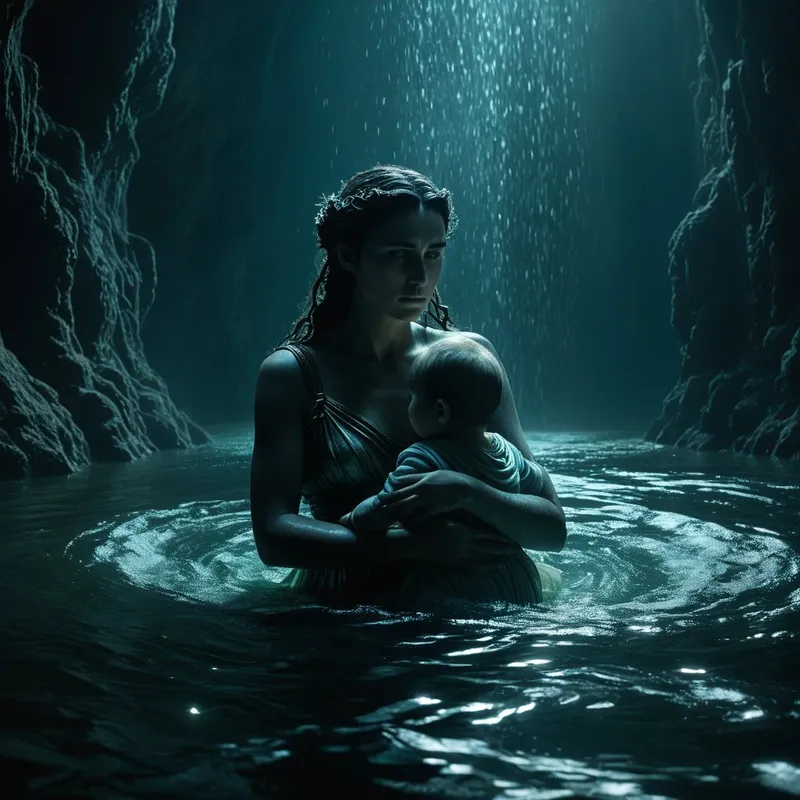
Driven by a desperation only a divine parent can know, she conceived a plan to defy destiny itself. One night, when the world was held in the grip of silence, she stole with her infant son to the very edge of the living world. They descended into the Underworld, to the banks of the River Styx, the black, binding water over which the dead are ferried. The air was thick with the sighs of forgotten souls; the water did not ripple but flowed with a heavy, oily stillness, a liquid darkness that drank the light.
Holding her child tight, Thetis whispered prayers to the unseen powers of that place. Then, steeling her immortal nerve, she dipped the tiny Achilles into the sacred, dreadful flow. She immersed him completely, turning him in the chill current, letting the waters of oath and eternity wash over his skin. Where the waters touched, his mortal flesh was transmuted. It became inviolable, harder than tempered bronze, a living armor bestowed by the river of death itself.
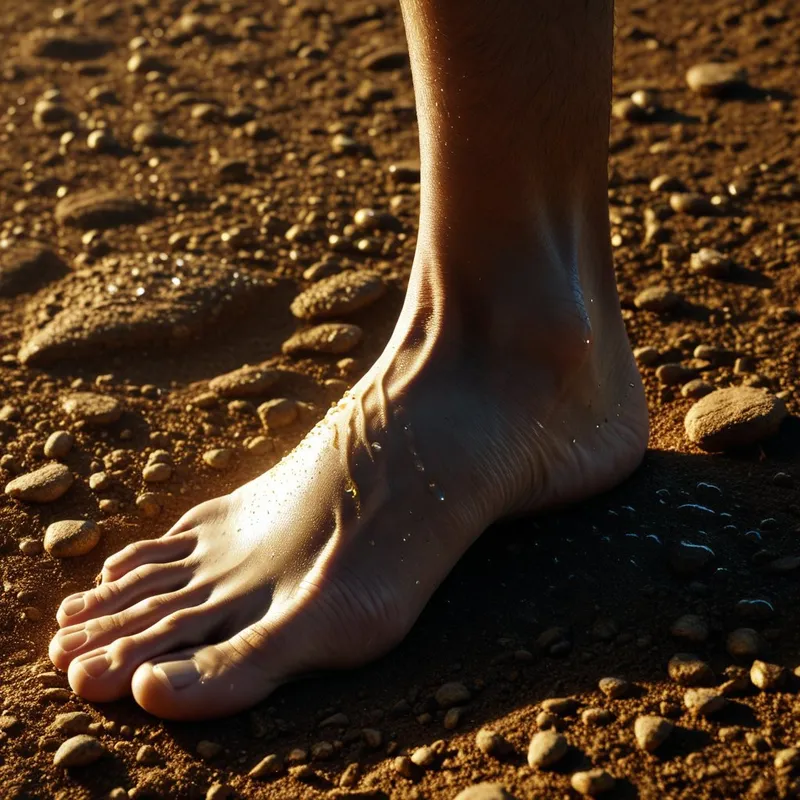
But as she lowered him, as the black water swirled, she had to hold him somewhere. Her fingers, tight with fear and love, closed around his left heel. That one small patch of skin, shielded by her own grip, remained dry. It was untouched by the Stygian magic. She lifted him from the river, a child now both more and less than human—a being of near-divine resilience, save for one tiny, mortal flaw. The heel, the place of her touch, remained pink and soft, the sole anchor of his humanity in a body made for legend. She did not know she held the instrument of the prophecy she sought to escape.
Cultural Origins & Context
This foundational episode of the Achilles saga comes to us primarily from later Roman sources, like the Achilleid of Statius, though its roots are deeply embedded in the Greek epic tradition, particularly Homer’s Iliad. In the Iliad, Achilles’ invulnerability is not explicitly mentioned; his might is that of the supreme warrior, favored by the gods yet emphatically mortal. The Styx-dipping myth likely evolved in the post-Homeric oral tradition, a “prequel” crafted to explain the paradox of his near-invincibility and his very specific, fated death.
It functioned as a powerful etiological narrative. For a culture that revered physical prowess and heroism (arete), the story provided a divine origin for a hero’s superhuman capabilities, setting him apart even from other great warriors. More importantly, it served a profound societal and philosophical function: it visually and narratively encapsulated the Greek understanding of the human condition. Even the greatest of men, touched by the divine, is subject to Moira. There is always a hidden weakness, a chink in the armor decreed by fate. The myth was a cautionary tale against hubris, reminding listeners that mortality is not a blanket condition, but a precise, inescapable point of entry for fate.
Symbolic Architecture
The myth is a perfect symbolic vessel, containing the core tensions of existence. The River Styx itself is not merely water; it is the boundary between life and death, the substance of oaths unbreakable. To be dipped in it is to be sealed by the ultimate authority. Achilles emerges not just protected, but defined by this encounter with the underworld. His strength is literally forged in the waters of death.
The invulnerability is not a gift, but a transaction with destiny; the price is the localization of all mortal fragility into a single, knowable point.
The immortal mother, Thetis, represents the divine aspiration, the part of us that seeks to transcend our limits, to make ourselves perfect and eternal. Her act is one of supreme, if misguided, love. The mortal heel, held by her, symbolizes what cannot be transcended—the embodied, vulnerable, human self. It is the locus of the “Achilles Heel,” a concept that has transcended myth to become universal shorthand for a fatal flaw. This flaw is not a moral failing, but a structural necessity: the point of connection to our humanity, our history, and our inevitable end. The hero is not killed by a superior foe, but by the one arrow that finds the one place he remained his mother’s vulnerable child.
The Dreamer’s Resonance
When this mythic pattern stirs in the modern psyche, it often manifests in dreams of fortified castles with a single, hidden door, or of a body encased in brilliant armor with a tingling, exposed spot. The dreamer may feel an immense, almost arrogant sense of capability in their waking life—a career “invincibility,” emotional walls deemed impenetrable—coupled with a deep, somatic anxiety centered on a specific, seemingly insignificant place or memory.
This is the psyche’s brilliant diagnostics. The dream points to the construction of a persona of near-perfect resilience, often born from necessity (a “mother’s” protective love, which could be a childhood survival strategy). The body in the dream knows the truth the conscious mind denies: total invulnerability is a fantasy. The glowing heel, the unguarded gate, is the shadow. It is the repressed grief, the unhealed wound, the hidden dependency, the secret shame. The dream is not foretelling a literal death, but a psychological reckoning. It signals that the energy required to maintain the myth of total strength is unsustainable. The flaw must be acknowledged, for it is the very thing that keeps the dreamer human, real, and capable of true connection. To ignore it is to invite the “arrow” of crisis—burnout, relationship collapse, sudden depression—that targets that spot with uncanny accuracy.

Alchemical Translation
The individuation process, the journey toward psychological wholeness, is mirrored perfectly in this myth. The first, unconscious stage is Thetis’s act: in our youth, we are “dipped” by our upbringing, culture, and traumas into certain patterns that make parts of us seemingly invulnerable. We develop brilliant defenses, intellectual armor, emotional calluses. This is necessary for survival. The alchemical work begins when we must turn and face the “heel.”
The goal is not to become invulnerable, but to become conscious. The heel is not a flaw to be eradicated, but the sacred wound through which the soul enters and departs.
The heroic task of the second half of life is to find that held place. This requires descending into our own personal Underworld—the river of our own hate, our grief, our forgotten oaths—not to be re-dipped, but to see clearly what was left out. To bring consciousness to the heel is to integrate the vulnerable, mortal, feeling self with the powerful, capable persona. It is to realize that our greatest strength lies in the conscious stewardship of our weakness. The “arrow” of Paris (guided by Apollo) is not merely fate, but the inevitable consequence of an unconscious life. In embracing our heel, we do not become weak; we transfer our power from the brittle armor of invulnerability to the resilient, living wisdom of a whole being. We cease being the unconscious hero racing toward a fated end, and become the author of a life that includes, and is deepened by, its sacred, vulnerable point.
Associated Symbols
Explore related symbols from the CaleaDream lexicon: